// SPACE.COM — SPAZIO & SCIENZA
Here's what to expect from 5 stages of the total solar eclipse 2026
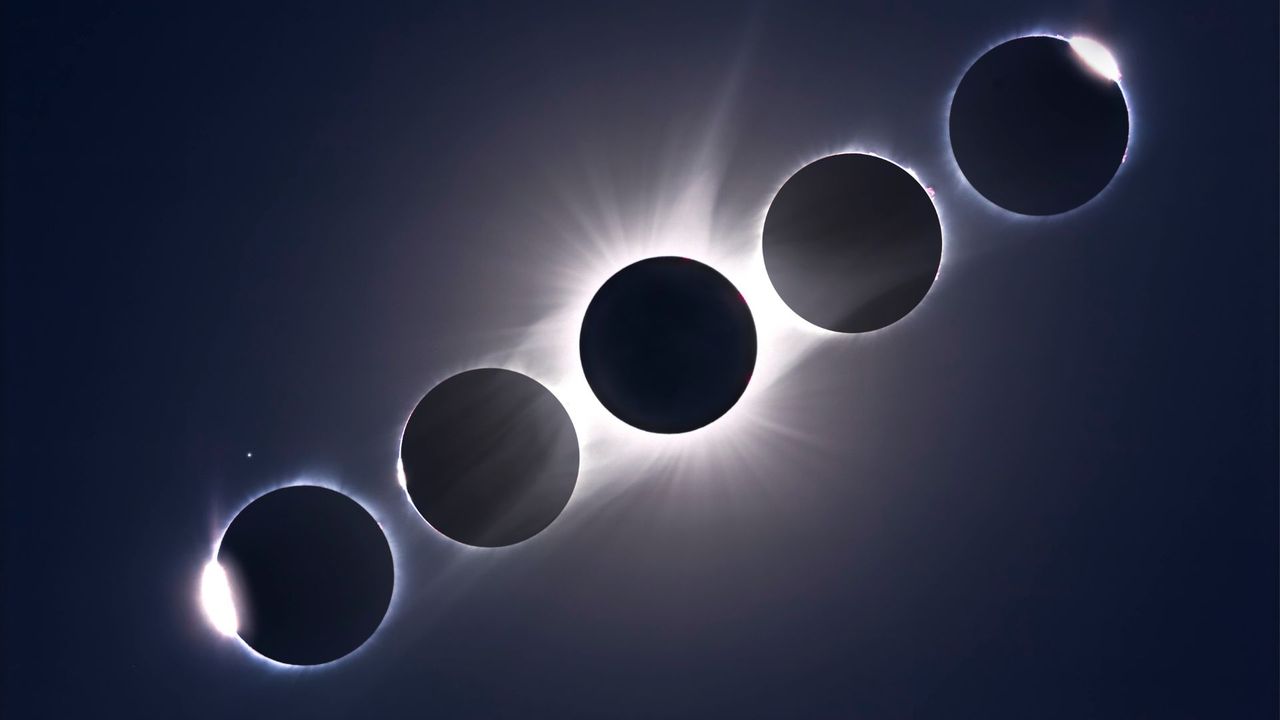
From first contact to totality and beyond, this is what will happen during each stage of the Aug. 12 total solar eclipse.
When you purchase through links on our site, we may earn an affiliate commission. Here’s how it works.
We're just a few short days away from the Aug. 12 total solar eclipse, when millions will watch as the moon glides across the face of the sun, hiding its light in a wondrous display of orbital mechanics.
The eclipse will unfold during August's new moon phase, as the lunar disk slips silently between the sun and Earth in the daytime sky. Ordinarily, the subtle tilt in the moon's orbit causes its shadow to pass just below, or above our planet, missing it entirely.
However, on Aug. 12, the moon's orbit will carry it into a near-perfect alignment with the sun and Earth, casting its colossal shadow across a 182-mile-wide corridor known as the path of totality, where viewers will get to see the lunar disk fully hide the sun's disk.
The path of totality for the Aug. 12 eclipse cuts through Spain, Iceland and Greenland. Hundreds of millions more watching from outside of this narrow corridor will also bear witness to a spectacular partial solar eclipse, as the moon passes in front of our parent star, without fully obscuring its surface. Those unable to watch the eclipse in person by dint of geography can also follow along online, with details of the livestream to be released closer to the event.
Read on to discover what will happen during each stage of the Aug. 12 total solar eclipse.
The partial phase of the eclipse officially begins at the moment of "first contact", when the lunar disk takes its first nibble out of the sun — a subtle transformation that will first become visible in the skies over the U.S. state of Alaska at 11:34 a.m. EDT (1534 GMT) on Aug. 12.
You can check out exactly when the partial eclipse will begin from your location and find out exactly how much of the sun will be hidden by the moon using Time and Date's interactive eclipse tracker.
The hour and a half following first contact will see the moon sink ever farther into the sun's disk for those in the path of totality, transforming it from a burning orb into a magnificent shining crescent.