// NATURE NEWS — SPAZIO & SCIENZA
Ubiquitous Kelvin–Helmholtz instabilities driving plasma mixing on the Sun
Nature
(2026) Cite this article
The interaction between the magnetic field and turbulent convection in the Sun’s photosphere drives the dynamics, evolution and structuring of its magnetized atmosphere. This interaction often takes place at or below the spatial resolution of modern-day observations. Here we report on high-spatial-resolution observations of the solar photosphere acquired using the world’s first 4-m class solar telescope, the US National Science Foundation’s Daniel K. Inouye Solar Telescope. Time sequence images reveal a far more complex and dynamic solar scene than previously observed. We identify ubiquitous magnetized Kelvin–Helmholtz instabilities at the edges of magnetic flux concentrations and provide experimental confirmation of a long-standing theoretical prediction1,2. The discovery of small-scale magnetized Kelvin–Helmholtz instabilities in the solar photosphere, which can be reproduced by high-resolution numerical simulations, has far-reaching implications for our understanding of the creation and dissipation of magnetic fields exhibiting vortex motion, which can lead to flux braiding. Our results support the picture of disjoint magnetic field concentrations in layers below the visible solar surface that connect to monolithic flux regions visible as facular concentrations and pores in the solar photosphere. Kelvin–Helmholtz instabilities are an efficient mechanism for transporting mass, energy, momentum and magnetic flux in magnetohydrodynamic systems, and they offer transformative insights into processes in magnetically active regions such as the one observed here.
Since their original formulation by Lord Kelvin3 and Hermann von Helmholtz4, Kelvin–Helmholtz instabilities (KHIs) have been observed and investigated across many areas of physics, including fluid dynamics5, oceanography6, heliospheric environments such as planetary magnetospheres7,8,9,10 (for example, Earth, Mars, Venus, Mercury, Jupiter and Saturn) and other astrophysical systems11,12,13,14,15. In the solar atmosphere, KHIs have long been the subject of both theoretical and observational studies1,2,16,17,18,19,20. Corrugated boundaries observed in coronal mass ejections are often interpreted as possible signatures of this instability16,17,18.
Solar and stellar magneto-convection produce complex plasma flows in the photosphere that evolve from coherent laminar motions into small-scale, unstable structures. Theoretical studies indicate that these flows in the solar photosphere can generate velocity shear layers around magnetic flux concentrations (MFCs) and trigger the KHI1,2. The existence of KHIs in the Sun’s photospheric layers has not been observed in the past, probably because the characteristic spatial scale is not easily accessible by telescopes with aperture sizes below 2 m.
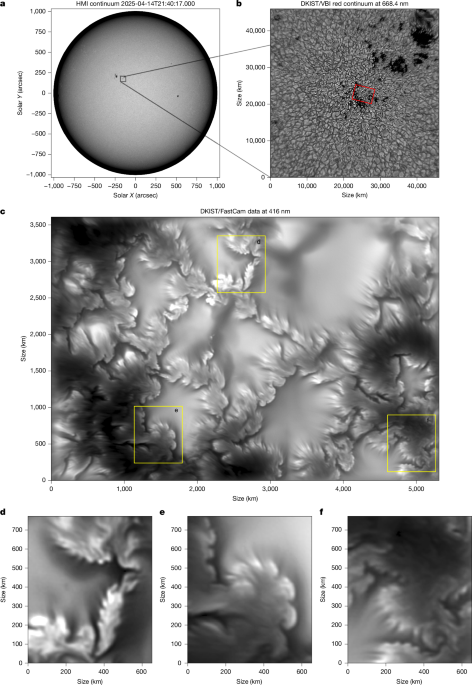
The observations made by the Daniel K. Inouye Solar Telescope (DKIST)21 at a wavelength of 416 nm reported here are of a magnetically active region in the vicinity of a sunspot (Fig. 1). At this wavelength, the visible solar surface is dominated by convective motions (granules) interlaced with small-scale MFCs (Fig. 1). This scene contains several larger coherent structures (pores). The interfaces between the magnetic features and the granulation in these images display a structure very different from the relatively smooth, blurry interfaces typically seen in lower resolution images. DKIST reveals these interfaces to be composed almost entirely of vortex-like structures and striations, drastically changing the solar scene compared with previous observations.
a, A contextual SDO/HMI continuum full-Sun image from 14 April 2025. The black box marks the part of the active region (NOAA 14060) observed with DKIST/VBI. b, Zoomed-in view of the boxed area in a at 21:40:40 ut. A subfield outlined by the red box indicates the FastCam FoV. The dark areas are pores, where—like the larger sunspots—the strong magnetic field inhibits convective