// NATURE NEWS — SPAZIO & SCIENZA
ZFP36L2 orchestrates stress-adaptive plasticity in regeneration and cancer
Nature
(2026) Cite this article
Phenotypic plasticity is a hallmark of cancer1; however the molecular switches required for cell-fate reprogramming are poorly understood. During intestinal wound-healing and colorectal cancer (CRC) metastasis, differentiated cells can dynamically dedifferentiate into an intestinal stem cell (ISC) state to drive epithelial regeneration and metastatic outgrowth2,3,4,5,6,7,8,9,10. Here we show that the RNA-binding protein ZFP36L2, which is mutated in 5–10% of CRC11,12,13,14,15, is a pivotal stress-responsive orchestrator of dynamic dedifferentiation. In mouse colon regeneration models, ZFP36L2 ablation inhibits dedifferentiation, ISC gene expression and function and impairs intestinal regeneration. In human CRC, loss of ZFP36L2 function abrogates metastatic seeding and the outgrowth of LGR5+ canonical metastases while promoting lineage plasticity and non-canonical differentiation into heterogeneous cell states. Mechanistically, ZFP36L2 binds to stress-associated mRNAs that contain AU-rich 3′ untranslated regions, which induces the formation of dynamic biomolecular condensates associated with mRNA degradation and termination of the stress response. Together, these data show that ZFP36L2 acts as an important molecular switch that couples stress sensing with phenotypic plasticity. This in turn drives cellular dedifferentiation essential for re-establishing the ISC state during wound healing and metastasis. In ZFP36L2-deficient CRC, the inability to re-enter the LGR5+ state during metastatic outgrowth promotes non-canonical lineage plasticity, which is associated with poor clinical outcomes.
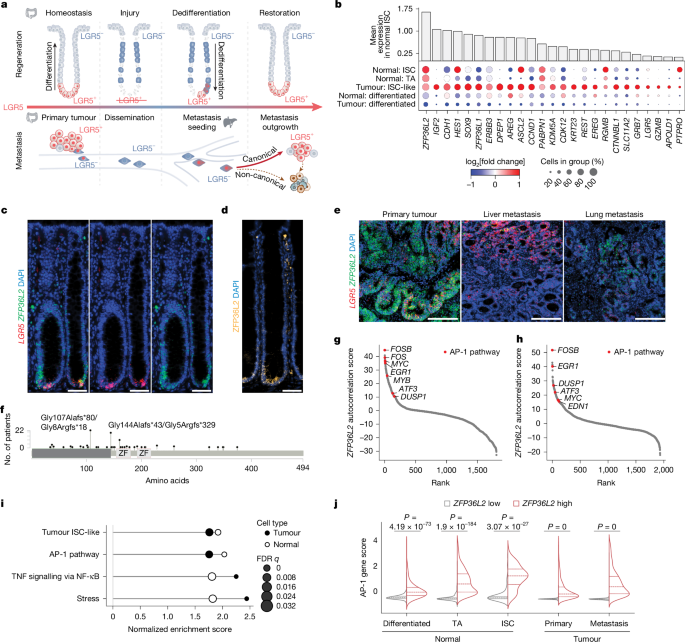
The intestinal epithelium is characterized by a hierarchy of cell states that balance self-renewal and differentiation to maintain homeostasis2. Crypt base ISCs, which are marked by the expression of genes such as LGR5, drive the continuous production of short-lived, specialized differentiated daughter cells that are eventually shed into the intestinal lumen16. However, when LGR5+ ISCs are lost during injury, the epithelium displays substantial plasticity. A broad range of differentiated cells have the capacity to undergo injury-induced reprogramming. Initially, cells enter into a transient regenerative state with fetal-like properties and then they dedifferentiate into a LGR5+ ISC state to repopulate the crypt base and restore homeostasis2,3,17 (Fig. 1a). Although the transcription factor ASCL2 is necessary for this process18, little is known about injury-induced triggers of dedifferentiation. In CRC, the capacity of the intestinal epithelium to undergo stress-induced reprogramming contributes to tumour progression, metastasis and therapy resistance19. Primary tumours largely adopt LGR5+ ISC states either through the acquisition of oncogenic driver mutations in crypt base ISCs or through the dedifferentiation of mutated differentiated cells into tumour-permissive ISC-like states20,21,22,23. Cells at the primary tumour-invasion front that detach from the tumour mass enter into LGR5– metastasis-initiating states marked by increased expression of injury-associated regenerative and fetal markers (for example, L1CAM, PROX1, TROP2 and ANXA1)7,10,24. These cells also exhibit increased expression of epithelial differentiation markers (for example, EMP1)9, and are associated with increased activity of the AP-1 family of stress-response transcription factors25,26 (henceforth termed an ‘injury–repair’ state). After extravasation in distant organs, differentiated LGR5– metastasis-initiating cells can dedifferentiate into canonical LGR5+ ISC states to seed metastasis and regenerate tumours, a process that mirrors the restoration of homeostasis during intestinal regeneration8,9,10,26,27,28 (Fig. 1a). Alternatively, CRC metastases can undergo lineage plasticity into non-canonical squamous-like and neuroendocrine-like states not observed during regeneration in the intestinal niche10,26. Such non-ca