// NATURE NEWS — SPAZIO & SCIENZA
Stimulation modulates gene-linked cell assemblies in the human brain
Nature
(2026) Cite this article
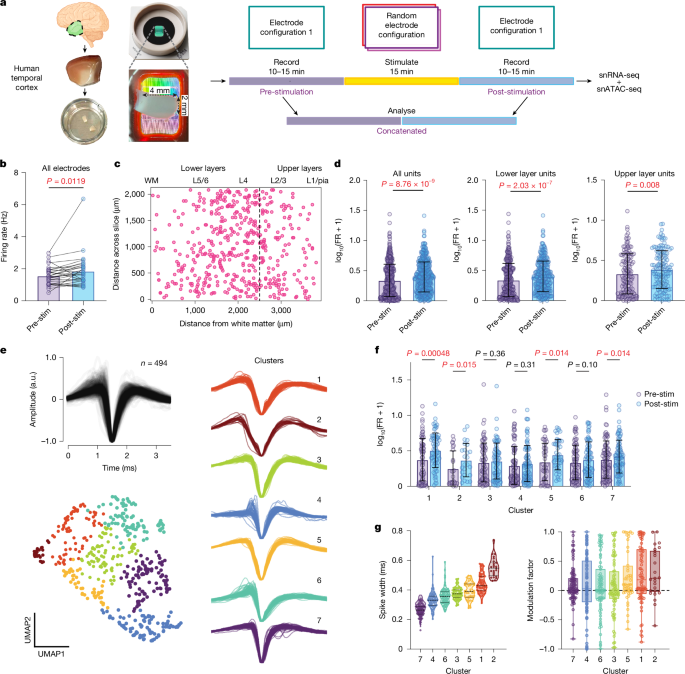
Reshaping cortical circuits through stimulation represents an emerging therapy for the restoration of cognitive function1,2,3,4,5, yet the biological mechanisms that underlie its effects remain largely unexplored in humans. Here, to directly investigate the mechanisms of neuromodulation elicited by human brain stimulation, we developed an ex vivo platform that integrates microelectrode array stimulation with simultaneous recording and single-nucleus genomics from resected temporal cortex obtained from patients undergoing neurosurgery. We found that stimulation strengthens cell assemblies and then linked this effect to cell-type-specific gene regulatory networks. We further demonstrated the generalizability of these findings by identifying common cell-type-specific gene expression signatures in the human cortex following in vivo stimulation. Together, our results establish a foundation for identifying targetable genetic signatures linked with physiology that may be harnessed for therapeutic benefit via neuromodulation strategies.
This is a preview of subscription content, access via your institution
Access Nature and 54 other Nature Portfolio journals
Get Nature+, our best-value online-access subscription
Prices may be subject to local taxes which are calculated during checkout
All raw MEA snRNA-seq, snATAC-seq and IVS snRNA-seq data were deposited to the Gene Expression Omnibus (GEO) archive under the accession number GSE288939. The data presented in this Article are available through interactive Shiny applications that enable users to explore the datasets in detail, including gene expression profiles, dimensionality reduction and clustering results, cell-type annotations, marker gene expression and additional features. Users can also generate custom visualizations directly from the datasets. These applications include data from MEA excitatory, inhibitory and non-neuronal cells: https://biocm-moore-etal-mea-multiome-subglia.share.connect.posit.cloud/https://biocm-moore-etal-mea-multiome-inhneurons.share.connect.posit.cloud/ and https://biocm-moore-etal-mea-multiome-excneurons.share.connect.posit.cloud/. These applications include data from IVS excitatory inhibitory, and non-neuronal cells: https://biocm-moore-etal-ivs-snrna.share.connect.posit.cloud/, https://biocm-moore-etal-ivs-excneurons.share.connect.posit.cloud/, https://biocm-moore-etal-ivs-inhneurons.share.connect.posit.cloud and https://biocm-moore-etal-ivs-subglia.share.connect.posit.cloud.
Figures and supplementary tables were generated using custom scripts in R (v4.2.1) and Python (v3.8.20, v3.11.8, v3.11.10 and v3.12.4). The code used for data analysis in this study is available on GitHub: https://github.com/BioinformaticsMUSC/Moore_etal_MEA/.
Kucewicz, M. T., Worrell, G. A. & Axmacher, N. Direct electrical brain stimulation of human memory: lessons learnt and future perspectives. Brain 146, 2214–2226 (2023).
Article
PubMed
Google Scholar