// NATURE NEWS — SPAZIO & SCIENZA
A cholinergic hub in the nucleus accumbens gates opioid-reward learning
Nature
(2026) Cite this article
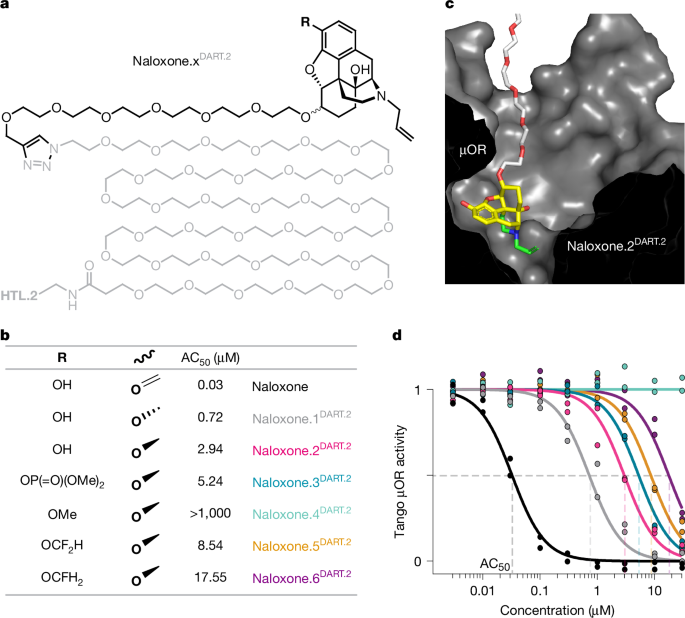
Beneficial and maladaptive opioid effects are difficult to dissociate1,2,3, partly because dopamine signalling contributes to both these effect types4,5,6,7,8,9,10,11,12,13. Here we show that associative opioid-reward learning can be blocked even under conditions that elevate dopamine in the nucleus accumbens. We developed naloxoneDART, a cell-type-specific analogue of the clinical opioid receptor antagonist naloxone14,15, and delivered it to genetically defined accumbal cholinergic interneurons, selectively rendering these cells morphine-insensitive. Acquisition of morphine conditioned place preference was abolished in a target-engagement-dependent manner, without evidence of contextual or locomotor impairment: saline habituation was enhanced between sessions and unchanged within sessions, whereas morphine-evoked hyperlocomotion, sensitization and acute analgesia remained intact. Microdialysis revealed that cholinergic interneuron-specific naloxoneDART prevented morphine-induced acetylcholine reductions without detectably altering dopamine increases in the accumbens. These findings identify a cholinergic gate for associative opioid-reward learning, support an emerging dopamine–acetylcholine plasticity theory16,17, and motivate exploration of opioid–cholinergic strategies that may preserve acute analgesia while limiting early associative reward learning18,19,20,21,22,23,24,25.
This is a preview of subscription content, access via your institution
Access Nature and 54 other Nature Portfolio journals
Get Nature+, our best-value online-access subscription
Prices may be subject to local taxes which are calculated during checkout
Source data are available at https://github.com/tadrosslab/CIN_NaloxoneDART. Source data are provided with this paper.
Custom code is available at https://github.com/tadrosslab/CIN_NaloxoneDART.
Gillis, A. et al. Critical assessment of G protein-biased agonism at the μ-opioid receptor. Trends Pharmacol. Sci. 41, 947–959 (2020).
Article
CAS
PubMed
Google Scholar