// NATURE NEWS — SPAZIO & SCIENZA
An ancient mitochondrial program tunes translation to haem availability
Nature
(2026) Cite this article
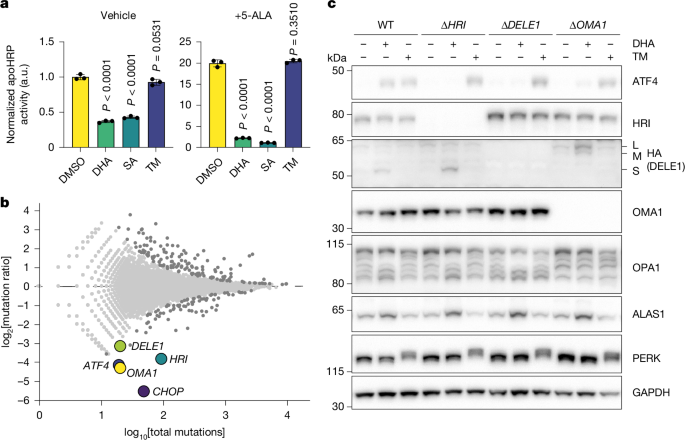
Anaemia is a major global health burden that affects one-quarter of the human population and annually accounts for over 50 million years of healthy life lost1. It arises from nutritional iron deficiency, hereditary disorders (including thalassaemia and sickle cell disease) and malaria, and is characterized by haemoglobin imbalances2. Haem—the active component of haemoglobin—is both essential and potentially toxic, which necessitates tight control of levels. However, the molecular circuitry that monitors haem levels remains obscure. The cytosolic eIF2α kinase HRI counteracts anaemia amid iron deficiency or thalassaemia3,4 by acting as a gatekeeper of translation during erythroid differentiation, which has been attributed to its haem-binding ability5. Here we uncover that haem scarcity is sensed inside mitochondria through an OMA1–DELE1 axis. Mechanistically, haem deficiency triggers OMA1-dependent mitochondrial release of DELE1. In the cytosol, DELE1 releases inhibitory haem from HRI, which enables modifications in a crucial disordered segment of the kinase. We demonstrate that this sensor–actuator operates across human tissues, including erythroid progenitors, and is evolutionarily conserved down to bloodless invertebrates, thus predating the emergence of haemoglobin-based oxygen transport. Notably, pharmacological manipulation of this system enhances fetal globin expression—a central therapeutic objective in haemoglobinopathies. Together, these results reveal a primordial sentinel system that safeguards against haem-related toxicity from the single-cell to the organismic scale.
Iron is the most biologically used transition metal and near-universally essential across all domains of life6,7,8. In humans, most iron is bound as haem in haemoglobin in erythrocytes8. Haem is synthesized in a multistep process that begins and concludes in mitochondria9, but mechanisms for extracellular haem uptake also exist10. Together with iron–sulfur clusters11, haem represents the principal functional pool of cellular iron that supports redox reactions, electron and oxygen transport and signalling7. However, like free iron, excess haem is cytotoxic and must be tightly regulated12. A factor decoding the cellular haem status (hereafter referred to as haemeostasis) and accordingly tuning translation was proposed over half a century ago based on experiments with reticulocytes (precursors of red blood cells)13. This pioneering work demonstrated that the addition of haemin, a cell-permeable haem source, to reticulocyte lysates promotes ribosome activity, which indicated the existence of a haem-inhibited translational suppressor. This factor was later identified as haem-regulated inhibitor (HRI), a serine/threonine kinase that phosphorylates eukaryotic initiation factor 2α (eIF2α)14,15. eIF2α phosphorylation is a hallmark of the integrated stress response (ISR), which blocks translation for most cellular mRNAs while favouring biogenesis of distinct proteins, including activating transcription factor 4 (ATF4) and C/EBP homologous protein (CHOP)16. The key function of HRI in tuning globin synthesis to haem availability is currently understood to be enabled by direct haem sensing in the cytosol5,17. Initially considered erythroid-specific18, HRI was subsequently found to be broadly expressed and to function beyond the development of red blood cells19,20. Recently, we and others discovered that HRI acts as a critical kinase in a relay system that communicates mitochondrial defects to the cytosol21,22. The stress-activated protease OMA1 cleaves the mitochondrial protein DELE1 during import, which triggers its redistribution to the cytosol. Cytosolic short DELE1 (S-DELE1) binds to and activates HRI through an unknown mechanism to initiate the mitochondrial ISR. Neither this interaction21 nor DELE1-mediated ISR signalling is quenched by haemin22, which suggests that DELE1 and haem may represent un