// NATURE NEWS — SPAZIO & SCIENZA
Structural mechanism governing the directionality of bridge recombination
Nature
(2026) Cite this article
Bridge recombinases from the IS110 family of transposons, such as IS621, associate with a bridge RNA (bRNA) to mediate programmable recombination between donor DNA and target DNA1,2. Although insertion is mediated by the recombinase–bRNA complex, it remains unknown how IS621 elements are excised from host genomes to form the circular DNA intermediates required for transposition. Here we show that bRNA is weakly expressed from IS621 loci in the Escherichia coli genome and that the IS621 recombinase–bRNA complex mediates excision less efficiently than insertion. Furthermore, we present the cryo-electron microscopy structures of the IS621 recombinase–bRNA complex bound to excision DNA substrates, providing mechanistic insights into the excision reaction. Similar to the previously reported donor- and target-bound insertion complex2, the excision complex comprises two recombinase dimers, each accommodating the target- and donor-binding loops of the bRNA. However, DNA recognition differs notably between the two complexes. Although the donor and target DNAs form a bent U-shape during insertion2, the excision substrates adopt linear conformations and bind across both bRNA loops, forming an X-shaped structure. This geometry reduces the efficiency of top-strand exchange and contributes to the naturally observed bias favouring insertion over excision. Despite these differences, the efficiencies of both reactions are similarly modulated by base pairing between specific dinucleotides in the bRNA, termed handshake guides, and the top strands of the DNA substrates. Overall, this study provides mechanistic insights into the complete IS110 transposition cycle and facilitates the optimal design of programmable bridge-editing applications.
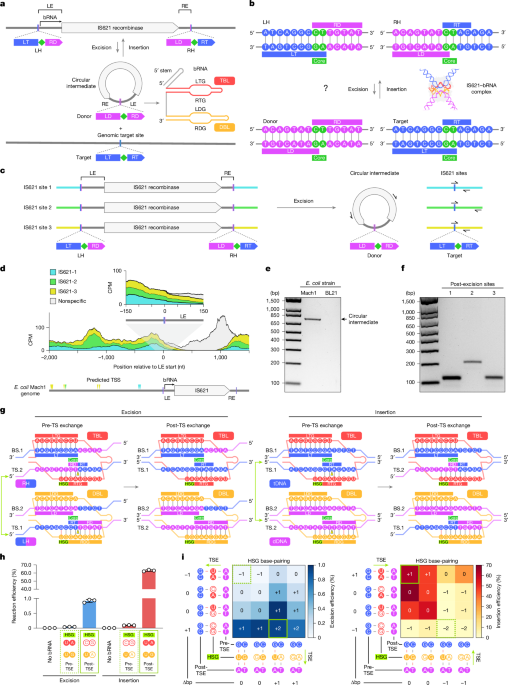
Insertion sequence (IS) elements are transposable DNA sequences found in prokaryotic genomes and are categorized into approximately 30 families, including IS110 (ref. 3). The transposition cycle of IS110 family elements involves two sequential recombination events: excision of the element from the host genome to form a circular double-stranded DNA intermediate and insertion of this circular form into a new target site4,5,6,7,8,9,10 (Fig. 1a,b and Extended Data Fig. 1a). Although insertion has been the focus of recent structural and functional studies1,2, the mechanism by which IS110 elements are excised under native conditions has remained poorly understood.
a, Schematic of the life cycle of the IS621 element. The CT core dinucleotide sequences are shown as green diamonds. b, Sequences of the DNA substrates for excision (left and right halves) and insertion (donor and target). c, Schematic of the IS621 sites in the E. coli Mach1 genome. Black arrows indicate PCR primers used to detect circular intermediates in e and post-excision sites in f. d, Transcription profiles of linear IS621 elements in the E. coli Mach1 genome. Mapped reads from the IS621 sites 1, 2 and 3 are overlaid. Reads that could not be assigned to specific loci due to sequence similarity were classified as nonspecific. Predicted transcription start sites (TSSs) are indicated by triangles. CPM, counts per million. e, Formation of circular intermediates in E. coli Mach1. The region spanning the LD–RD junction was amplified by PCR from E. coli Mach1 genomic DNA. E. coli BL21(DE3) was used as the control. f, Formation of post-excision sites in E. coli Mach1. The regions spanning the LT–RT junctions were amplified by PCR from E. coli Mach1 genomic DNA. In e and f, DNA was visualized with SYBR Gold. Data shown are representative of three technical replicates. For gel source data for e and f, see Supplementary Fig. 6. g, Schematic showing base pairing between the TBL/DBL in the wild-type bRNA and the DNA substrates before and after the top-strand exchange during excision and insertion. Non-canonical base pairs are indicated by red lines, and DNA cleavage sites are marked with yellow trian