// NATURE NEWS — SPAZIO & SCIENZA
Heterogeneous climatic controls on tropical-forest biomass
Nature
(2026) Cite this article
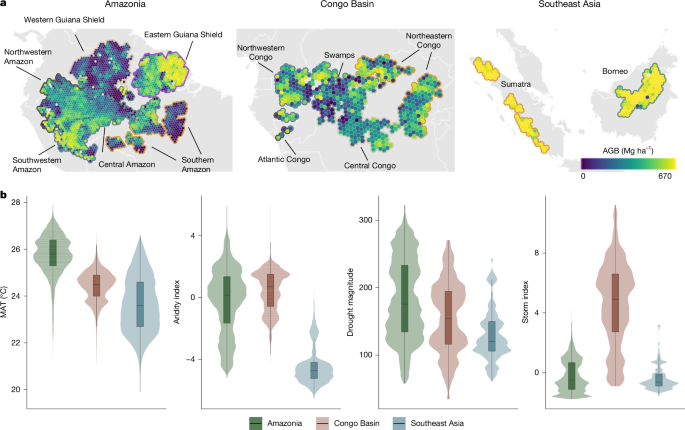
Tropical-forest aboveground biomass (AGB) is a major component of the global carbon cycle and understanding its response to climate change is crucial for predicting future climate–carbon feedbacks. Yet debate continues as to whether differences between studies in observed associations with climate reflect true regional variation or methodological differences1,2,3,4,5. Here we analyse around 16 million spaceborne-LiDAR-derived estimates of AGB for the year 2020 across intact lowland forests in the Amazon, the Congo Basin and Southeast Asia to investigate how climatic variables differentially relate to AGB on pantropical scales. We show that climatic associations with AGB are heterogeneous and depend on environmental context. Temperature dominates in drier forests, with AGB in the Congo Basin the most sensitive to warming, whereas Southeast Asian forests have the strongest declines in AGB under increasing water limitation. Across regions, the effects of temperature and drought anomalies intensify with aridity and are further modified by soils and topography. In the tallest (above 70 m), carbon-dense forests6,7, storms (lightning and windthrow) emerge as a strong negative driver. These results reconcile previously conflicting findings and show that predicting tropical-forest carbon storage requires accounting for interactions among climate, disturbance, soil and topography in a variety of biogeographical contexts.
This is a preview of subscription content, access via your institution
Access Nature and 54 other Nature Portfolio journals
Get Nature+, our best-value online-access subscription
Prices may be subject to local taxes which are calculated during checkout
The data supporting the findings of this study are publicly available via Zenodo at https://doi.org/10.5281/zenodo.19474558 (ref. 105). Version 1 contains forest structure and environmental data at the GEDI footprint level, whereas version 2 contains forest structure and environmental data aggregated to 2.5 × 2.5-km grid cells. Source datasets used in this study are publicly available and include NASA GEDI Level 4A AGB density data (https://doi.org/10.3334/ORNLDAAC/2056), WorldClim climate data (https://worldclim.org/data/worldclim21.html), the Global SPEI database (SPEIbase v.2.10 (Earth Engine Data Catalog and Google for Developers)), CHIRPS precipitation data (https://www.chc.ucsb.edu/data/chirps), the CHIRPS-derived MCWD dataset (https://doi.org/10.5281/zenodo.4903340), MODIS MOD09GA version 6 surface reflectance data (https://lpdaac.usgs.gov/products/mod09gav061/), ERA5 reanalysis data (https://cds.climate.copernicus.eu/datasets/reanalysis-era5-single-levels), World Wide Lightning Location Network lightning data (https://doi.org/10.5281/zenodo.10725446), SoilGrids soil data (https://soilgrids.org), OpenLandMap soil data (https://openlandmap.org), SRTM elevation data from NASA Earthdata (https://earthdata.nasa.gov) and GLAD intact forest landscapes and global land cover datasets (https://glad.umd.edu). All processed data required to reproduce the analyses are available in the Zenodo repository.
Custom R scripts used for data processing, statistical analyses and figure generation are publicly available via Zenodo at https://doi.org/10.5281/zenodo.19474558 (ref. 105).
Fauset, S. et al. Drought-induced shifts in the floristic and functional composition of tropical forests in Ghana. Ecol. Lett. 15, 1120–1129 (2012).
Article
PubMed
Google Scholar