// HACKER NEWS — CYBERSECURITY
How do you sell a CPU design when the instruction set is free?
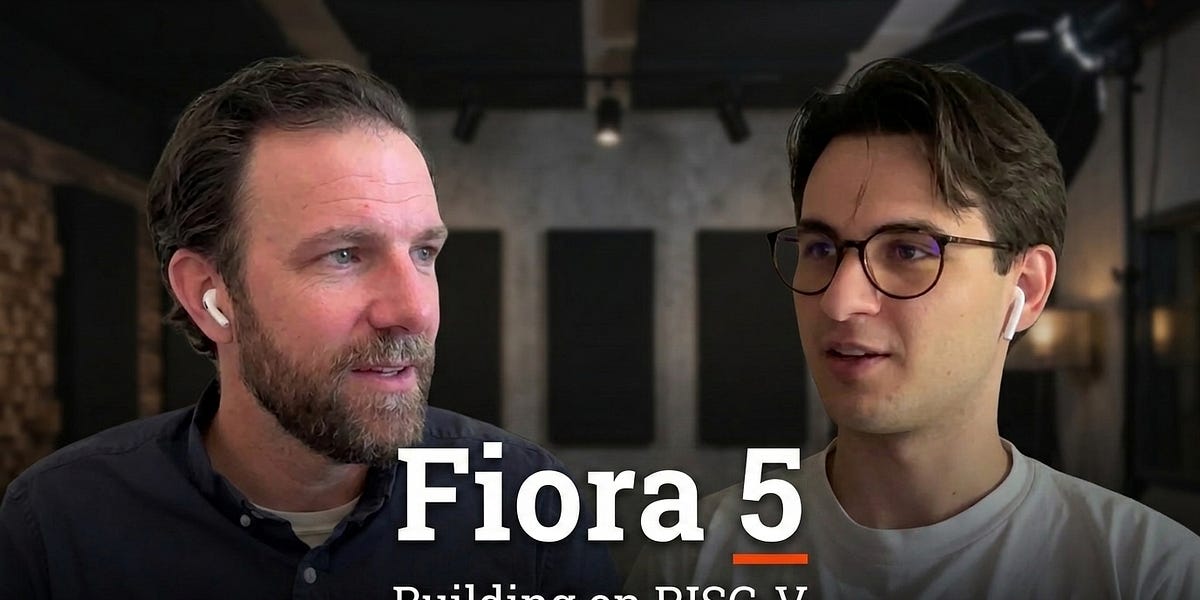
Darian Domocos told me the hardest part of starting a CPU company wasn’t the engineering; it was getting anyone to believe that two young guys from Romania could do it.
He’s the CEO and co-founder of Fiora5, a startup that develops and licenses RISC-V processor IP out of Europe. That’s where the conversation started before it charged through supply chain politics, why he’s ignoring the datacenter on his path to market, and what he’s reading to keep growing.
Our discussion hit a pretty wide range of topics, from career advice to nation state security.
We discussed open source instruction sets and how you build a business model around one. Closed systems still have the edge, but given how rapidly the EDA world is changing, and how rapidly the architecture of chips is changing, open source is having a moment. As we discussed with Daniel Schulz in Episode 8 of The Siliconimist, many parts of the silicon model are moving rapidly toward open: as more of the industry builds on it and embraces it, a self-reinforcing cycle starts.
Arm’s advantage is ecosystem maturity, not the instruction set. Toolchain, debugging, integration, forty years of programmer habit. As Darian put it:
“you might have a really amazing RISC-V core, but because you don’t have the auxiliary software it is harder to integrate.”
The unlock is standardization, specifically RVA23, which he called out as the single biggest step RISC-V International has taken.
Driving RISC-V further and faster are the shifts in the global supply chain and the changing geopolitical winds. Open source can mean sovereignty. With no single controlling company, nations have fewer effective pressure points to control or compromise the instruction set.
With America and China locked in on each other, the EU has decided that they too need more sovereignty over their chips. Rather than cast their lot with one or the other, they’re trying to build a local ecosystem. Europe won’t replace the entire supply chain, or control it, and unlike China they’re being realistic about that. Rather, if they control critical pieces of the chain, they buy optionality for the future. The strategy’s not MAD, it’s not self reliance, and it’s not Lenin’s “commanding heights of the economy” worldview. Both the US and China are closer to those approaches of strategic supply chain security. It’s more like Global Value Chain integration: specialize and participate in order to gain security and be irreplaceable (also, good career advice!).
Fiora5 is capitalizing on this as the EU invests in startups to support various parts of the semiconductor industry.