// NATURE NEWS — SPAZIO & SCIENZA
How the Middle East can become a hub for sustainable aviation fuels
Ying Jiang is a bioenergy researcher in the faculty of engineering and applied sciences, Cranfield University, Cranfield, UK.
Search author on:
PubMed
Google Scholar
Samuel S. Mao is senior director of the Resource Management and Sustainability Institute and a professor of mechanical and nuclear engineering at Khalifa University, Abu Dhabi, United Arab Emirates.
Search author on:
PubMed
Google Scholar
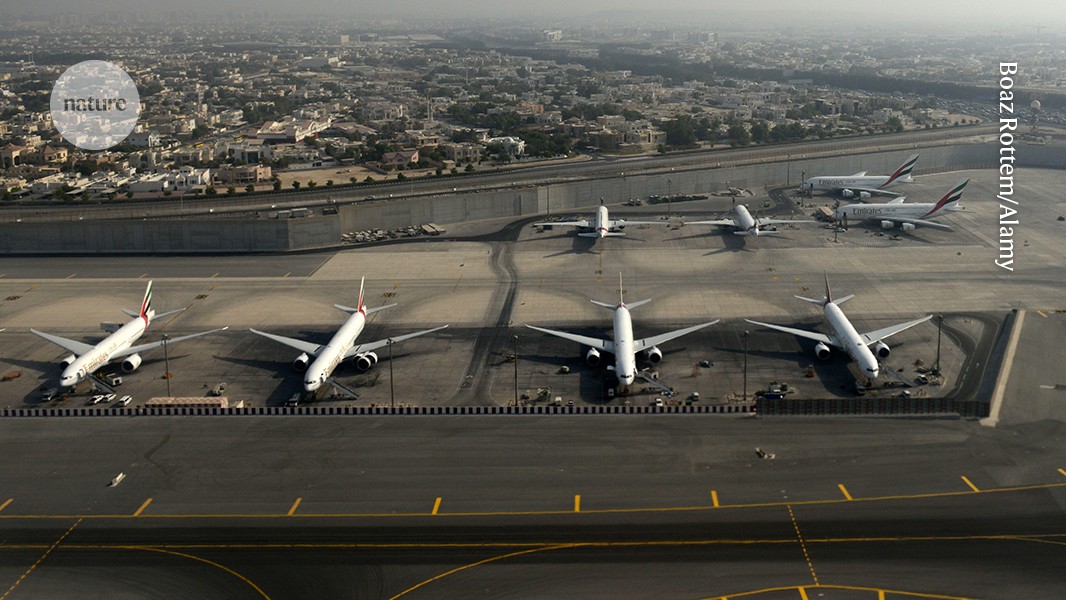
As a global transit hub, Dubai airport in the United Arab Emirates could establish ‘green flight paths’ that use sustainable aviation fuels. Credit: Boaz Rottem/Alamy
Oil producers in the Middle East have been experiencing disruptions to maritime traffic through the Strait of Hormuz. But this could present a strategic opportunity to rethink how energy infrastructure can be deployed in an increasingly uncertain world.
The global transition towards low-carbon energy sources is often framed as a challenge for fossil-fuel-producing nations. Yet many of the assets developed during the oil era, including ports, refineries, tanker fleets, aviation hubs and government-operated investment funds, could accelerate the transition to clean energy.
Here’s how oil producers in the Middle East could leverage these assets to become architects of a global supply chain for sustainable aviation fuel (SAF).
The aviation sector produces more than 2% of global anthropogenic carbon dioxide emissions and is under increasing regulatory and societal pressure to decarbonize. For long-haul routes, electric and hydrogen-fuelled planes are many years away. But in the near term, SAF, which is produced from waste oils and fats, agricultural residues, industrial waste gases and wastewater sludge, and biomass-based or synthetic feedstocks, is a credible option for delivering emissions reductions this decade1 (see go.nature.com/4wrwfws).
A cleaner future for flight — aviation needs a radical redesign