// TOM'S HARDWARE US — HARDWARE & GADGET
Asus ROG Swift PG32UCWM 32-inch OLED gaming monitor review: A flagship display with premium performance and imagery
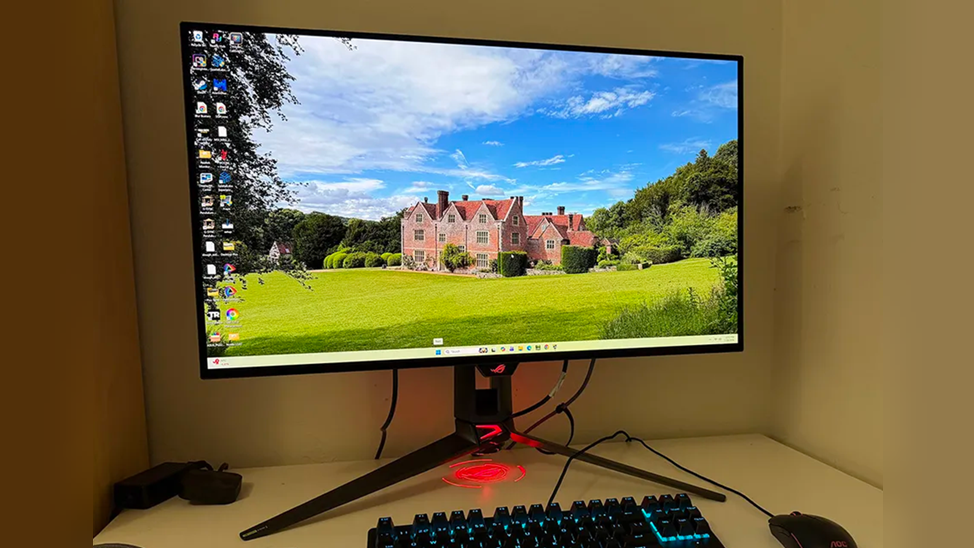
The Asus ROG Swift PG32UCWM games with an addictive quality that carries over to its incredibly sharp and colorful image. It is a flagship among flagships.
Extra image clarity from Tandem RGB Stripe technology
Why you can trust Tom's Hardware
Our expert reviewers spend hours testing and comparing products and services so you can choose the best for you. Find out more about how we test.
With prices generally higher than their LCD counterparts, the best OLED gaming monitors remain a premium category. And within that, there are flagships even though you’ll rarely see the words “bad” and “OLED” in the same sentence.
Asus ROG Swift displays represent an entire series of flagships, with every model featuring plenty of bells and whistles along with benchmark performance. I’ve looked at many of these in the past, and here, I have the latest one, the PG32UCWM. It’s a 32-inch Tandem RGB Stripe OLED with 4K resolution at 240 Hz, FHD at 480 Hz, Adaptive-Sync, HDR10, DisplayHDR 400, Dolby Vision, and wide-gamut color. Let’s take a look.
Organic Light Emitting Diode (OLED) Tandem RGB Stripe
First, we’ll tackle the alphabet soup in the room: Tandem RGB Stripe OLED. Let’s call it TRS-OLED, consisting of two light-emitting layers with red, green, and blue diodes. This approach addresses several issues. With two layers comes lower power consumption at a given light level. Tandem white OLEDs do the same thing. RGB Stripe takes care of the fringing issue where white diodes behind color filters can spread their light and cause a loss of sharpness. In practice, you will be hard-pressed to see any softness from any OLED, but an RGB Stripe panel like the PG32UCWM is a tad sharper, and you’ll see it in a side-by-side comparison. To this, Asus adds its True Black Glossy screen coating, which earns its name by reducing the effect of ambient light on the screen. Visually, it deepens black areas and improves perceived contrast.
Another advantage of RGB Stripe is increased color volume. Most wide gamut screens employ Quantum Dots to increase volume up to 110% of DCI-P3 or more. RGB Stripe achieves most of that without the light-reducing effect of a QD layer. The PG32UCWM delivers an honest 100% of P3, which is a little less than the competition, but it’s more than the 93-95% coverage of non-QD monitors. Asus promises and delivers accuracy out of the box as well with a calibration report stored in the panel’s firmware.
It wouldn’t be ROG without serious gaming performance, and on that, the PG32UCWM delivers in spades. 240 Hz at 4K is available for those with enough video card power to achieve it. If you want maximum fps, there’s a 480 Hz mode with FHD 1920x1080 resolution. You can also employ ELMB at lower frame rates to reduce motion blur. Asus includes its exclusive OLED Anti-Flicker feature, which mitigates stutter during rapid frame rate transitions. Does this translate into a fast and smooth experience? Check out my test results on page two to find out.
The PG32UCWM supports HDR10 with multiple picture modes and an adjustable option. And it accepts Dolby Vision content, which is still a rarity among computer monitors. Its dynamic tone mapping creates a major improvement in picture depth, regardless of the level to which content is mastered. It will show you every nuance and render every detail present in the original material.