// NATURE NEWS — SPAZIO & SCIENZA
Family genetic designs in MoBa provide insights into health and functioning
Nature
(2026) Cite this article
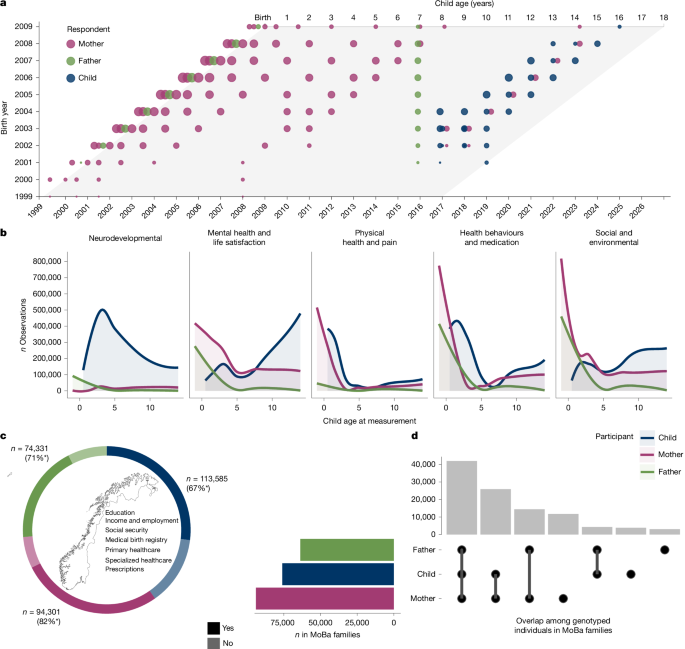
Genome-wide association studies using large, population-based samples of unrelated individuals have discovered thousands of genetic associations with health and disease1. These studies can help explain genetic and environmental risks. However, increasing evidence suggests that population-based estimates, while precise, can also reflect confounding that affects their use and interpretation. This confounding can be overcome using data from genotyped family members, such as nuclear mother–father–child trios2,3. However, samples of genotyped families are rare4,5,6,7,8,9,10,11. Here we illustrate some of the advantages of familial data using the Norwegian Mother, Father and Child Cohort Study (MoBa), a population-based cohort of parents and offspring with extensive genotype data (n ≈ 230,000) (ref. 3), along with broad and longitudinal phenotyping of health and functioning. We provide an overview of MoBa and describe the quality control of genotype data tailored to this extensively related sample. We then use trio data to illustrate how family-based genomic designs can identify distinct direct and indirect sources of genetic influence and structural confounding. As examples, we analyse children’s height, educational achievement, depressive symptoms and sleep duration. These demonstrations highlight MoBa as a broadly valuable resource for advancing understanding of health and functioning across the lifecourse and generations.
The field of genome-wide association studies (GWAS) has continued to advance through ever-increasing sample sizes and imputation with improved reference panels12,13,14,15,16,17,18,19,20,21,22,23. This has allowed the identification of thousands of single-nucleotide polymorphisms (SNPs) associated with a multitude of human traits1. Advancements in statistical methodologies and modelling software have allowed increasingly complex research questions to be addressed, for example, using multivariate GWAS24, polygenic score analysis25,26,27 and Mendelian randomization28,29.
Most of the GWAS so far have used clinical or population-based samples of unrelated individuals3,30. However, increasing evidence suggests that genetic associations estimated from unrelated individuals reflect not only direct genetic effects—in which an individual’s genetic variants causally influence their own phenotype—but also indirect effects of other individuals’ genotypes, such as parental genotypes shaping the rearing environment and thereby influencing offspring outcomes31,32. Estimates of indirect genetic effects in parent–offspring models reflect the association between parental genotypes and offspring outcomes after conditioning on the offspring’s genotype. These estimates capture ‘genetic nurture’ effects, as well as components arising from broader population structure, such as assortative mating and population stratification. Disentangling direct from indirect genetic effect estimates is very challenging in samples of unrelated individuals3,33. By contrast, family-based analyses can directly control for parental genotypes and exploit the random inheritance of genetic variation from parents to offspring to preclude many forms of environmental confounding. Therefore, using large samples of genotyped, related individuals4,5,6,7,8,9,10,11 is one of the most compelling ways to estimate the contributions of direct and indirect effects of both genotypes and phenotypes.
Genome-wide significant associations between SNPs and educational attainment in population-based GWAS of unrelated individuals are particularly attenuated in family-based studies34. A within-family GWAS of 179,086 siblings also suggested substantial attenuation of population-based estimates within families for height, age at first birth, number of children, cognitive ability, depressive symptoms and smoking2. Other studies of parent–offspring duos and trios have explicitly demonstrated that the parents’ non-trans