// NATURE NEWS — SPAZIO & SCIENZA
A biased allosteric modulator is a molecular glue for β2AR dimerization
Nature
(2026) Cite this article
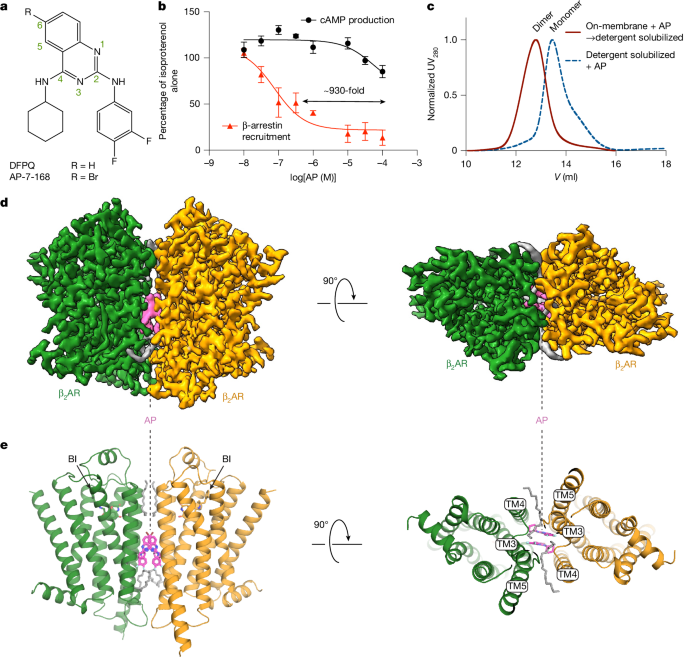
Family A G-protein-coupled receptors (GPCRs) are typically described as monomers, yet growing evidence suggests that they can form dimers with distinct signalling properties1,2,3. However, the mechanisms and therapeutic potential of such dimerization remain poorly understood. Here we show that AP-7-168, an optimized derivative of a β-arrestin-biased negative allosteric modulator of the β2-adrenergic receptor (β2AR) that sustains bronchorelaxation in cell and tissue models4, functions as a molecular glue to stabilize β2AR homodimerization. Cryogenic electron microscopy structures reveal a unique binding mode in which two AP-7-168 molecules pack within a pocket formed by transmembrane helices 3, 4 and 5 of two protomers, stabilizing a dimeric conformation that selectively prevents β-arrestin coupling. In cells, AP-7-168 robustly stabilizes β2AR dimerization and drives enlarged nanocluster formation. Combined with extensive functional studies, our findings identify an allosteric mechanism by which a small molecule biases β2AR signalling through dimerization, highlighting ligand-stabilized dimerization as a strategy for GPCR modulation.
G-protein-coupled receptors (GPCRs) represent the largest superfamily of transmembrane (TM) proteins, exhibiting complex signalling behaviours. GPCRs can interact with G proteins or other effectors, such as arrestins and kinases, mediating G-protein-independent pathways and giving rise to diverse physiological responses5,6. Over 800 human GPCRs have been identified and classified into five families7: A, B1, B2, C and F. Although family C glutamate-like receptors are known to be obligate dimers8, mediated primarily by Venus flytrap extracellular domains, dimerization of other families is not well described.
Over the past few decades, many studies have suggested that family A rhodopsin-like receptors can also form dimers9,10,11,12,13, yet defining their physiologically relevant quaternary structures and functional roles has been a long quest in the field. Recent cryogenic electron microscopy (cryo-EM) studies on rhodopsin1, apelin receptor (APJR)2,14,15,16 and GPR3 (refs. 3,17,18) have provided direct evidence for the dimerization of these family A GPCRs. In contrast to family C receptors, family A receptors typically do not have a large extracellular domain and therefore dimerize primarily through TM interactions14. Despite extensive studies on potential family A dimers, their physiological relevance is still debated. The development of ligands that stabilize family A receptor dimers remains a challenge19,20, and it is difficult to reliably reproduce these dimers and to comprehensively study their functional, biochemical, and biophysical properties.
We previously identified a class of negative allosteric modulators (NAMs) selective for the β2-adrenergic receptor (β2AR), a family A GPCR, that exhibited biased inhibition of β-arrestin recruitment with minimal impact on stimulatory G protein (Gs)-mediated cAMP production in cell-based assays4. Through comprehensive structure–activity relationship studies, we developed AP-7-168 (hereafter, AP)—a compound that has high potency and biased effects4. Activation of Gs after coupling with β2AR triggers the downstream cAMP signalling pathway, leading to many physiological effects, including the relaxation of airway smooth muscle, which is the core mechanism underlying the use of β2AR agonists in treating airway diseases such as asthma and chronic obstructive pulmonary disease. However, after prolonged agonist stimulation, β2AR undergoes desensitization through arrestin-mediated inhibition of Gs coupling and receptor endocytosis, resulting in a diminished bronchodilatory effect21,22. Our ex vivo tissue assays demonstrated that AP effectively maintained agonist-induced β2AR activation and the subsequent bronchodilation while significantly delaying receptor desensitization4, highlighting its potenti