// NATURE NEWS — SPAZIO & SCIENZA
Critical zone processes limit alkalinity export from natural basaltic systems
Nature
(2026) Cite this article
Enhanced weathering (EW) of rocks is a proposed strategy for carbon dioxide removal (CDR) that relies on the dissolution of silicate minerals, typically basalt, applied to soils1. Globally, large-scale CDR by means of EW requires the generation of alkalinity during mineral dissolution in soils and preservation and transport of that alkalinity through groundwater and rivers to reach the ocean2,3. Although field trials and models have focused on near-surface alkalinity generation after addition of crushed rock4,5, the transmission of this alkalinity is modulated by hydrological and geochemical processes that unfold across watersheds6,7,8. Here we synthesize observations from natural volcanic watersheds to evaluate alkalinity export along the complete reactive pathways from soil to river. Data from basaltic catchments demonstrate attenuation of alkalinity fluxes, leading to reductions in exported alkalinity. This attenuation is probably the result of precipitation of secondary clay and carbonate minerals along subsurface flow paths and during river transport. Although natural weathering systems differ from engineered EW deployments, these observations provide an empirical baseline on watershed-scale alkalinity export. Our results indicate that critical zone processes influence the efficiency with which weathering-derived alkalinity is exported, implying the need to incorporate watershed processes into future assessments of EW CDR.
EW is a strategy for long-term removal of CO2 that seeks to mimic Earth’s natural carbon cycle through the addition of crushed volcanic rock, generally basalt, to agricultural fields1,9. Weathering of basalt converts CO2 in soil water to dissolved inorganic carbon, including both HCO3− (bicarbonate ion) and CO32− (carbonate ion) that comprise carbonate alkalinity. If that alkalinity is transported to the oceans, it could modify ocean pH and promote the dissolution of atmospheric CO2 into seawater, potentially moderating ocean acidification that results from increasing pCO2 and ultimately removing CO2 as calcium carbonate minerals2. The ready availability of basaltic rocks, combined with the operational scale of agricultural systems, has been used to argue for potential CDR between 0.5 and 2.5 Gt year−1 (refs. 10,11). However, this scale of removal, and the diverse geochemical and hydrologic processes that will govern it, have not been assessed relative to well-established natural basaltic weathering rates.
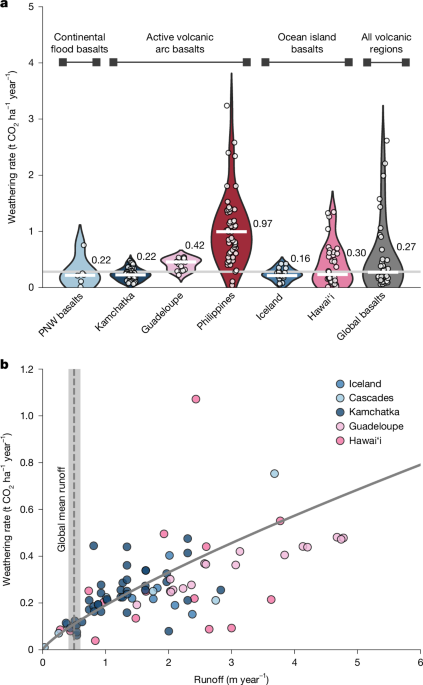
Globally, weathering of silicate rocks transfers 0.52 ± 0.10 Gt CO2 year−1 from subaerial surfaces to the oceans12. On the basis of analysis of global river data, mafic rock weathering accounts for approximately 15–30% of this long-term flux13,14, or 0.08–0.18 Gt CO2 year−1 (Methods), highlighting the outsized role of volcanic provinces in the carbon cycle. EW seeks to mimic this process by applying basalt to soils and equating the alkalinity produced by weathering to a carbon removal value. However, global rates of natural basalt weathering are a factor of 8–30 times less than present estimates of EW CDR potential. The present basaltic CO2 consumption rate integrated over the rest of the century is 3.4–5.0 Gt CO2, which is 1.0–4.7% of the 105–335 Gt CO2 target for removal of remaining cumulative emissions estimated as necessary to meet climate goals for 2100 by the Intergovernmental Panel on Climate Change (IPCC)15. Although EW seeks to amplify this natural flux, whether sufficient alkalinity can be generated to substantially exceed background rates, and thereby achieve measurable CDR, remains uncertain.
Assessing how much CO2 could be sequestered by basalt amendment is challenging16,17. The quantity of basalt added to soils in most studies is a small fraction of the native soil. Typically, 1–20 kg m−2 are added to soil; for a soil treatment depth of 30 cm and soil density 1,300 kg m−3, the amendment comprises only 1–5% of the post-trea