// NATURE NEWS — SPAZIO & SCIENZA
Endocannabinoids facilitate reward engagement through retrograde gain control
Nature
(2026) Cite this article
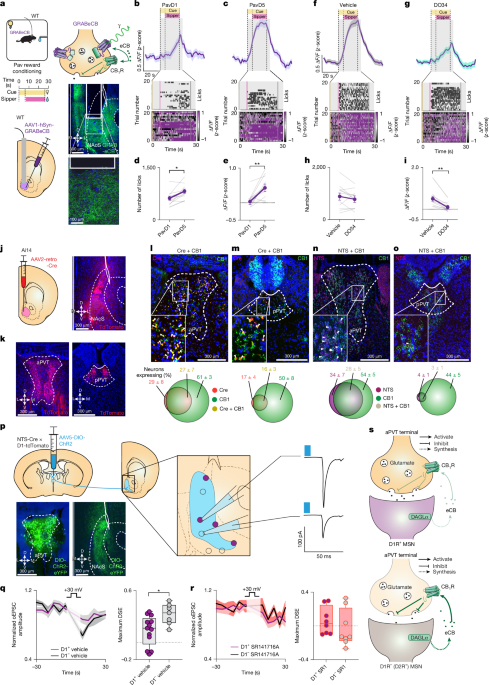
Neuromodulatory signalling is poised to serve as a neural mechanism for gain control, acting as a crucial tuning factor to influence neuronal activity by dynamically shaping excitatory and inhibitory fast neurotransmission. The endocannabinoid (eCB) signalling system, the most widely expressed neuromodulatory system in the mammalian brain, has been demonstrated to filter excitatory and inhibitory inputs through retrograde, presynaptic action in vitro and ex vivo1,2,3,4,5,6,7,8,9. However, whether eCBs exert retrograde gain control to ultimately facilitate motivated behaviours in freely moving mammals has not been established. Here, using a suite of in vivo physiological, imaging, genetic and machine learning-based approaches, we uncover a fundamental role for the dynamic release of eCBs in controlling behavioural engagement during reward seeking through a genetically and anatomically defined thalamostriatal circuit.
This is a preview of subscription content, access via your institution
Access Nature and 54 other Nature Portfolio journals
Get Nature+, our best-value online-access subscription
Prices may be subject to local taxes which are calculated during checkout
All data associated with this project have been uploaded to Figshare (https://figshare.com/authors/David_Marcus/23255861).
All code associated with this project has been uploaded to Figshare (https://figshare.com/authors/David_Marcus/23255861).
Devane, W. A., Dysarz, F. A., Johnson, M. R., Melvin, L. S. & Howlett, A. C. Determination and characterization of a cannabinoid receptor in rat brain. Mol. Pharmacol. 34, 605–613 (1988).
Article
CAS
PubMed
Google Scholar