// TOM'S HARDWARE US — HARDWARE & GADGET
Hot Chips 2026: Cerebras lays out the future of wafer-scale AI — Nexus system architecture triples rack-scale performance, CS-6 wafer to incorporate stacked DRAM
When you purchase through links on our site, we may earn an affiliate commission. Here’s how it works.
Cerebras' SRAM-packed wafer-scale engines (WSEs) have carved out a niche in the AI model serving space for extremely low-latency, high-throughput inference, enabling services like OpenAI's ChatGPT-5.6 Sol Ultrafast tier. At Hot Chips 2026, the company revealed the next two generations of its wafer-scale accelerator roadmap. It also discussed the benefits of its new Nexus rack design for the CS-4 rack-scale accelerator and the performance of the three WS-3T wafer-scale engines contained within.
The integration of a huge coherent processor on a single massive slice of silicon is a unique feat in the industry. But that approach also comes with limitations. AI demands for memory are only increasing due to growing model sizes (the memory occupancy of which can be amortized across multiple inference sessions) and ever-lengthening contexts stored in large KV caches (which are also unique to each inference session).
Traditional GPU makers have addressed those pressures, in part by working with memory makers to stack HBM higher and by using more of it per accelerator to expand that precious resource in proximity to the processor. But on a wafer-scale design whose area is already 100% utilized by logic and memory, adding more of a particular resource requires giving up area that might have been used for some other purpose. Since silicon production will continue to take place on 300mm wafers for the foreseeable future, Cerebras must look in other directions to scale up the on-chip resources available to its processors.
Cerebras revealed that it will start expanding its wafer-scale engines into stacked designs with its CS-6 system’s WSE, currently two generations out on its roadmap. For the first time, Cerebras will attempt 3D stacking of DRAM on top of its logic and SRAM wafer, a move it claims will maintain the company's performance lead for inference while reducing the area required for the overall chip.
The goal of stacking wafer-scale logic and memory chips on top of one another is certainly ambitious, but it’s only one potentially important change in the CS-6 system. The concurrent reduction in area Cerebras foresees suggests the company might be able to increase the overall number of WSEs it produces, which could relax a crucial constraint as the company seeks to scale its business amid a world of ever-increasing wafer demand.
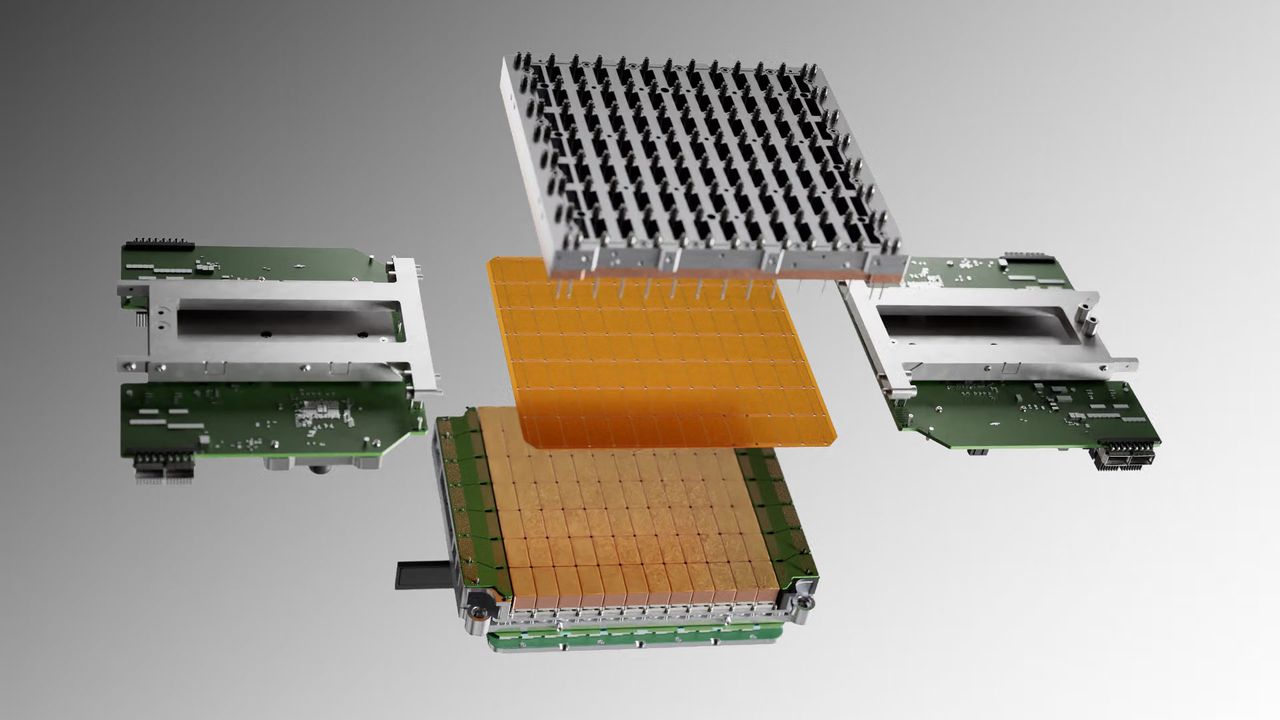
In the present, Cerebras is boosting the performance of its existing wafer-scale platform with its new CS-4 rack-scale system and its Nexus rack design. CS-4 incorporates three of the company's refreshed WS-3T wafers into self-contained "backpacks" that incorporate power delivery, scale-up networking, and liquid cooling infrastructure into a single pluggable module.
Cerebras notes that because these modules are self-contained, future wafer-scale engines built with this architecture can be swapped in without exchanging the entire rack in the process.
Cerebras chief system architect JP Fricker had choice words when describing the 5,000 cables that are used to connect the Rubin NVL72 NVLink scale-up domain within each of those racks, calling it "a mess" and contrasting it with the cleaner and less failure-prone design provided by the on-die interconnects and self-contained compute module design of the Nexus system.
The Nexus backpack design also disaggregates the I/O interfaces of the WSE from the rest of the backpack's components. Two I/O modules now connect to the edges of the wafer, providing RoCE v2 RDMA connections for interoperability with other systems, alongside a direct connection to other wafers in the rack. Because these modules are also interchangeable, they provide another potential route for future upgrades, independent of the core compute wafer.