// SPACE.COM — SPAZIO & SCIENZA
A 'new' star could finally appear in the night sky this week, thanks to a once-in-a-lifetime explosion
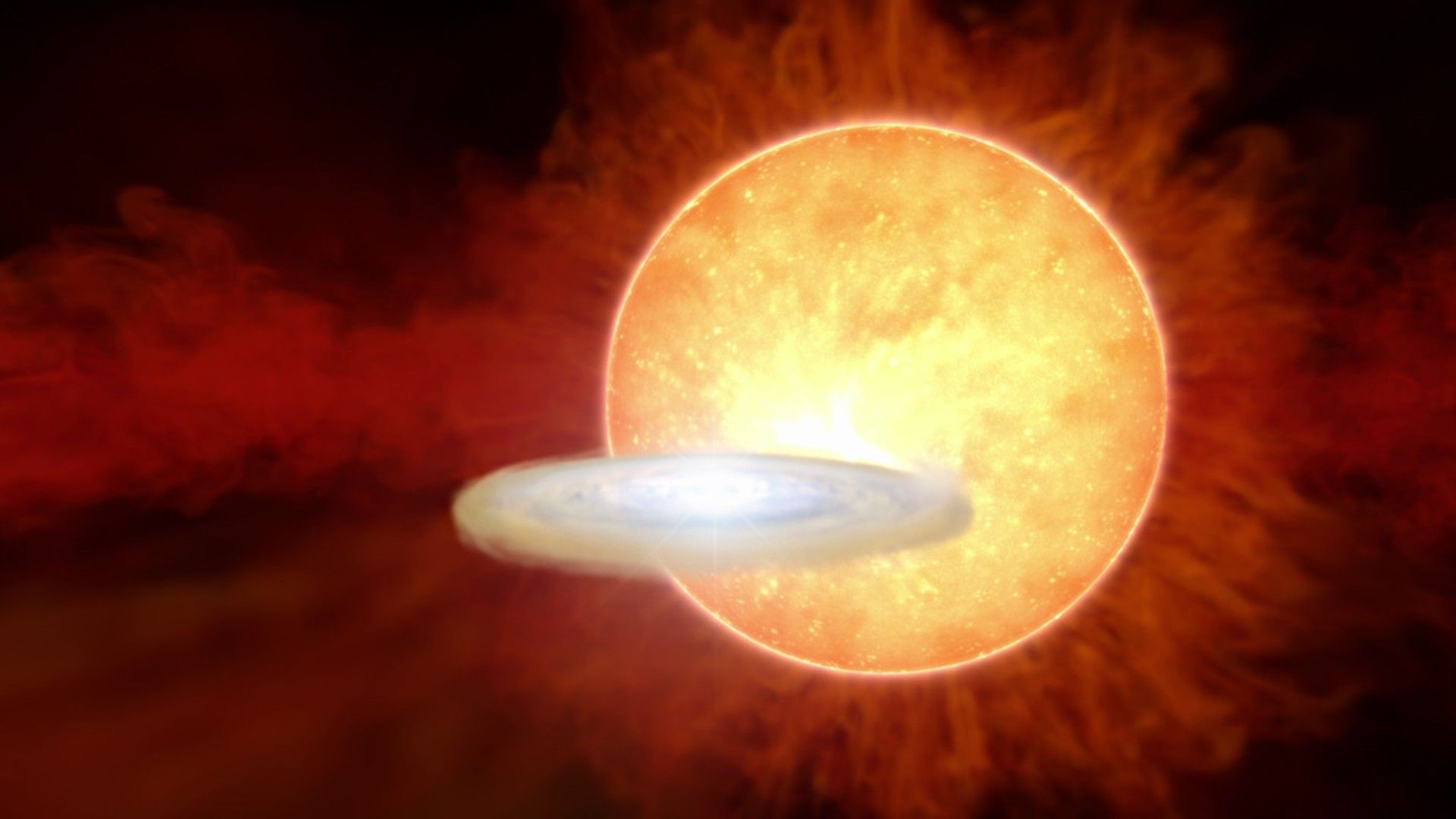
T. Coronae Borealis undergoes a dramatic nova explosion once every 80 years on average, causing it to shine as bright as Polaris, the North Star.
When you purchase through links on our site, we may earn an affiliate commission. Here’s how it works.
A once-in-a-lifetime stellar eruption could occur at any time, potentially causing a 'new star' to appear in the night sky. If it does, the star system T Coronae Borealis could suddenly brighten to rival Polaris, the North Star. Here's what you need to know about the "Blaze Star" T. Coronae Borealis (T CrB).
T CrB is a prime example of a recurring nova. This thermonuclear explosion erupts from the atmosphere of a white dwarf star roughly once every 80 years, when it reaches a point of critical mass, having stripped vast quantities of material from a co-orbiting red giant.
After each eruption, the white dwarf returns to vampirically feeding on its companion star, until ready to start the process anew. Recurring novas like T CrB are extremely rare, with only five known to exist within the entirety of the Milky Way, according to NASA.
T CrB brightens roughly once every 80 years — an average based on eight centuries of historical observations. The most recent deluge of nova light reached Earth in 1946, prompting some astronomers to predict that the next brightening could occur as early as February 2024, based on an earlier dip in the system's light that echoed historical data.
It seems that T CrB had other ideas, however, and instead has remained stubbornly dim through numerous unsuccessful prediction attempts. Astronomers repeatedly attempted to fit subtle shifts in the brightness of T CrB to the few points of reliable historical data on offer, while accounting for fluctuations in the white dwarf's feeding rate.
The Celestron NexStar 4SE is ideal for beginners wanting quality, reliable and quick views of the night sky. It's sturdily built, quick to set up and automatically locates night sky targets and provides crisp, clear views of them. For a more in-depth look at our Celestron NexStar 4SE review
"We know it has to happen," astrophysicist Elizabeth Hays, project scientist on NASA's Fermi gamma-ray space telescope, told Space.com in 2024. "We just can't pin it down to the month."
One paper authored by Jean Schneider of the Paris Observatory put forward a set of four potential dates for the brightening — the last of which falls on June 25, 2026 — based on the presence of a theoretical third body in the T CrB system. However, other astronomers were sceptical of the predictions, as no evidence of this phantom third body has been spotted in modern data.