// SPACE.COM — SPAZIO & SCIENZA
'No guts, no glory': How I captured NASA's Roman Space Telescope cross the sun on a picture-perfect SpaceX Falcon Heavy launch
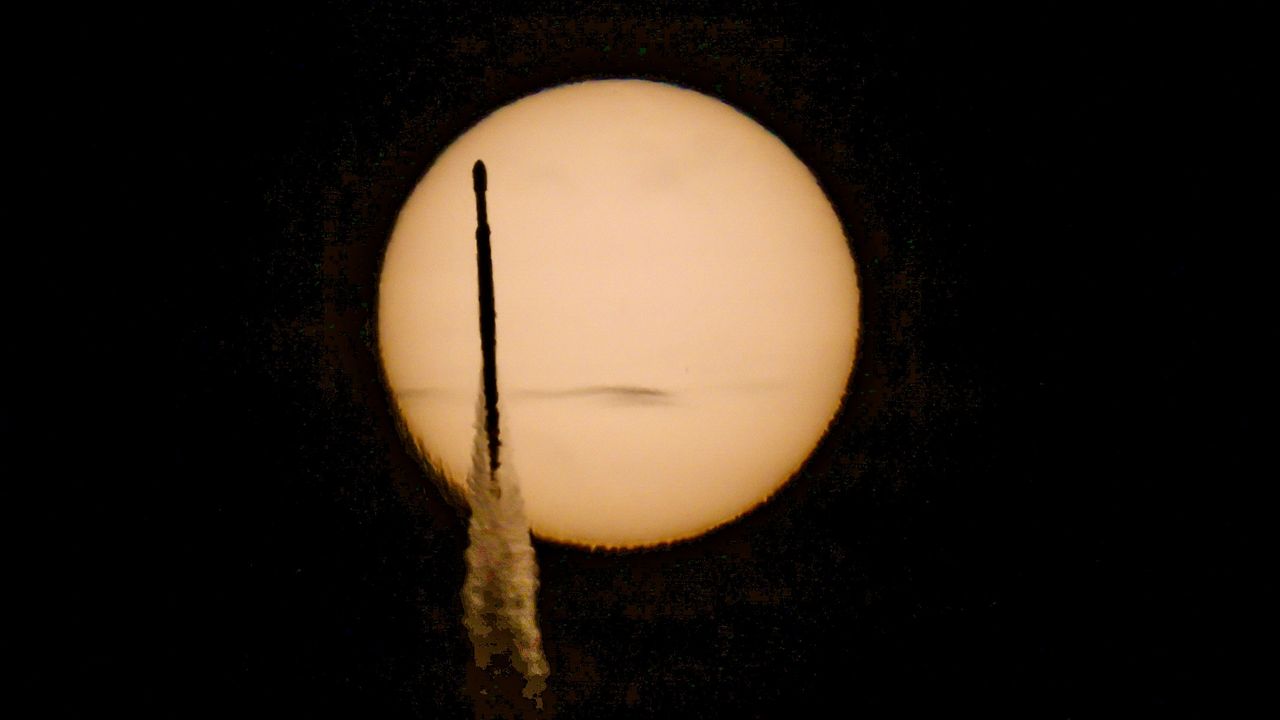
Space.com's Josh Dinner caught an amazing shot of NASA's Roman Space Telescope crossing the sun on a SpaceX rocket. But why was he at Hobby Lobby?
When you purchase through links on our site, we may earn an affiliate commission. Here’s how it works.
CAPE CANAVERAL, Fla. — Standing in the parking lot of the Titusville Hobby Lobby was maybe something I should have planned on before traveling to Florida for the launch of NASA's Nancy Roman Grace Space Telescope, but it was not where I expected to be until I was speeding there in my car.
Rocket enthusiasts and locals around Florida's Space Coast gathered Sunday morning (Aug. 30) to watch SpaceX's latest Falcon Heavy launch. The triple-booster rocket launched NASA's newest flagship observatory, the Nancy Grace Roman Space Telescope, which is now on its way to an orbital sweet spot nearly 1 million miles from Earth to image the widest views of the universe ever captured, map planets around alien stars and usher in a new wave of discovery into phenomena like dark matter and dark energy.
Liftoff occurred at 07:26:49 a.m. EDT (11:26:49 GMT), from Launch Complex-39A at NASA's Kennedy Space Center (KSC). Specifying those 49 seconds was very important. Roman's launch opportunity is known as an "instantaneous" launch window because its proper orbital delivery was dependent on getting the time right down to the very second. And the seconds mattered for those watching the launch, too. Any fewer, and the clouds from viewing the location of dozens of photographers at Hobby Lobby, myself included, wouldn't have cleared in time. Any more and the sun would have moved too high in the sky to capture what me and all those photographers were hoping to capture.
Josh Dinner is a Spaceflight Writer for Space.com. He also photographs rockets. Sometimes, from a Hobby Lobby parking lot...
The early morning launch got off the ground a little more than 20 minutes after sunrise, while the bright glowing orb was still relatively low in the sky. The Space Coast's eastward shores on the Atlantic Ocean, coincidentally, sometimes offer the rare alignment with one of the missions launching from KSC for a rocket to fly right in front of the sun on its way to space, but only from specific vantage points.
Plotting and predicting the trajectories of a launch vehicle is no easy task, but it is made incredibly simpler using certain softwares like the popular FlightClub.io, which is used by many photographers to help line up shots that would be nearly impossible without a rocket's flight trajectory info before launch. That, and apps like PhotoPills or The Photographer's Ephemeris are incredibly useful for planning rocket launch photos ahead of time.
It's rare for a launch to line up just right, and even more rare for a launch vehicle like Falcon Heavy, which flies far less often than SpaceX's workhorse Falcon 9 rocket, to line up for a solar transit the way Roman's launch did. The sun rises in a slightly different spot on the horizon each day, and even a few minutes delay in a launch can be enough for the sun to move out of alignment of where the rocket is going to fly. And the alignment for Roman's launch happened to be in the parking lot of Hobby Lobby.
I hadn't checked FlightClub.io, and was so focused on other parts of launch coverage for Roman's mission, I didn't think to check if a transit was in the cards for Sunday morning. But as the excitement for launch built, and the days until Roman's launch dwindled, excitement over the possibility of a solar transit spread among the photojournalists at KSC.