// NATURE NEWS — SPAZIO & SCIENZA
Creating bottom-up RNA transfer vehicles from synthetic protein assemblies
Nature
(2026) Cite this article
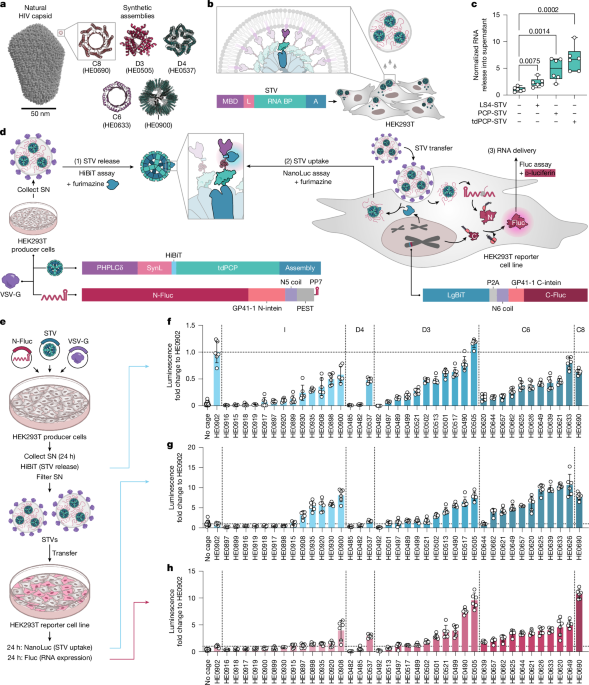
Evolution guides biological systems to populate ecological niches, with viruses among the most successful examples of this principle. Viruses evolved over billions of years to efficiently transfer genetic information. Although viruses are highly diverse, most have converged towards remarkable similarity in the size and shape of their capsids1,2. By contrast, generative models for protein design enable the creation of protein architectures that are absent from nature3,4,5. Here we investigate whether protein assemblies designed by artificial intelligence can be functionalized to construct nucleic acid transport vehicles that are independent of evolutionary trajectories. By combining natural protein domains with synthetic protein assemblies, we create more than 100 bottom-up RNA transfer vehicles with unique sizes and shapes. These vehicles surpass the RNA transfer efficiency of widely used delivery vehicles by several orders of magnitude. In addition, we demonstrate that their tropism can be programmed by incorporation of computationally designed peptide binders and use them to deliver therapeutically relevant cargo RNAs into a wide range of cellular models. We show the in vivo biodistribution of one of these vehicles in a mouse at near-single-cell resolution, confirm its safety, and use it to perform a gene-editing treatment strategy for Duchenne muscular dystrophy in patient-derived cells and a pig. Our work demonstrates how proteins created by generative artificial intelligence can be harnessed for the rational engineering of RNA transport systems with the desired properties by overcoming the limitations of natural protein diversity.
Selective pressure drives biological systems towards a local minimum on the evolutionary landscape, enabling them to occupy an ecological niche6,7,8. Viruses, for instance, are highly optimized vehicles for gene transfer; however, despite their diversity, they have converged on similar features. Most viruses rely on large supramolecular protein capsids composed of thousands of subunits, which self-assemble mostly into icosahedral or helical symmetries to enclose and protect their genome1,2,9,10. Viral capsids are selected for their resilience in harsh environmental conditions. However, when repurposed as vectors for genetic engineering, they are handled in controlled environments. This raises the question of whether certain features selected for by evolution may be unnecessary or even disadvantageous when a biological system is placed in a context outside its original ecological niche. Recently developed artificial intelligence models for protein design can be harnessed to explore this question. These models create protein structures that are physically feasible but do not occur naturally3,4,5,11,12, enabling the manipulation of evolutionary trajectories with non-natural protein architectures.
Here we exemplify this idea by constructing bottom-up RNA transfer vehicles consisting of natural protein domains, combined with artificial-intelligence-designed synthetic protein assemblies. We name these RNA carriers synthetic transfer vehicles (STVs). STVs are distinct from known natural RNA transfer vehicles, exhibiting unique characteristics that include cyclic and dihedral symmetries, open structures and low complexity of the assembled protein. We develop a multidimensional screening system that enables testing of hundreds of designs and identify STV-C8, which is built from an unusual planar symmetry, as the most efficient structure for RNA delivery. We characterize the shape, content and packaging capacity of STV-C8 and program its tropism by combining it with computationally designed peptide binders. Regardless of its distinct structure, STV-C8 is several orders of magnitude more efficient in RNA transfer compared with its natural counterparts and with lipid nanoparticles (LNPs) in clinical use. We demonstrate the versatility of STV-C8