// NASA BREAKING NEWS — SPAZIO & SCIENZA
NASA’s Hubble Tracks New Decagon Encircling Saturn’s South Pole
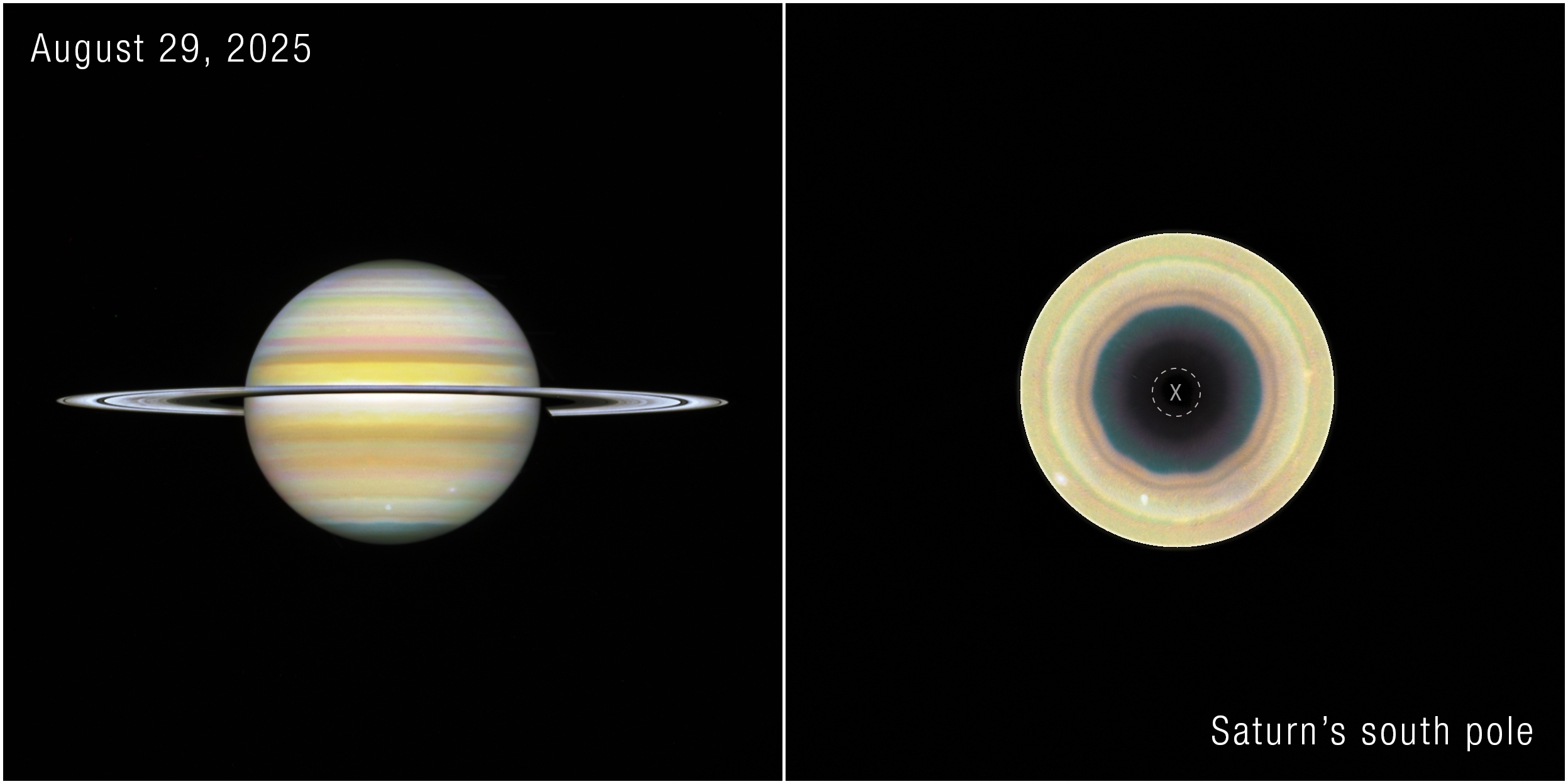
Recent observations with NASA’s Hubble Space Telescope have revealed a giant, evolving, 10-sided atmospheric wave encircling Saturn's south pole. This discovery marks the first time a large, regular-sided jet pattern has been observed in the planet's southern hemisphere. The feature appears remarkably similar to Saturn's famous hexagon at its northern pole, but is also distinctly different, suggesting scientists may be witnessing a new atmospheric phenomenon develop on the iconic gas giant.
The results published Wednesday in the journal Science Advances.
By piecing together several years of Hubble observations dating back to 2023, researchers found subtle hints of the structure beginning to emerge before it became a clearly defined pattern. Those observations were taken as part of Hubble’s Outer Planet Atmospheres Legacy (OPAL) program, which has photographed the outer planets annually for more than a decade.
"We've never seen anything quite like this in Saturn's southern hemisphere," said Amy Simon, study co-author and OPAL principal investigator, NASA's Goddard Space Flight Center in Greenbelt, Maryland. "The northern hexagon has been there every time we've looked for more than 40 years. This feature is different — it appears to be strengthening, giving us the rare opportunity to watch a giant atmospheric pattern develop."
The discovery was possible because Saturn's changing seasons gradually brought the planet's south pole back into view from Earth, where astronomers who collectively analyze images of Saturn from ground-based observatories first identified it.
Agustín Sánchez-Lavega, lead author of the new study, is a researcher at the University of the Basque Country in Spain. The university manages a website, called Planetary Virtual Observatory Laboratory, that accepts ground-based images of solar system planets contributed by observers all over the world. It was in those images, first in 2024, that Sánchez-Lavega and amateur astronomers Trevor Barry and Jean-Paul Oger noticed a subtle undulating band along the southern pole. Additional 2025 imagery taken from the ground hinted even more strongly toward this decagon structure.
That’s when the Hubble observations come into the picture. Hubble’s view from space offers unmatched image sharpness and spatial resolution over full rotations of Saturn, without smearing by Earth’s atmosphere.
“Given Saturn’s symmetry in its north-south jet stream system, we have been searching for a counterpart to Saturn’s northern hexagon on the south pole in Hubble images since 1990,” Sánchez-Lavega said. “Images from NASA’s Cassini spacecraft, which orbited Saturn between 2004 and 2017, showed no inkling of a long-lived formation, either. The Hubble data confirmed the feature’s presence back to 2023.”
The wave sits within one of Saturn's powerful jet streams and extends through multiple layers of the atmosphere, indicating it is not just a cloud-level feature, but a vertically extended atmospheric structure. The decagon’s apparent position shifts slightly, because Hubble captures images from different wavelengths. Those different wavelengths probe different altitudes in Saturn's atmosphere.
“The most intriguing part to me is that this seems to have just formed recently,” said Simon. “The question is, why did it suddenly form now when we haven't seen one before?”