// SPACE.COM — SPAZIO & SCIENZA
2 spacecraft headed to Mercury are about to begin their long-awaited arrival for Europe and Japan — watch it live on Sept. 3
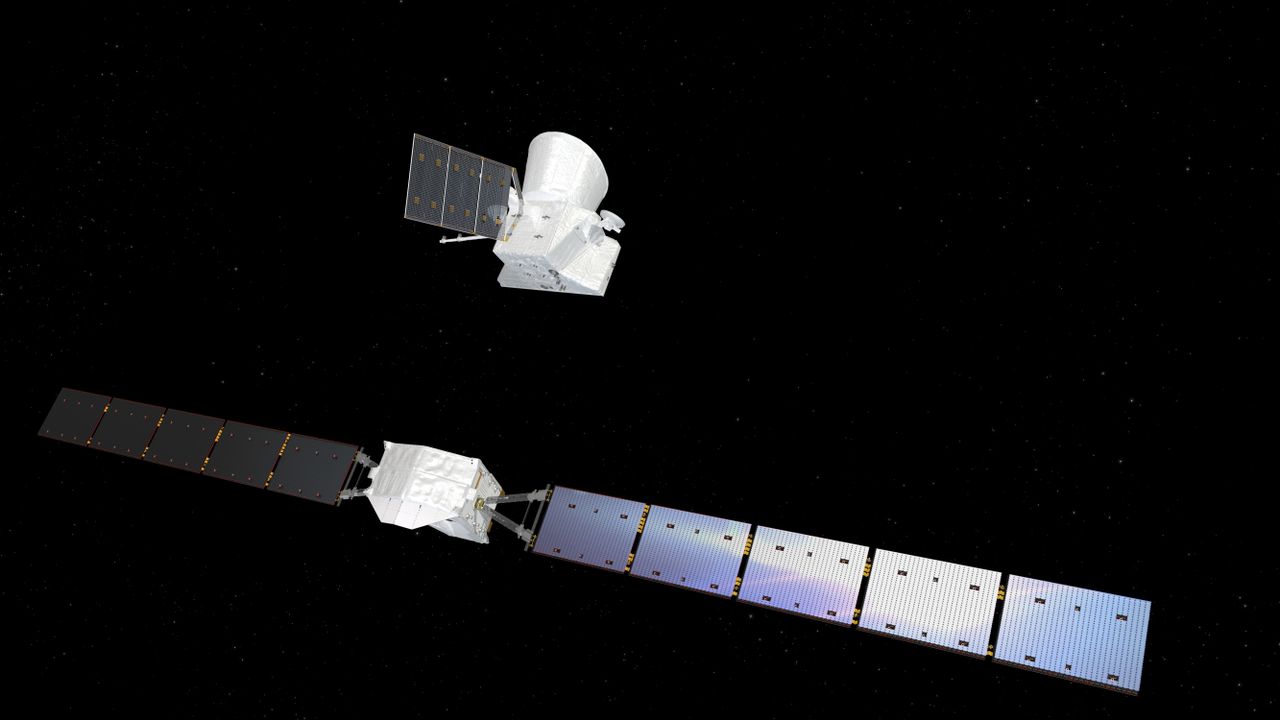
The BepiColombo mission's two science orbiters will separate from their transfer module at around 8 a.m. EDT on Thursday (Sept. 3).
When you purchase through links on our site, we may earn an affiliate commission. Here’s how it works.
The BepiColombo mission is finally getting ready to arrive at its exotic destination.
BepiColombo launched in October 2018 and took a long, looping and highly circuitous route toward Mercury our solar system's innermost planet. That journey is now nearly over, and the mission is gearing up for arrival.
BepiColombo's two science orbiters — one run by the European Space Agency (ESA) and the other by the Japan Aerospace Exploration Agency (JAXA) — will separate from their power and propulsion module on Thursday (Sept. 3) at around 8 a.m. EDT (1200 GMT). You can watch that milestone live here at Space.com, courtesy of ESA, starting at 7:45 a.m. EDT (1145 GMT).
ESA will pause the webcast at 8:30 a.m. EDT (1230 GMT), then resume it an hour later to cover the mission teams' acquisition of signals from the newly free-flying orbiters.
Those communications links are expected to be established no earlier than 9:53 a.m. EDT (1353 GMT), according to ESA officials. The webcast will chronicle that activity, as well as some spacecraft status checks, before ending between 10:15 and 10:45 a.m. EDT (1415 to 1445 GMT).
The separation is just the beginning of BepiColombo's Mercury-arrival phase. For example, the two science orbiters — ESA's Mercury Planetary Orbiter (MPO) and JAXA's Mercury Magnetospheric Orbiter (MMO, or Mio) — won't be captured by the planet's gravity until Nov. 21.
The duo will still be linked up on that date. If all goes according to plan, MPO will release Mio into its final orbit — a highly elliptical one that gets as close as 367 miles (590 kilometers) to Mercury and as far away as 7,233 miles (11,640 km) — on Dec. 9 or Dec. 10, then start moving toward its own designated path a week later.
MPO is scheduled to reach its final orbit — an ellipse with altitude extremes of 298 miles and 932 miles (480 by 1,500 km) on March 10, 2027. The science phase of the BepiColombo mission (which is named after Italian mathematician and engineer Giuseppe "Bepi" Colombo) will begin on April 6.