// SPACE.COM — SPAZIO & SCIENZA
Did NASA just find evidence of ancient life on Mars? Perseverance rover spots complex carbon in Red Planet rocks
"Measurements of two mudstones show hundreds of organic detections, making this the most robust organic detection in Jezero crater."
When you purchase through links on our site, we may earn an affiliate commission. Here’s how it works.
Could Martian mudstones be holding evidence of ancient microbes? New findings strengthen the case that the Red Planet once held life.
New data from NASA's Perseverance rover has revealed complex carbon in two Martian mudstones found in Mars' Jezero crater, the same location where previous evidence of possible ancient life has been found. Scientists think this macromolecular (meaning large) complex carbon, could hold evidence that ancient microbial life once existed in the same sedimentary material, according to one new paper describing these observations. "Measurements of two mudstones show hundreds of organic detections, making this the most robust organic detection in Jezero crater," the paper reads.
This comes soon after the news last year that Perseverance found what has been dubbed the strongest evidence of potential biosignatures, or hints of life, on Mars.
"Carbon is the primary building block for life on Earth, and all living things are made up of complex organic macromolecules," lead author Ashley Murphy, a researcher at the Planetary Science Institute, told Space.com. "On Earth, [macromolecular carbon] is often found in extremely old rocks and in some cases it is the only organic evidence of past microbial life.
"Since early Mars may have been more similar to Earth," Murphy added, "we may anticipate finding [macromolecular carbon] in old Martian rocks too, so we are searching for these organic macromolecules on Mars and other planetary bodies to determine whether the necessary chemical ingredients and environmental conditions to support life have ever existed there."
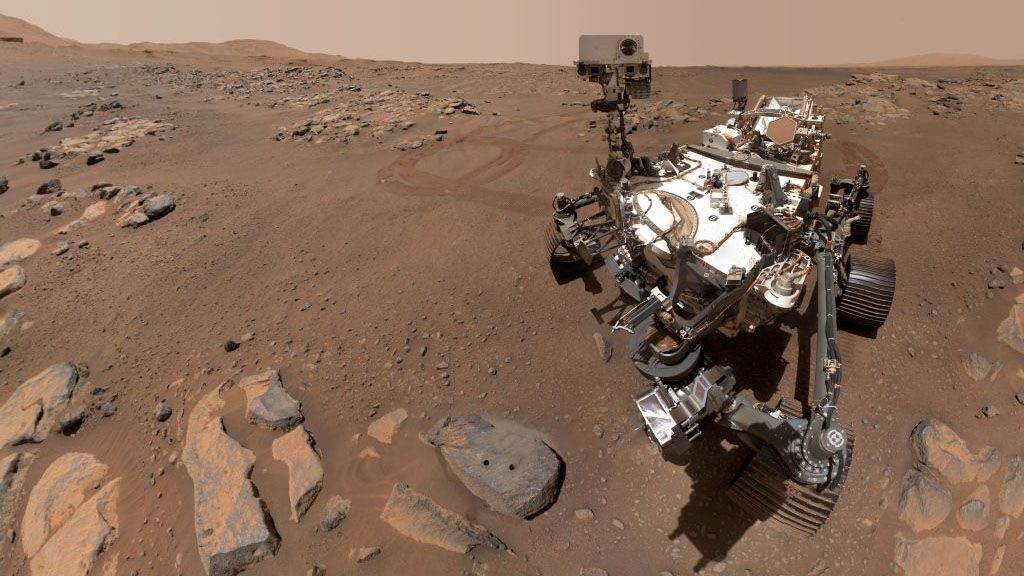
Perseverance landed on Mars in 2021 in Jezero Crater, an expansive crater thought to once be a lake that could have possibly harbored life. This landing site was in fact chosen because scientists thought it could have some of the best evidence for possible ancient life on the planet. And so far, in Perseverance's extensive explorations — which have now officially taken the rover the distance of a marathon on Mars — that prediction seems like it's turning out to be true.
In this new research, a team of scientists led by Murphy used Perseverance's spectrometer SHERLOC (the Scanning Habitable Environments with Raman and Luminescence for Organics and Chemicals), which uses lasers to identify an area or object's chemical and mineral makeup, to map the distribution of organic matter in the individual mudstones. The crew found organic carbon inside two mudstones.
Furthermore, these carbon-filled mudstones were found in the same location as the last year's discovery of a potential biosignature found in a sedimentary rock on the Red Planet, which scientists say is still the strongest evidence that life could have once existed on early Mars. In this discovery, Perseverance found a rock now-named "Cheyava Falls" with distinctive "leopard spots."