// SPACE.COM — SPAZIO & SCIENZA
'A new mission starting today': 8 years after launch, BepiColombo begins Mercury arrival
"Arriving to Mercury is not as simple as other missions."
When you purchase through links on our site, we may earn an affiliate commission. Here’s how it works.
After nearly eight years traveling through the inner solar system, the trailblazing BepiColombo spacecraft has finally begun its arrival at Mercury.
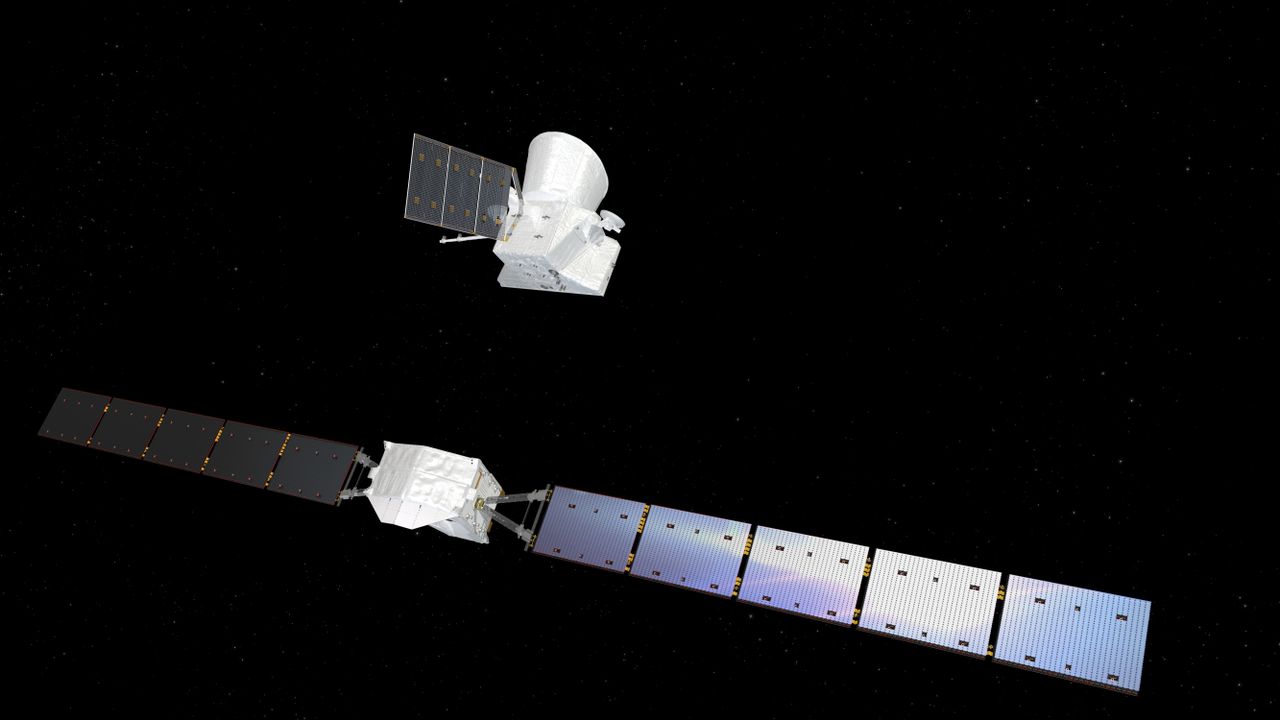
The joint European Space Agency (ESA)-Japanese Aerospace Exploration Agency (JAXA) mission reached a major milestone today (Sep. 3), entering its arrival phase at one of our sun's least-studied planets. BepiColombo's Mercury Transfer Module (MTM), the main power and propulsion system that has ferried a dual stack of planetary probes through space for nearly eight years, released its payload to kick off a sequence of operations that will ultimately place the two spacecraft in Mercury's orbit.
The separation left ESA's Mercury Planetary Orbiter (MPO) and JAXA's Mercury Magnetospheric Orbiter, known as Mio, together for their final approach, which will take about six more months. "It will basically be a new mission starting today," said Bruno Sousa, ESA's head of operations definition and engineering, during today's mission livestream.
BepiColombo launched aboard an Ariane 5 rocket from Europe's Spaceport at the Guiana Space Center in Kourou, French Guiana, on Oct. 19, 2018, beginning a journey that was expected to take about seven years. To assist its plunge sunward, the spacecraft's trajectory has included one flyby of Earth, two of Venus and six of Mercury, as it has shed more and more gravitational energy during to slow its approach to the system's innermost planet.
"It's one of the most complicated missions we have ever flown," Sousa said. The mission was made even more complicated in April 2024, when a solar panel issue reduced the available power for MTM's electric thrusters. Engineers devised a lower-thrust trajectory that saved BepiColombo's mission but delayed its Mercury arrival from December 2025 to November 2026.
Today's maneuver doesn't place BepiColombo in orbit around Mercury quite yet. MPO and Mio will spend the next several weeks navigating toward the planet ahead of orbital insertion on Nov. 21. "Arriving to Mercury is not as simple as other missions that do a big maneuver and they are there," said Elsa Montagnon, BepiColombo's operations manager. "In our case, it's going to be six months of continuous activities."
The Nov. 21 arrival will begin a sequence of 16 maneuvers to progressively lower and reshape BepiColombo's orbit. Mio is scheduled to separate from MPO around Dec. 9 and settle into a highly elliptical polar orbit. MPO will jettison Mio's MOSIF sunshield (Magnetospheric Orbiter Sunshield and Interface Structure) on Dec. 16, then continue lowering its own altitude before reaching its own polar orbit on March 10, 2027.
BepiColombo is scheduled to begin science operations on April 6, 2027, with MPO and Mio studying Mercury simultaneously from complementary orbits. MPO will focus on Mercury's surface composition, geology and planetary interior, while Mio will investigate the planet's magnetic field and its interaction with the solar wind.