// HACKER NEWS — CYBERSECURITY
Doomscrolling Ourselves to Death
I’m not the only parent who feels increasingly anxious about their children’s media diet. For teenage boys in particular, entertainment often comes in the form of YouTube, which for any adult briefly glancing at the screen seems to feature an array of thumbnailed gawping imbeciles, besides an invitation to watch the latest work of creativity: ‘I took a bath full of Diet Coke and Mentos’ or ‘I cemented a microwave to my head’. In comparison to this, the mindless television I watched in the 1990s seems as narratively complex as Dostoevsky.
Most of all, it’s notable that many children aren’t reading anymore, and it’s steadily become a topic of interest among fellow parents, then worry, and now panic. It’s impossible to ignore the fact that something quite bad is happening.
Wrong Side of History is a reader-supported publication. To receive new posts and support my work, consider becoming a free or paid subscriber.
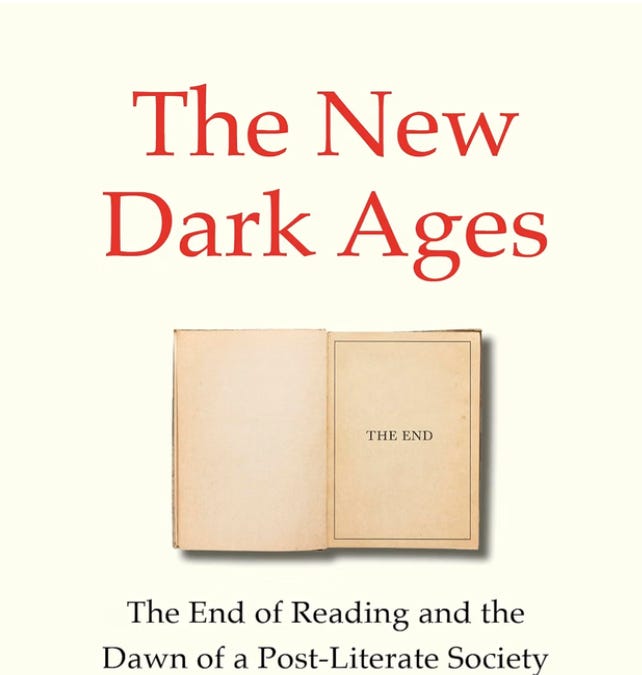
Every catastrophe needs its Jeremiah, and for this we have Times columnist James Marriott, whose increasing anxiety about the decline of literacy was articulated in a hugely popular substack post last year. Having written extensively about how no one reads books anymore, he decided to turn the subject into a book, The New Dark Ages, published this week.
I wouldn’t call the book ‘urgent’ because I usually take that to mean ‘worthy scolding by an ideological ally’; it’s entertaining, informative, often amusing and makes a coherent case in 50,000 or so words, which many of us can still manage. But the implications he lays out are disturbing, and influence everything around us.
James and I have become friends over the past couple of years, drawn together by a mutual sense of despair, and he’s probably the only person in journalism even more pessimistic than I am. If you believe the media to be a circle-jerk of people helping their mates (which it is, obviously), bear that in mind, but reading his prose one gets a sense of how likeable as well as articulate he is, even if born in the wrong decade. His upbringing will seem as alien to those raised in the coming years as the world of Boethius would have been to Alfred the Great.
‘Literature was our religion: the way we explained and interpreted our lives. As a child I quickly learned that every possible event — from a major bereavement to a minor playground contretemps — could be cross-referenced against a novel by Thomas Hardy or a poem by Philip Larkin. There was a quote for everything. I was dragged off to Shakespeare plays at what now strikes me as a rather cruelly young age (“if you’re not enjoying it”, I remember my dad telling me, “you can just read your book instead”). We worshipped pretty much all the canonical English poets but in our pantheon of literary saints, Shakespeare was Jesus or, more probably, God.
‘We celebrated his birthday every year with a homemade cake and in the holidays we were taken on solemn pilgrimages to Stratford-upon-Avon. I recall that I was once presented with a Shakespeare-themed stuffed bear (it was wearing a t-shirt with a quotation from Hamlet).’
Such a veneration for the written word naturally made him sensitive to disturbing stories about declining literacy that began circulating around the turn of the decade. ‘The first rumours that something important was happening reached me via friends working in universities,’ he writes: ‘I came close to going into academia myself (though I don’t think the world is a poorer place for the loss of my proposed PhD on landscape imagery in post-war British poetry).’
Anecdotes were soon backed up by data, showing significant declines in reading comprehension among students, as well as an even sharper drop in the number of adults and children reading for pleasure. The chief suspect seemed obvious: it’s the phones. (Everything’s ‘the phones’). Yet the more Marriott looked into it, the more he came to believe that the real transformation came with television, as Neil Postman had warned in his 1985