// SPACE.COM — SPAZIO & SCIENZA
Earth's moon could have formed in just 5 hours after giant impact
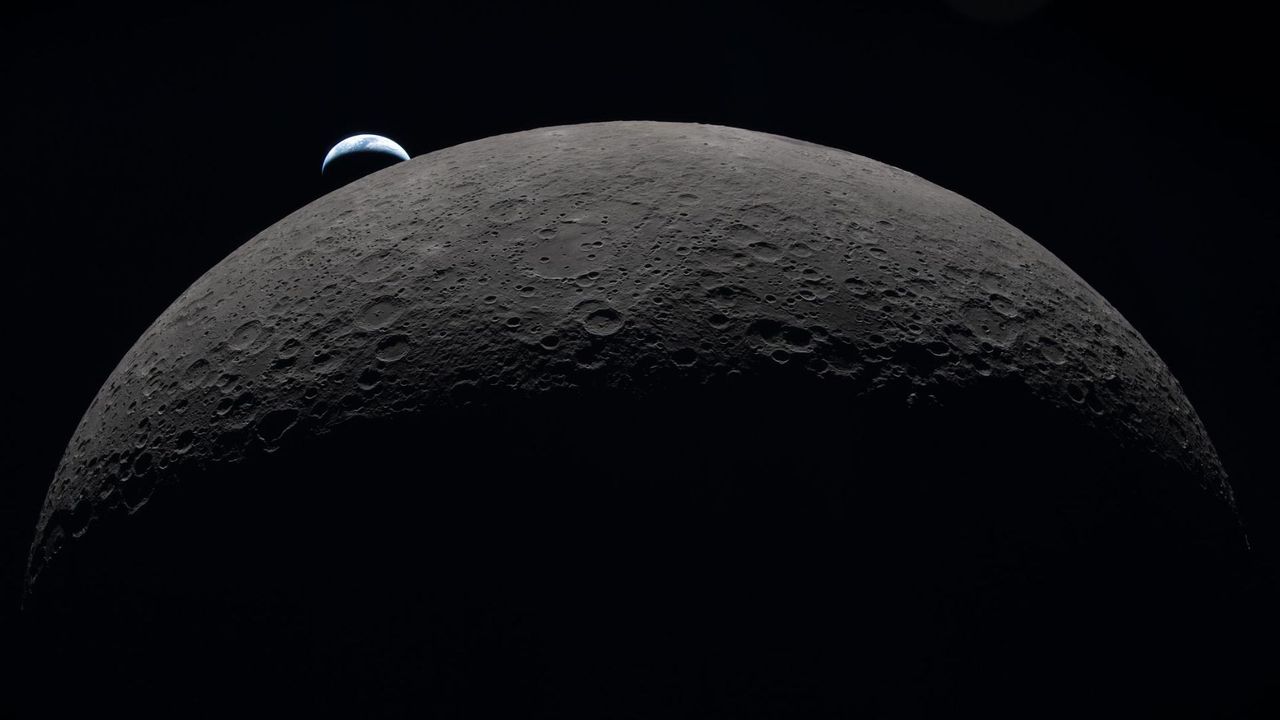
One day in history about 4.5 billion years ago was a dramatic one for Earth, potentially giving our planet an instant moon and an almighty headache all in one go.
When you purchase through links on our site, we may earn an affiliate commission. Here’s how it works.
The moon could have formed in a matter of hours following the giant impact between Earth and a Mars-size protoplanet early in the history of the solar system. The theory comes from new simulations that take into account how the internal temperature of young protoplanets affected their geologic properties and therefore the collisions they experienced.
This giant impact scenario has become the leading theory of how the moon formed, thanks in particular to work done by planetary scientist Robin Canup. Since 2001, she has conducted and refined numerous computer simulations that describe how a Mars-size body called Theia collided at an angle just right to throw debris into orbit around the proto-Earth.
Now other researchers are getting in on the act. Adeene Denton of the South-west Research Institute led a team who performed some of the most detailed simulations of the collision yet, taking into account more of the geologic properties of the colliding worlds.
"Models have evolved to include material strength, something that's really important when you're studying collisions between smaller bodies like asteroids or for my previous paper about the formation of the Pluto–Charon system," said Denton in a statement. "We weren't sure it would matter for the moon or not. When we did the simulations, we found it actually matters quite a bit."
It turns out that warmer bodies are weaker than colder ones. After the planets formed, they were still hot inside from their formation, which would have affected their material strength. Given that the moon-forming impact occurred not long after the solar system's formation, this would have affected the collision with Theia — but to what degree depends on exactly when the collision occurred and how much Theia had cooled.
As Theia smashed into Earth, it was utterly destroyed. While much of what was left of Theia's shattered iron core sank into the Earth, a large ring of debris wrapped around Earth to form the moon.
The main effect of the temperature being warmer in the outer few hundred miles of Theia was that it would have affected its ability to deform upon impact and absorb the momentum of the collision. This, in turn, would have affected how debris was strewn around Earth to form the moon. Therefore, by including varying temperatures and material strengths in the simulations, Denton's team was able to get a better look at how the collision and the resulting formation of our moon played out.
Previous simulations have shown two possible scenarios. One is that the ring of debris hung around for a substantial amount of time, allowing the moon to accrete from it gradually. The other scenario, first depicted in NASA-led simulations in 2022, implies that the moon came together from this debris in a matter of hours.