// NATURE NEWS — SPAZIO & SCIENZA
Denisovans from southwestern China and their subsistence strategies
Nature
(2026) Cite this article
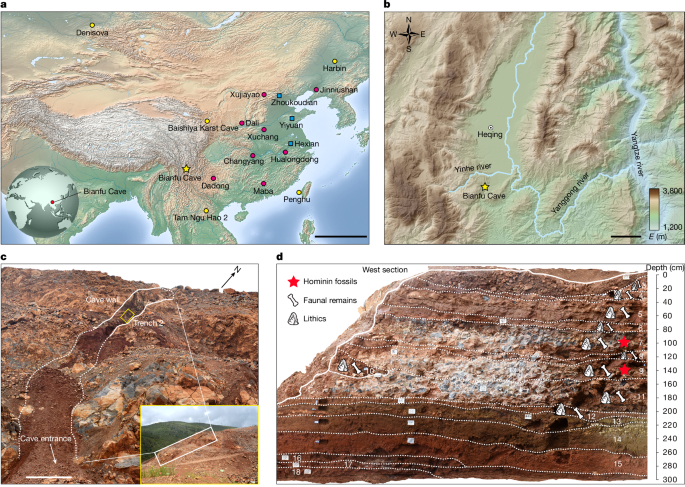
Growing fossil and genomic evidence has substantially advanced our understanding of Denisovans’ evolutionary history1,2,3,4,5,6,7,8,9, yet their technological behaviours and subsistence strategies remain poorly documented. Here we present a comprehensive analysis of hominin fossils and associated archaeological remains from Bianfu Cave, Yunnan Province, southwestern China. The hominin fossils are dated to about 167–134 thousand years ago (ka), whereas the cultural sequence spanned from about 190 ka to 70 ka, representing one of the longest cultural records most parsimoniously attributed to Denisovans—identified through enamel–dentine junction morphology and palaeoproteomic analyses10. The new fossils include four teeth that expand the known dental variation of this group, two cranial fragments and a radius. Faunal and pollen records indicate a conifer-dominated forest or forest-steppe environment across Marine Isotope Stages 6 to 4. The inhabitants of Bianfu Cave practised specialized hunting of medium- to large-bodied prey and used a technological strategy characterized by expedient core reduction and tool production, alongside pervasive use of unmodified bones. This pattern suggests an adaptive system prioritizing the exploitation of object affordance over intensive tool manufacture. Bianfu Cave provides unprecedented insights into Denisovan biology, behaviour and ecology in eastern Asia and points to a substantial genetic and cultural legacy in later populations in Southeast Asia and Oceania.
This is a preview of subscription content, access via your institution
Access Nature and 54 other Nature Portfolio journals
Get Nature+, our best-value online-access subscription
Prices may be subject to local taxes which are calculated during checkout
The raw data used for analysis are available in the Supplementary Information and can be accessed online at OSF (https://doi.org/10.17605/OSF.IO/PFWNR). All archaeological materials studied in this paper are stored in the Yunnan Provincial Institute of Cultural Relics and Archaeology, China. Access to the materials can be arranged by contacting our first author Q.J.R.
Sample code to analyse the available data to reproduce part of the above results is available at OSF (https://doi.org/10.17605/OSF.IO/PFWNR) under an open licence.
Krause, J. et al. The complete mitochondrial DNA genome of an unknown hominin from southern Siberia. Nature 464, 894–897 (2010).
Article
ADS
CAS
PubMed
PubMed Central
Google Scholar