// HACKER NEWS — CYBERSECURITY
Liesegang Rings
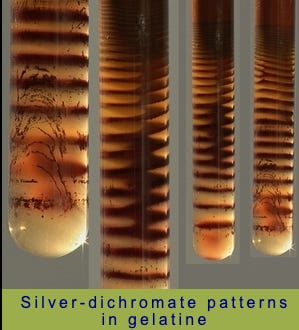
Last time I write about trying to find phenomena where the physics might stay the same as you shrink down the dimensions. Another one of the themes of the independent science society is to figure out how to create complex phenomena worth experimenting with on tabletop.
Previously I demonstrated Rayleigh Bernard convection cells with Mica powder and oil, where I saw cell-like devisions in liquid when I applied a temperature gradient. This was an example of non-equilibrium , self organising phenomena due to the application of a temperature gradient. I've preciously tried and failed to do other things like the Briggs Rauscher reaction, which is a (safer) example of an oscillating chemical reaction.
With regards to complex phenomena, I am trying to figure out which variables actually matter through both math and physical experiments, which is hard. In the case of convection cells, we have variables like the thickness of the liquid layer, the temperature gradient, the size of the container, amongst other things. And these ideas are something I want to get around to understanding myself in this lab.
Another piece of complex phenomena that caught my eye is Liesegang rings. These are rings that form in a gel according to a spacing that goes like (1 + p)^n, which is a geometric series. You can get them through a bunch of different waysHere is what they look like, images taken from this really cool website on Liesegang ring models.
You can see quite clearly the spacing going in a geometric pattern in this one with magnesium hydroxide.
Why do I find this interesting? When reading books about embryology, like the Triumph of The Embryo, I got interested in how chemical reactions give rise to patterning in some animals. I also find that the theory of patterning in chemical reactions is mathematically rich as well, something which I'm trying to understand more through the lens on non-equilibrium statistical mechanics. The aesthetics of these things are just mesmerising. Even though liesegang rings aren't the mechanism behind animal patterning, you still can't help but marvel at what goes on behind the scenes.
Here's a page out of 'A Field Guide To the Birds of Malaysia'.
And to the best of my knowledge, the mechanisms behind Liesegang rings haven't really been fully resolved yet. Which puts this in prime territory to try and replicate some of this stuff at home.
I had a think about trying to replicate Liesegang rings using Potassium dichromate and silver nitrate, which seems to yield the brightest rings. But when I was shopping for potassium dichromate on sigma aldrich and then realised that it was carcinogenic, with inhalation risk. So not really that appropriate for homelab style stuff...
And then the other example on the Liesegang website was using a gel soak of magnesium hydrochloride with ammonia, but I also found the ammonia quite sketchy since the concentrations looked high.