// NATURE NEWS — SPAZIO & SCIENZA
OpenAI maths bombshell sparks debate about who gets credit in age of AI
Search author on:
PubMed
Google Scholar
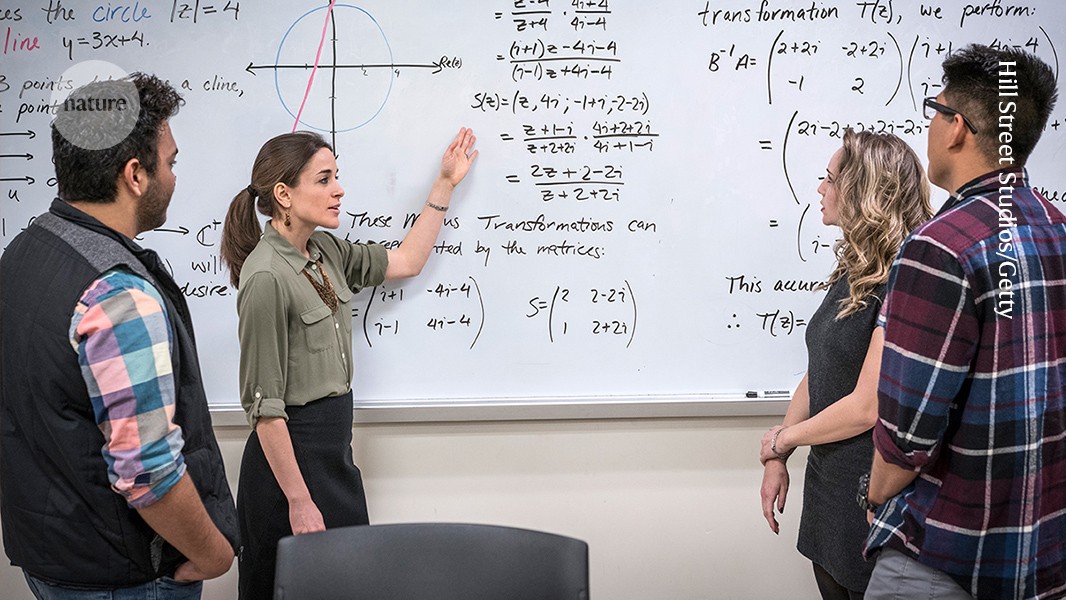
Mathematicians give credit for insights gleaned through discussion but AI tools are not set up to do this. Credit: Hill Street Studios/Getty
OpenAI’s announcement that it used an artificial-intelligence model to solve a major puzzle in fluid dynamics — the Navier–Stokes problem — is likely to change how mathematics is done forever. The claim, made by the AI company in San Francisco, California, on 8 September, has also sparked controversy about whether OpenAI tools have learnt information from human mathematicians who were also racing to solve the problem using AI tools.
The widespread use of AI models across most fields of research, and the difficulty of tracing the origin of the information used to train models, could put the very notion of scholarly credit into jeopardy, researchers warn.
“It is quite possible that academic researchers have not fully grasped the consequences of uploading data and knowledge to a personal AI model account,” says Luke McDonagh, who studies intellectual property law at the London School of Economics and Political Science.
In an open letter decrying AI companies’ entry into solving mathematical problems, 25 winners of the Fields Medal — which is often considered mathematics’ equivalent to the Nobel Prize — write that AI tools muddy the ability to give appropriate credit: “As in all creative professions, this raises severe attribution and plagiarism questions.”
The day before OpenAI confirmed rumours that it had solved the Navier–Stokes problem — one of the highest-profile questions in mathematics — one researcher was already raising the alarm. Tristan Buckmaster, a mathematician at New York University in New York City and his collaborator Levent Alpöge, a mathematician at Harvard University in Cambridge, Massachusetts, had been working on an aspect of the Navier–Stokes problem using tools from OpenAI as well as Anthropic. They were told that OpenAI was preparing to announce that it had solved the problem. Buckmaster wrote on social media that the company had jumped on the problem after hearing about the work by him and Alpöge, and that OpenAI's model could have been learning from their interactions with ChatGPT.
An OpenAI spokesperson told Nature: "After investigating, we can say with full confidence that no user inputs past July 3rd could have influenced this system in any way." The company said that it started working on the problem on 1 September and that it had not seen "any of their work through any means until they released it publicly”.
Buckmaster says he had used OpenAI tools to work on the problem for a year. He told Nature that he had three separate accounts on OpenAI's ChatGPT, and that only on two had he he opted out of the setting that gives permission to the company to use chatbot conversations in the training of its models.
Assuming that the OpenAI solution is independently confirmed, it remains to be seen how the maths community will choose to apportion credit — and who deserves the US$1-million award offered by the Clay Mathematics Institute for completing one of seven Millennium Prize Problems that it selected at the turn of the century.