// NATURE NEWS — SPAZIO & SCIENZA
Europe pushes for space independence amid geopolitical rifts
Search author on:
PubMed
Google Scholar
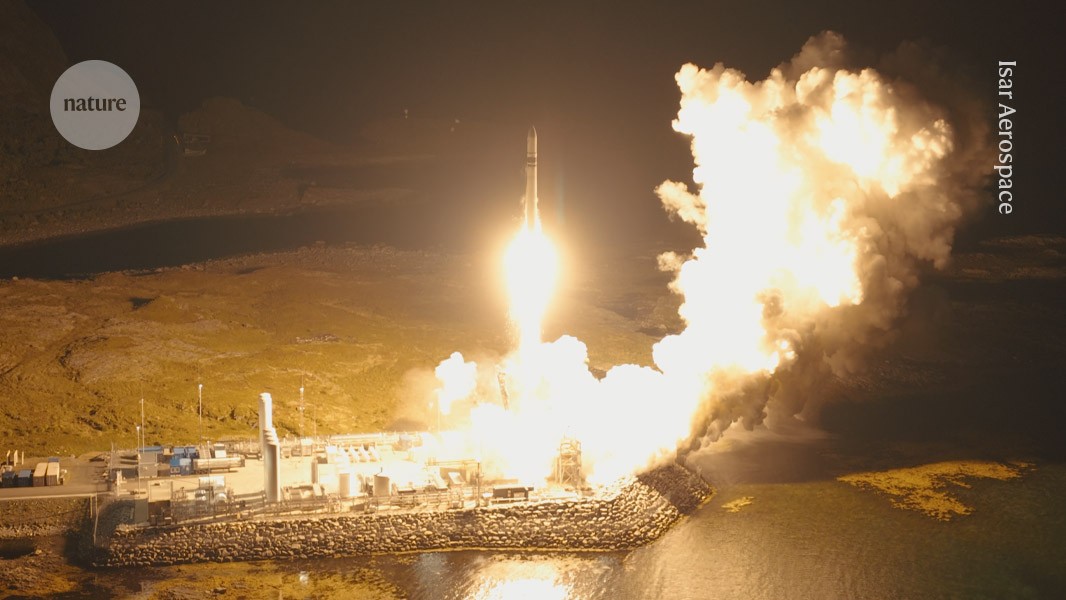
The uncrewed Spectrum launch vehicle is the first commercial rocket to be sent into orbit from continental Europe.Credit: Isar Aerospace
Momentum is growing for Europe to develop its own sovereign space capabilities, including satellite launches and human spaceflight, and reduce its dependence on the United States as divisions grow across the Atlantic.
“Our security on Earth increasingly depends on our security in space,” European Commission president Ursula von der Leyen said at the inaugural International Space Summit in Paris, France on 10 September. “Europe must act together, invest at scale, and turn our market into a competitive advantage.”
Europe currently relies on NASA and companies such as SpaceX in Brownsville, Texas, to launch some of its astronauts and satellites to space. SpaceX’s Starlink network of broadband satellites in low-Earth orbit is now the leading provider of Internet from space around the world. And commercial European space activity has lagged behind that of the United States. Of the global US$13.5 billion invested in space companies last year, only 12% went to European companies, compared with 68% for US organizations.
But change is in the air. The European Space Agency (ESA), the European Union, national governments and private companies are gearing up to give Europe greater autonomy in space than it has had previously.
The latest developments come after the White House was reported to have discouraged US space companies such as SpaceX and Blue Origin from attending the Paris summit, according to reporting from Politico and others. During the meeting, president of France Emmanuel Macron spoke of his desire for Europe to develop the ability to achieve human spaceflight independently. “Europe must fly with its own crews,” he said.
Eva Berneke, previously the chief executive of the French satellite company Eutelsat, told Nature that the last-minute cancellation by “the big Americans” was a “wake-up call” for Europe to push for greater sovereignty. “Europe needs to step up,” she says, after previous tensions with the US had raised alarms.
US agencies have also eased on some collaborations. For example, last week, NASA said that it would no longer supply an instrument for a European Space Agency mission to Venus called Envision, set to launch in 2031.
One of the key areas that Europe needs to strengthen to become more independent is its launch capabilities. The Ariane and Vega series of rockets, which take off from a spaceport in French Guiana, South America, are European but the region lacks a well-developed private rocket industry similar to those in the United States and, in the past few years, China.