// NATURE NEWS — SPAZIO & SCIENZA
Daily briefing: How to turn a paper into an AI agent
Search author on:
PubMed
Google Scholar
Hello Nature readers, would you like to get this Briefing in your inbox free every day? Sign up here.
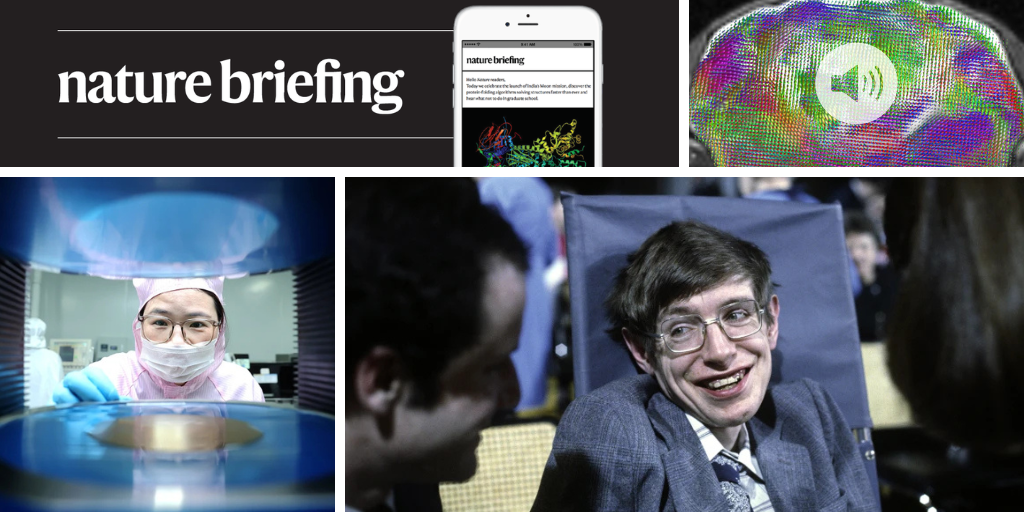
Stephen Hawking worked on the black-hole information paradox throughout his life.Credit: Santi Visalli/Getty
An RNA therapy for rare forms of amyotrophic lateral sclerosis (ALS) has shown promising results in the first person to receive it. He experienced improved symptoms and continued to work as a physician a year after starting treatment. Antisense oligonucleotide therapy uses short strands of genetic material to target RNA produced by a faulty gene called CHCHD10. Roughly 5–10% of people with ALS have a known genetic mutation, and antisense oligonucleotide therapies could someday benefit them and others with neurodegenerative diseases caused by rare mutations.
Chinese firms subject to sanctions by the US government seemed to produce more science-related patents and publish more papers than did unsanctioned companies. It’s not certain that being placed on the US ‘Entity List’ actually caused an increase in innovation, but the findings might be a sign of unintended consequences of such restrictions. “Whether or not one supports technology controls, it is important to recognize that they can come with costs,” says political economist Dinsha Mistree.
A new tool (freely available to use) has been designed to help researchers interact with published papers. The Paper2Agent tool accesses a paper’s text, code, data and more to generate a specialized agent, and interfaces with a large language model (LLM) to answer a reader’s questions. When tested on the AlphaGenome paper, the authors report that the tool created an agent in 45 minutes (using US$14 of computing power) that bested other top biomedical agents in question-answering accuracy. In another test, the tool failed to create an agent in 25% of cases — usually because a paper was accidentally missing code or had some other flaw.
How can AI systems help us understand longevity, when we are only starting to define what ‘ageing’ actually is? That’s the challenge taken on by a team of researchers who designed a series of benchmarks to measure how well large language models (LLMs) handle related biological markers such as DNA methylation. They also created an LLM specifically tailored for ageing researchers.
An artificial-intelligence system called the Virtual Biotech comprises as many as 37,000 agents — AI systems that autonomously interact with LLMs or with each other and are capable of performing multistep tasks. Its makers say it uncovered a molecular signal that could help to predict clinical-trial success. And with some human oversight, it identified a promising lung-cancer treatment. Other scientists note that the Virtual Biotech has not been vetted in the crucible of real-world drug discovery, and its predictions were not validated through experiments, let alone clinical trials.
Chavín de Huántar, a 3,000-year-old temple complex high in the Peruvian Andes, has long been thought to be a centre for rituals amplified by the use of psychoactive drugs. Now advances that make it possible to detect the faintest traces of chemical and biological substances — and a research environment that is increasingly open to the topic of hallucinogens and other drugs — are adding to the evidence of what happened there.
The latest short story for Nature’s Futures series asks: as nature declines, how can we grieve for a world we have never known? It is environmental researcher Hannah Cocks’s first published creative writing piece. “I hope the first of many,” she writes. “I would like to write to remind us that we are part of nature and always have been.”