// NATURE NEWS — SPAZIO & SCIENZA
A widespread agricultural practice is an unexpected CO2 sink
G. Philip Robertson is in the W.K. Kellogg Biological Station, Michigan State University, Hickory Corners, Michigan 49060, USA, and the Department of Plant, Soil, and Microbial Sciences, Michigan State University, East Lansing, Michigan, USA.
Search author on:
PubMed
Google Scholar
Stephen K. Hamilton is in the W.K. Kellogg Biological Station, Michigan State University, Hickory Corners, Michigan 49060, USA, and Department of Integrative Biology, Michigan State University, East Lansing, Michigan, USA.
Search author on:
PubMed
Google Scholar
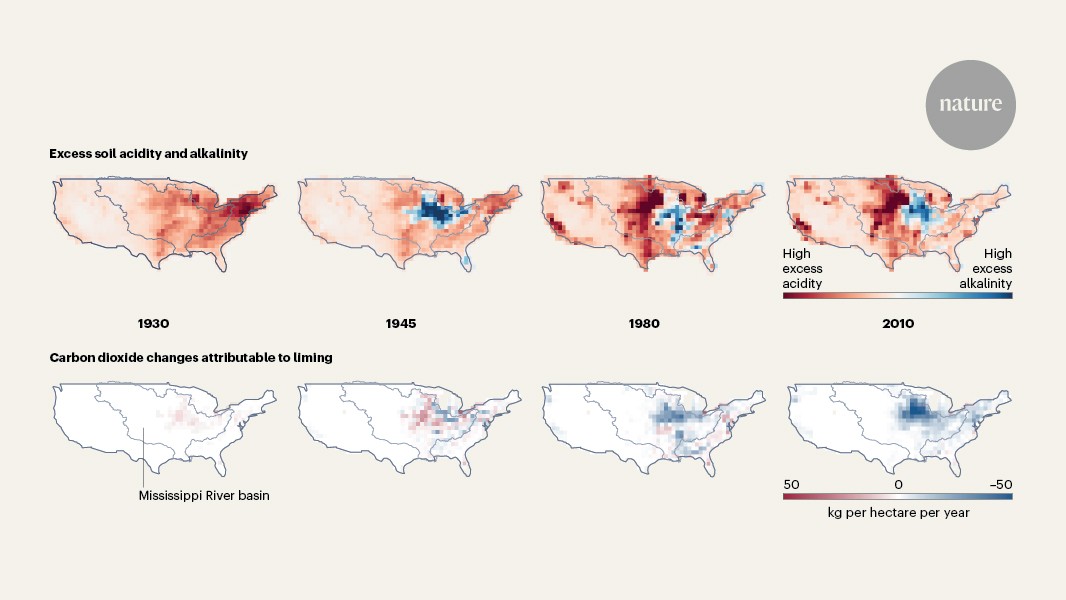
Every year, more than 30 million tonnes of agricultural lime, comprising mainly calcium and magnesium carbonates, are applied to US croplands to maintain optimal soil acidity (pH) for plant growth. The United Nations Intergovernmental Panel on Climate Change (IPCC) considers this process, known as liming, to be a source of greenhouse-gas emissions because the chemical reaction through which lime, which is a source of alkalinity, neutralizes strong acids in soil also generates carbon dioxide1. However, writing in Nature, Suhrhoff et al.2 provide a comprehensive analysis of water chemistry in the Mississippi River basin and show that, overall, lime has been a substantial sink, not a source, of atmospheric CO2. This finding makes agricultural liming, in effect, a strategy for CO2 reduction.
Access Nature and 54 other Nature Portfolio journals
Get Nature+, our best-value online-access subscription
Prices may be subject to local taxes which are calculated during checkout
Intergovernmental Panel on Climate Change. 2006 IPCC Guidelines for National Greenhouse Gas Inventories (United Nations, 2006).
Suhrhoff, T. J. et al. Nature https://doi.org/10.1038/s41586-026-11040-2 (2026).