// SPACE.COM — SPAZIO & SCIENZA
Mars may have once been filled with seas of magma that made the Red Planet habitable
"If Mars could develop this kind of complex crust without plate tectonics, then maybe the conditions needed for habitability can emerge on more planets than we realized."
When you purchase through links on our site, we may earn an affiliate commission. Here’s how it works.
Deep oceans of magma once sloshed about inside the crust of Mars, seismic measurements taken by NASA's InSight mission suggest.
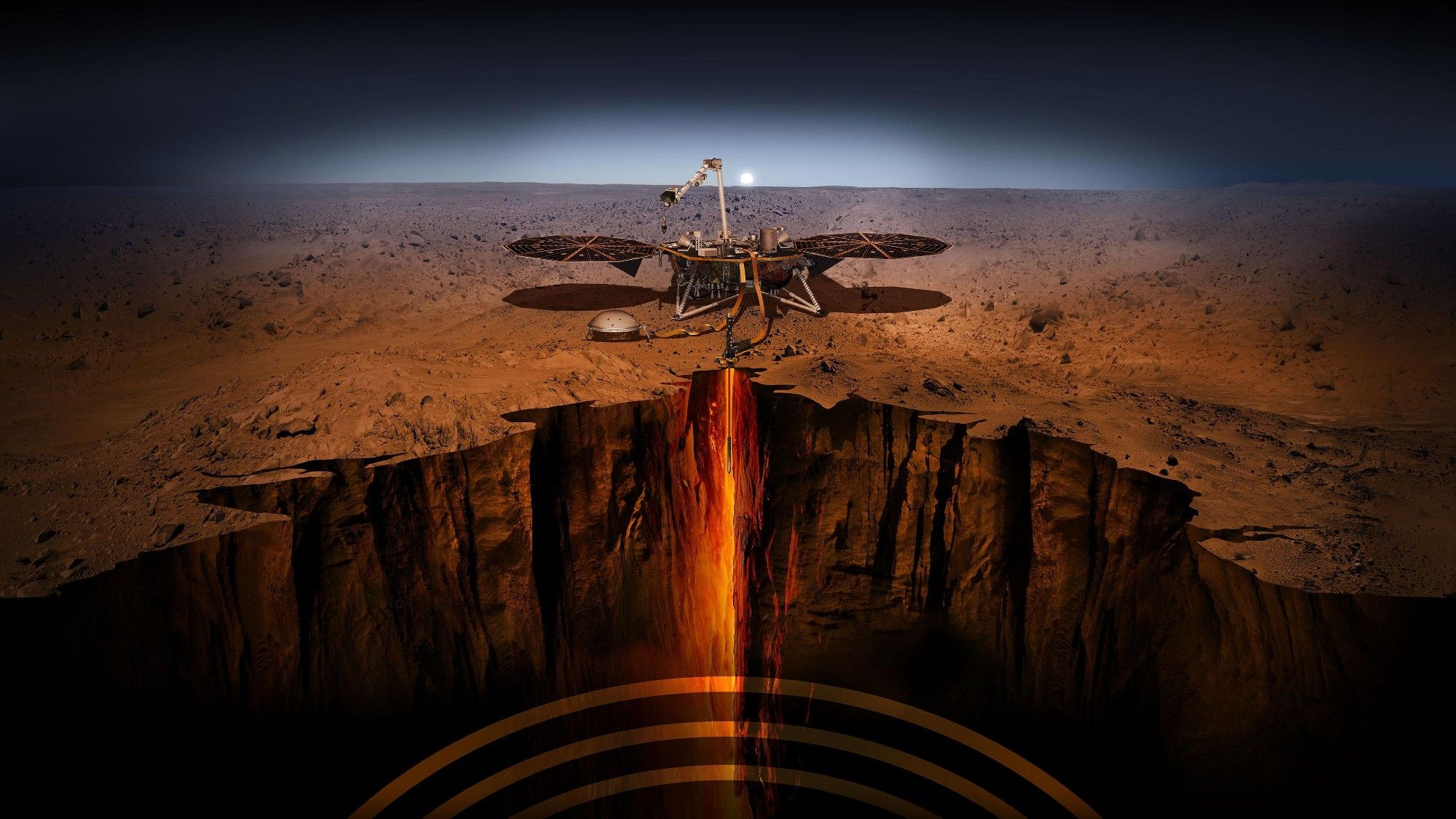
The marsquakes detected by InSight show a boundary 15 miles (24 kilometers) deep between two different types of rock that were formed by enormous pools of magma. The presence of these magma pools could completely change what we thought we knew about the early development of Mars.
Already, scientists say the discovery could change what we know about the history of Mars. "One of the big questions in planetary science is whether Earth is unique," said the University of Oxford's Jon Wade in a statement. "If Mars could develop this kind of complex crust without plate tectonics, then maybe the conditions needed for habitability can emerge on more planets than we realized, including those previously dismissed based on size or their apparent lack of tectonic activity."
Earth is shaped by plate tectonics, the shifting of giant slabs of the planet's crust above our planet's molten mantle in a motion that generates earthquakes and volcanoes, but which also creates new land and regulates atmospheric carbon by drawing it out of the atmosphere and re-releasing it though volcanic eruptions. This constant reprocessing results in a fairly complex crust with multiple layers.
However, no convincing evidence has been found that the Red Planet has ever had plate tectonics. Instead, it is what we call a 'stagnant lid' planet, where the entire crust is one unbroken layer. Beneath this solid lid, all the way down to the mantle 23.6 miles (38 km) below the Martian surface, was considered to be fairly homogenous.
But NASA's InSight (Interior Exploration using Seismic Investigations, Geodesy and Heat Transport) mission, which operated on Mars's surface between 2018 and 2022, put this to the test. InSight's seismometer was designed to detect tremors from marsquakes triggered by meteorite impacts or shifts in the planet's interior. These seismic tremors would reverberate through Mars, and InSight could learn about the interior structure of the Red Planet based on how they reached the lander.
Thanks to the way these tremors passed through Mars's interior after traveling at different velocities through different kinds of rock, InSight discovered a boundary between two layers of crust, but its existence has not been explained until now.
Researchers at the University of Oxford tasked themselves with figuring it out. Using geothermal models and statistics, the Oxford team identified the two types of rock that best matched the seismic data. They conclude that above 15 miles (24 km) deep is a thick layer of mafic rock, which is rich in iron, magnesium and silica. Below this depth is denser, crystalline ultramafic rock, which contains iron and magnesium but is depleted in silica and which descends a further 8.7 miles (14 kilometers) to the boundary between the crust and the mantle.