// HACKER NEWS — CYBERSECURITY
A New Experiment Meta-Strategy
The messiness of my lab got so painful that I couldn’t do experiments easily. I would be demoralised by the effort of searching for things, or clearing up my desk every time. This made me less likely to do experiments after a tiring day at work. But given my schedule, not being able to do experiment on any free evening is extremely costly to me, since free evenings are scarce. And so maximising the probability of being able to do experiments in the free time I have is important. After all, I am still doing science outside my day job.
So, I spent a few hours reorganising things into different shelves to do with their purpose, like temperature, probes, and glassware. And then I spent a bunch of money on IKEA furniture. And then I spent like 4 hours building the shelves and desks, with my lower back hurting from bending over and screwing things.
But in the process of cleaning up my lab, I kept a list of every component or piece of equipment that I had. I was hoping to eventually be able to give this list to Claude so that I could find stuff easily later, given how much time I’ve wasted losing stuff and then trying to find it again. I wrote a notes of everything I had. Stuff like the things I use to measure temperature, my probes, David Jordan’s bioreactor, and other stuff like
temperature, CO2, and particle concentration monitor for biosecurity experiments
I also wrote all of the chemical samples that I had, down to the different types of geological samples that I own.
Most of the time, I buy things to replicate a certain experiment online. But I wondered what would happen if I tried to flip this on its head and tried to come up with stuff based on what I had already. Would this allow me to do interesting science more cheaply? If I did things this way, I wouldn’t need to buy things in the first place!
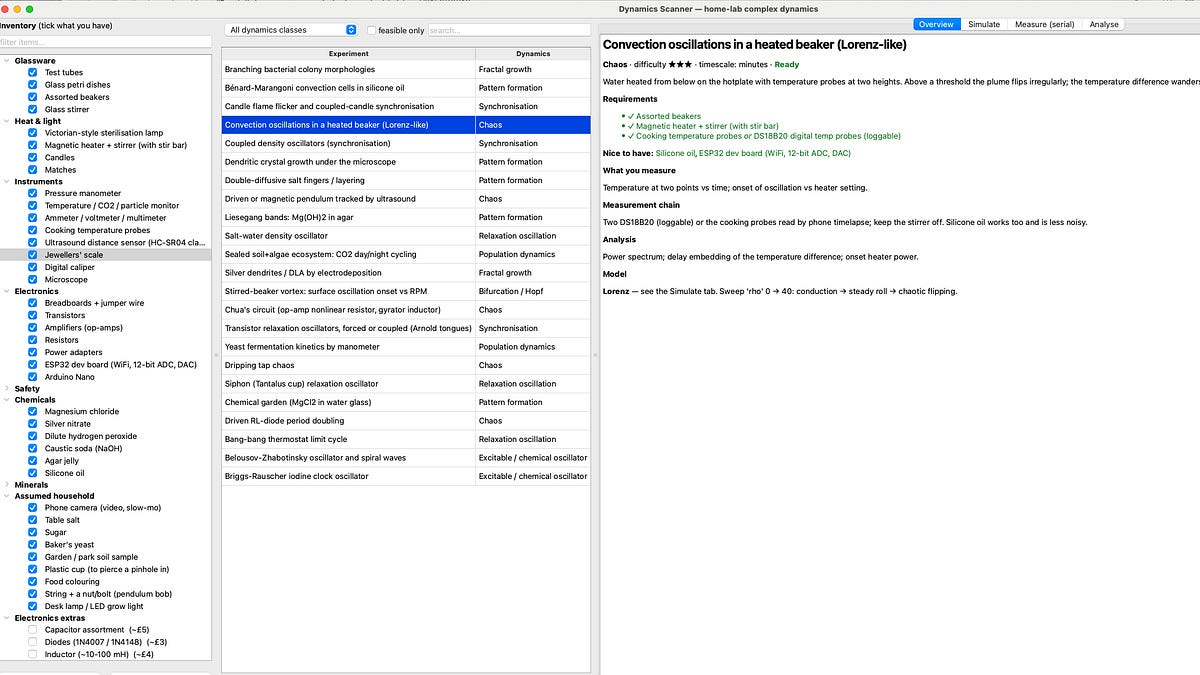
So just to see what would happen, I gave Claude this list of equipment. I then asked it to make a QtPy app of the state space of possible experiments that I could do with my equipment. I told it that the experiments should try to probe at complex phenomena that feels unexplored in literature, and could potentially be recreated in a home setting. In other words, I wanted the experiments to be amenable to independent scientists, and have the quality of ‘table-toppiness’ that I wrote here. The stuff right now I’m looking at is noisy phenomena, quantifying theory in biology, and organised structures like Rayleigh-Bernard convection cells.
I also got it to tell me what kind of dynamics each experiment would try to explore, and it also ranked each experiment by difficulty and time it took to set up. I also gave it the link to my blog, so that it As you can see, the left column is the list of stuff that I have. The middle column is the list of suggested experiments, and when you click on one you get a protocol to try and test out.
I think this is super cool, it also just makes organising my experiment ideas much easier, and I can update the equipment list as I buy more stuff. I’m keen to integrate this tool with learning tools, so I can get a better handle of the theory behind each dynamical system I am exploring. I also wanted to get better integration with literature review so that I could spot which phenomena feels really unexplored.
In the ideal case, this tool solves some optimisation problem where we maximise for novelty, diverge from current literature, but minimise cost and complexity of setup. There should also be a metric for the likelihood that a given experiment might agree or disagree with other experiments out there in current literature. And then maybe the user should also be able to subjective rank each experiment for interestingness. At the Independent Science Society we’ve been thinking a lot about how to optimise experiment quality with low resources, whilst still being curiosity driven, so I enjoy thinking about this problem a lot.