// NATURE NEWS — SPAZIO & SCIENZA
Bigger than CRISPR? A guide to the latest genome editors
Heidi Ledford reports for Nature from Seattle, Washington.
Search author on:
PubMed
Google Scholar
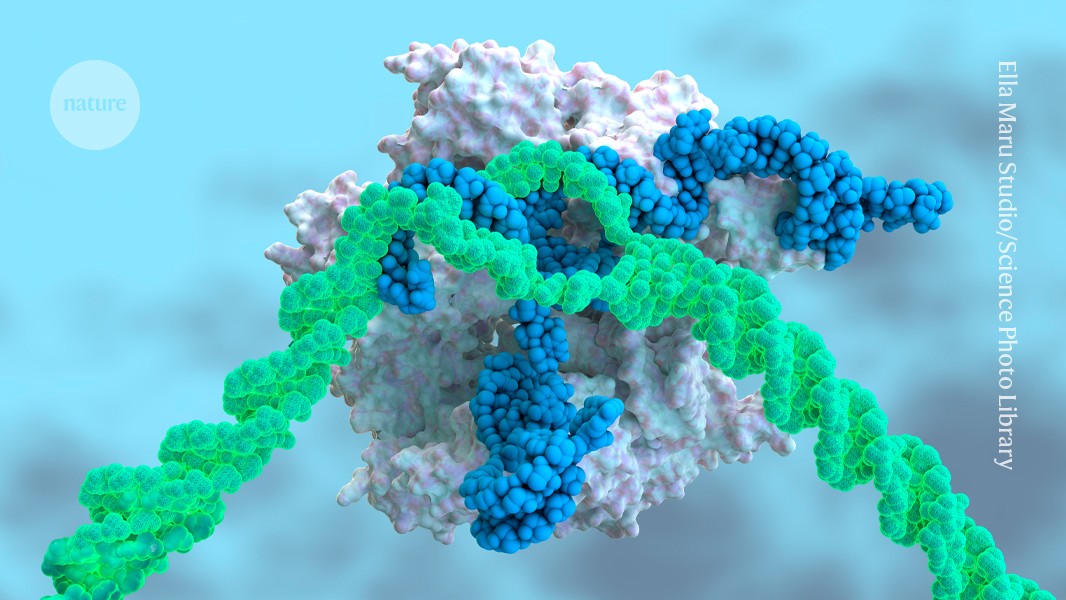
The Cas9 protein (white) uses a guide RNA (blue) to make precise cuts in DNA (green). Credit: Ella Maru Studio/Science Photo Library
A decade ago, Ying Zhang found herself on the cusp of a medical revolution.
CRISPR crops are coming to Europe — why bolder would be better
Zhang was one of the first scientists to be hired by CRISPR Therapeutics in Zug, Switzerland. The biotechnology firm was formed in 2013 to treat disease using CRISPR–Cas9 gene editing. The technique had only recently been published, and Zhang and her colleagues were dreaming up ways to put the innovative tool to use.
But she soon grew frustrated. Many of her plans would require replacing an entire faulty gene with a healthy copy — and that, she quickly learnt, can be a challenge with CRISPR–Cas9. “When we first got there, we were full of excitement,” Zhang says. “And when we actually did all the work, we found it’s more complicated than we thought.”
Today, it’s easier. Now at Wuhan University in China, Zhang and others in her field are developing a fast-growing toolkit for rewriting genomes, whether for therapeutics or basic research. Some methods build on CRISPR–Cas9; others have broken free of it entirely. “It’s been an insane explosion of new technologies,” says Shannon Miller, a bioengineer at Scripps Research in La Jolla, California.
It is still early days for these techniques, and each has its pros and cons. None has demonstrated the simplicity and versatility that CRISPR–Cas9 brought to more-modest DNA-editing tasks. Which method to choose depends on the size of DNA that needs to be inserted, where in the genome it needs to go and which cell type is being modified (see ‘A short guide to big gene editing’). “There are so many different flavours,” says Amy Pooler, head of neurotherapeutics at Regeneron in Tarrytown, New York. “It’s not going to be a one-size-fits-all approach.”
Convenient and versatile, CRISPR–Cas9 gene-editing technologies truly shine when they are used to make small changes in the DNA sequence to abolish a gene’s function. A related and more precise technique, called base editing, harnesses the CRISPR machinery to change individual DNA ‘letters’.