// ARS TECHNICA — MOBILE & WEB
F1 in Azerbaijan: That was almost a close-run thing
Kimi Antonelli could not repeat his Monza magic after a crash in qualifying.
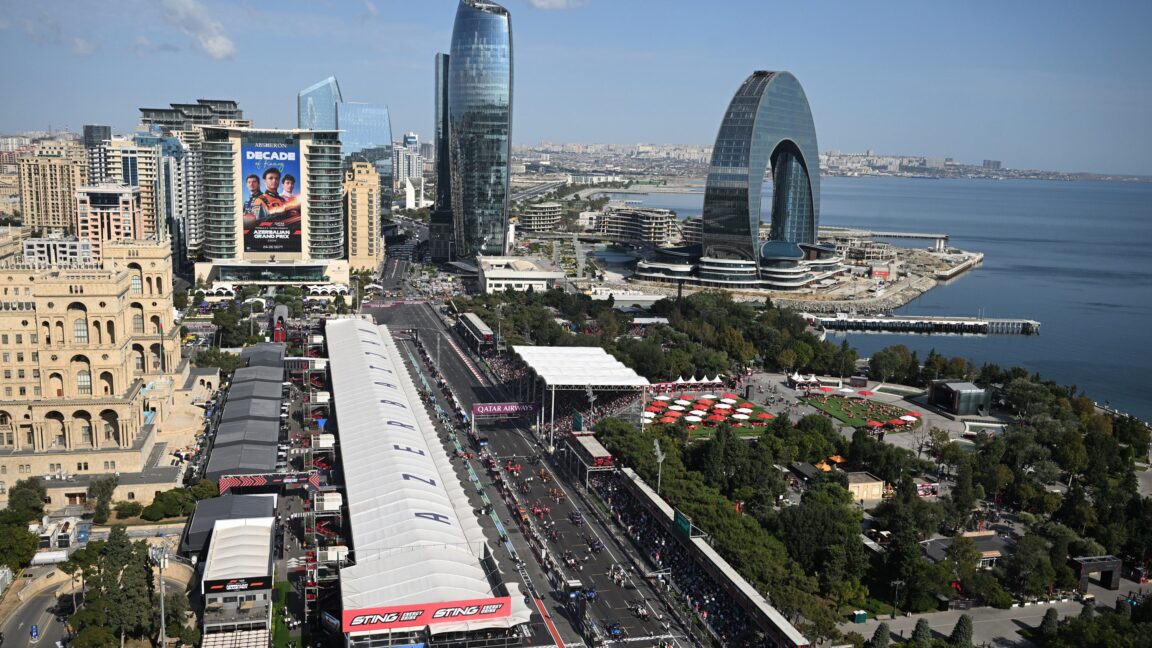
Formula 1 raced on the streets of Baku, Azerbaijan, this past weekend. Although the race predates Liberty’s acquisition of the sport by a few months, it’s a rather good microcosm of the sport as it exists today. The track is a real challenge; it takes place on dusty city streets lined with concrete walls and through a medieval fortress gate, followed by a 1.4-mile (2.2 km) flat-out blast to the finish line, with gusts of wind from the Caspian Sea a block away. It’s interesting to look at Baku’s mix of modern and classical architecture sharing the stage with a massive hospitality and pit lane complex. And since it wouldn’t be F1 without some controversy, this year the race was held a day earlier than normal after F1 switched up its schedule to avoid clashing with Azerbaijan’s celebration of its recent war with Armenia—it’s almost as if Bernie Ecclestone had never left.
The proximity of the walls leaves very little margin for error at the speeds F1 cars go around Baku. Last year, qualifying was interrupted by no less than six red flags after crashes. This year was much less dramatic, unless you were championship leader Kimi Antonelli. The 20-year-old sophomore misjudged how much front grip he had going into turn 1, found more than expected, and clipped the corner of the wall with his left front tire. It happened in the first of the three knockout qualifying sessions, and while Antonelli had already banked a time good enough to proceed to the next session, the damage to his car meant he would take no further part and start the race from 16th.
A few weeks ago, at Monza, penalties for a power unit change saw Antonelli start the race from even further back (19th), which he followed a day later with a spectacular drive through the field to take the win away from his teammate George Russell. But there was some luck involved then; two standing starts (the second following Leclerc’s big crash on lap 2) allowed him to pass a lot of cars quickly, for one thing. In Baku he would have a much tougher task.
By contrast, his beleaguered teammate George Russell had the kind of weekend he probably expected to have a lot of in 2026, as the established driver in the team with the season’s best car. He was comfortably faster than anyone else on Friday in qualifying, setting pole by nearly a second from Charles Leclerc (who’s something of a Baku one-lap specialist, even if he’s never converted any of his four pole positions there into a win).
Come the race, Russell led from start to finish, putting in the kind of performance we haven’t seen from him since the first race of the year when people were calling him the title favorite. But it was almost a close-run thing at the very end; a turbocharger failure in the final laps allowed Red Bull’s Max Verstappen to close to within two-tenths of a second by the checkered flag. Red Bull’s V6 engine is the most powerful in the field, and both cars placed highly—Verstappen’s teammate Isack Hadjar returned to the car for the first time since the summer break after injuring his hand, then out-qualified his four-time world champion teammate, following him home in the race for third place.
Leclerc couldn’t hold onto any of the podium positions but did bring his car home in fourth. Next was Antonelli in the second Mercedes, who was unhappy with his recovery drive, describing his performance as that of “a grandmother.” Lewis Hamilton was sixth in the other Ferrari. The engine upgrade that the red cars introduced at Monza was not the panacea it was hoped for, and any realistic title hopes have evaporated. Instead, the court intrigue that is a fixture of Ferrari, with the exception of the Todt/Brawn/Schumacher years, is revving up. Those unhappy with the performance of the team under Fred Vasseur’s leadership appear to be lobbying for him to be replaced by Christian Horner, who ran Red Bull until being let go last year after the team sl