// NATURE NEWS — SPAZIO & SCIENZA
X-ray liquidography decodes complex motions in azobenzene isomerization
Nature
(2026) Cite this article
Capturing ultrafast structural rearrangements of organic molecules in solution remains a central challenge, with isomerization being a key example. Yet, despite decades of studies, a detailed atomic-level structural understanding of how isomerization occurs remains elusive for most molecules. Even for azobenzene, a textbook case of trans–cis isomerization with its deceptively simple structure of two phenyl rings linked by an azo bridge, the mechanism remains contentious. Extensive experimental and theoretical studies1,2,3,4,5,6,7,8,9,10,11,12,13,14,15,16,17,18,19,20,21,22,23,24,25,26,27,28,29,30,31,32,33 have proposed disparate pathways, including rotation1,2,3,4,5,6,7,8,9,10,11,12,13,14,15, inversion16,17,18,19, hula twist20,21 and inversion-assisted rotation22,23,24,25,26,27,28,29,30, without reaching consensus owing to the lack of direct structural evidence. Here we apply femtosecond X-ray liquidography to trans-azobenzene in solution and resolve, with atomic-level precision, the molecular structures of two transient intermediates bridging the trans and cis forms. The unveiled structures reveal that the trans-to-cis conversion proceeds through a sequence of distinct motions, initiated by C–N torsion, a motion that has received little attention in previous studies, and subsequently dominated by N–N rotation. This work provides structural insights into the volume-conserving nature of azobenzene isomerization and establishes X-ray liquidography as a versatile tool for molecular filming of structural dynamics in solutes lacking heavy atoms, overcoming the limitations imposed by dominant solvent scattering.
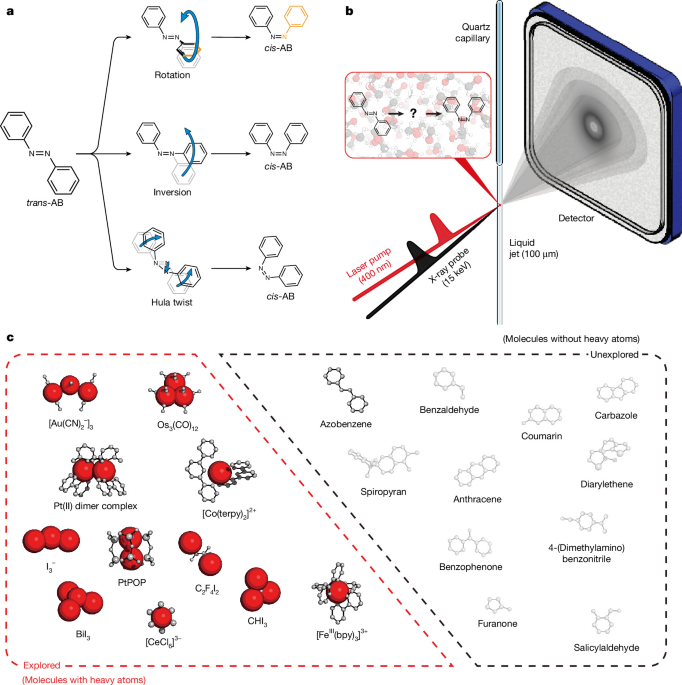
Three representative mechanisms for the nπ* photoisomerization (S0 → S1) of trans-azobenzene (trans-AB), proposed in extensive experimental (Extended Data Table 1) and theoretical (Extended Data Table 2) studies, are illustrated in Fig. 1a. Notably, even studies using identical experimental techniques have yielded conflicting interpretations, and theoretical predictions vary widely (Extended Data Table 2). This ongoing ambiguity arises primarily from the lack of direct structural evidence for transient intermediates, which spectroscopy alone cannot resolve. To overcome this limitation and directly determine both the transient structures and reaction kinetics, we used femtosecond time-resolved X-ray liquidography (fs-TRXL), a structure-sensitive technique that retrieves molecular structural changes from time-resolved X-ray solution scattering patterns34,35,36,37,38,39,40. A 400-nm femtosecond laser pulse excited trans-AB in methanol to induce the nπ* transition. After a controlled time delay (t), a femtosecond X-ray pulse from an X-ray free-electron laser (XFEL) beamline probed the transient molecular structures (Fig. 1b). Thousands of laser-on and laser-off scattering images were collected at each delay, processed to obtain isotropic and anisotropic components36. The laser-off components were then subtracted from the laser-on components, and the resulting difference signals were averaged to yield the isotropic and anisotropic difference scattering curves, denoted as ΔSiso(q, t)raw and ΔSaniso(q, t)raw, respectively. This procedure isolates the laser-induced difference scattering as a function of q, the magnitude of the momentum transfer vector. For visualization in the figures, difference curves are plotted as qΔS(q, t) to enhance the high-q features associated with solute structural changes.
a, Three representative mechanisms proposed for the trans-to-cis isomerization of trans-AB from previous studies. Each mechanism is described in Supplementary Note 1. b, Schematic of the fs-TRXL experiment performed in this study (see Methods for details). c, Small molecules classified into two groups: one containing heavy atoms and the other having no heavy atoms. Heavy atoms are shown in red. Owing to the strong scattering from heavy atoms, molecules in the first group pro