// NATURE NEWS — SPAZIO & SCIENZA
Human genetics implicates a BACH2–NRF2 axis in fetal haemoglobin activation
Nature
(2026) Cite this article
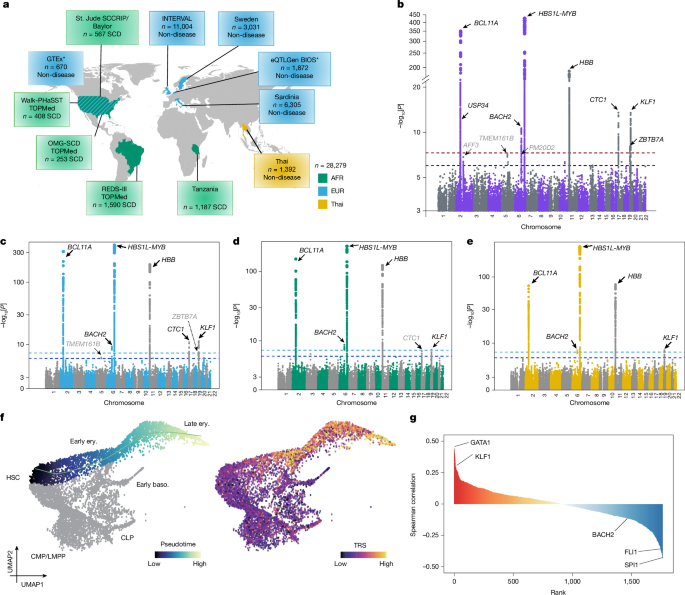
Human genetic studies have identified key regulators of fetal haemoglobin (HbF) expression, including BCL11A, resulting in therapeutic advances1,2,3,4,5,6,7,8. Yet the mechanisms by which HbF expression is activated remain incompletely understood9. Here we conduct a large multi-ancestry genome-wide association study of HbF levels in 28,279 individuals that identifies 91 conditionally independent associations across 12 genomic regions. In one previously uncharacterized associated region, the high-HbF-linked causal variant rs1010474-C reduces BACH2 expression and elevates HbF levels. Direct perturbation or inhibition of BACH2 likewise increases HbF expression. Mechanistically, BACH2 restrains activation of the HbF-encoding γ-globin genes, while loss of BACH2 enhances NRF2 chromatin occupancy and promotes the formation of activation foci at the γ-globin genes. Although BACH2 and NRF2 binding motifs in the γ-globin promoters overlap, they can be selectively edited to activate or repress γ-globin, respectively, and do so independently of BCL11A. These findings illustrate how human genetic variation continues to advance our understanding of therapeutically relevant regulatory mechanisms underlying HbF expression.
During human development, haemoglobin transitions shortly after birth from the fetal form (HbF; containing γ-globin, a β-like globin encoded by HBG1 and HBG2) to the adult form (HbA; containing β-globin encoded by the HBB gene). This process is referred to as the fetal-to-adult haemoglobin switch1. Persistently increased production of HbF after infancy can ameliorate clinical symptoms in common and life-threatening disorders arising from HBB mutations, including sickle cell disease and β-thalassaemia. While the ameliorating effects of HbF in these haemoglobin disorders have been known for decades, the mechanisms regulating HbF and strategies to target them have only recently been elucidated. Initial genome-wide association studies (GWASs) revealed three regions associated with HbF levels—the HBB locus on chromosome 11, the HBS1L-MYB locus on chromosome 6 and the BCL11A locus on chromosome 2 (refs. 10,11,12). These studies prompted functional follow-up that revealed BCL11A as a key and direct repressor of HBG1/2 transcription2. Subsequently, additional insights have emerged from the study of rare loss-of-function mutations impacting BCL11A13,14; transcriptional regulatory elements necessary for erythroid expression of BCL11A15,16; upstream regulators of BCL11A expression17,18,19; and analysis of the mechanisms by which BCL11A alters transcription20,21,22. Targeting of BCL11A, its erythroid-specific enhancer or its binding sites in the HBG1/2 promoters using genome editing or gene therapy approaches have emerged as effective treatment strategies for sickle cell disease and β-thalassaemia3,4,5,6,7,8. Moreover, functional studies in cellular models of other HbF regulators have provided insights9, such as the identification of ZBTB7A as another direct repressor of the γ-globin genes22,23.
Despite substantial progress in understanding HbF regulation, largely derived from studies in cell lines and mouse models, many fundamental questions about how HbF is regulated in humans in vivo remain unanswered. The majority of genetically validated regulators of HbF expression that have been identified to date are repressors. However, the precise mechanisms by which the γ-globin genes get activated remain incompletely understood. Despite the progress in understanding the mechanisms underlying HbF expression, many bona fide regulators of this process likely remain undefined.
To address these limitations, we conducted a multi-ancestry GWAS of HbF levels in 28,279 individuals from diverse populations. We identified BACH2 as a genetically nominated regulator of HbF expression that acts by restraining NRF2-mediated transcriptional activation of the γ-globin genes. Collectively, thes