// NATURE NEWS — SPAZIO & SCIENZA
Medicine Nobel awarded for brain ‘switch’ that controls neurons with light: live updates
Search author on:
PubMed
Google Scholar
Search author on:
PubMed
Google Scholar
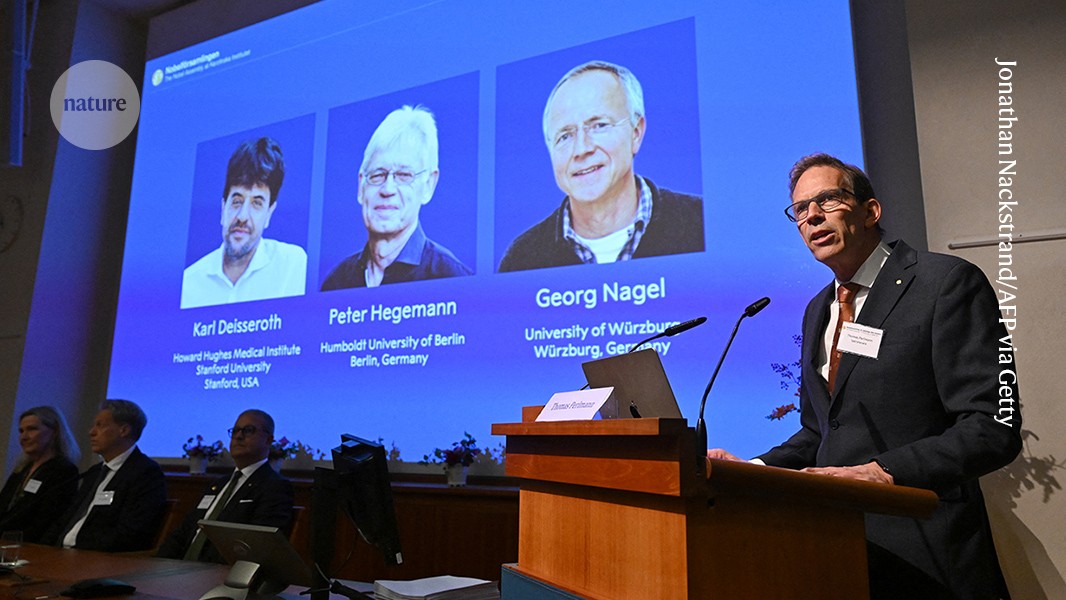
Karl Deisseroth, Peter Hegemann and Georg Nagel have won the 2026 Nobel Prize in Medicine or Physiology for their discoveries in optogenetics, announced by Nobel Committee secretary-general Thomas Perlmann (right).Credit: Jonathan Nackstrand/AFP via Getty
After being on many scientists’ shortlists for years, the 2026 Nobel Prize in Physiology or Medicine has recognized optogenetics — a technology that allows researchers to control neurons with pulses of light.
The winners are Karl Deisseroth at Stanford University in California, Peter Hegemann at Humboldt University of Berlin, and Georg Nagel at the University of Würzburg in Germany.
Working together in the early 2000s at Germany’s Max Planck Institute for Biochemistry in Martinsried, Hegemann and Nagel discovered a light sensitive protein in the alga Chlamydomonas reinhardtii, called channelrhodopsin. In response to blue light, the protein opens to allow charged molecules to flood into cells, creating a tiny electrical charge.
Deisseroth and his colleagues inserted the gene encoding channelrhodopsin into neurons of rats, and found that it could cause the cells to fire and communicate with other neurons.
Optogenetics has revolutionized neuroscience, because it allowed researchers to precisely control the activity of individual neurons and brain circuits, to study the downstream effects on behaviour.
This is a breaking news story and will be updated with further details.
How to win a Nobel prize: what kind of scientist scoops medals?