// SPACE.COM — SPAZIO & SCIENZA
More clues surface about the origins of interstellar comet 3I/ATLAS
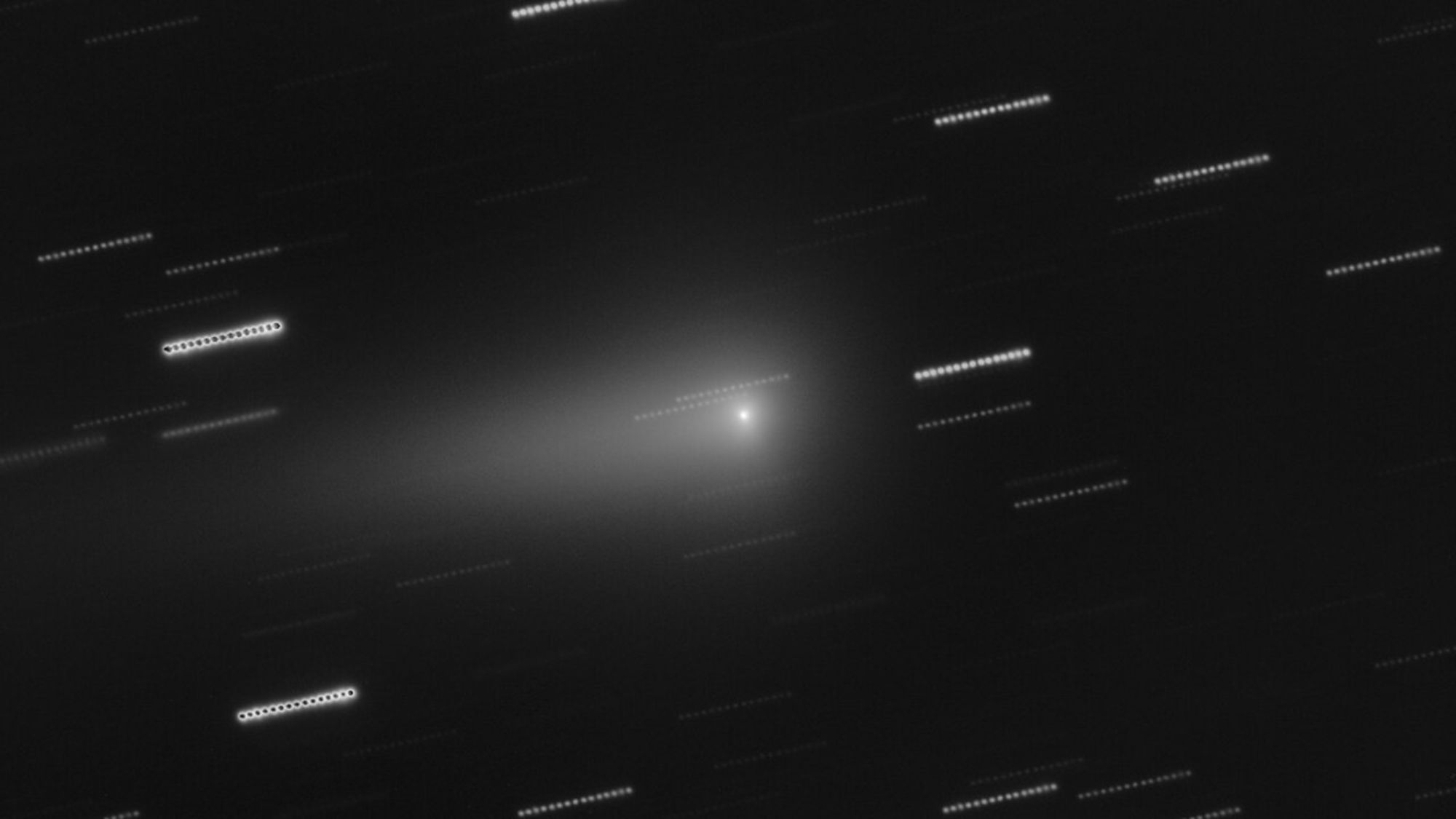
The interstellar comet is a fossil from a planetary system that formed a long time ago in an area of our galaxy far, far away.
When you purchase through links on our site, we may earn an affiliate commission. Here’s how it works.
More evidence that the interstellar comet 3I/ATLAS is much older than our solar system has come to light, along with clues that it formed on the outskirts of the protoplanetary disk belonging to its parent star long ago.
Earlier this year, researchers led by Martin Cordiner of NASA's Goddard Space Flight Center revealed that data from the James Webb Space Telescope (JWST) suggested that 3I/ATLAS is between 10 and 12 billion years old, based on the ratios of its carbon and deuterium isotopes. This would make it more than twice the age of our 4.6-billion-year-old solar system. Now, new results from the Ultraviolet and Visual Echelle Spectrograph (UVES) on the European Southern Observatory's Very Large Telescope support the JWST observations of carbon isotopes, and also introduce measurements of nitrogen isotopes that arrive at very interesting conclusions.
Isotopes are versions of atomic elements with different numbers of neutrons. For example, carbon-12 contains six protons and six neutrons, while carbon-13 contains six protons and seven neutrons. Meanwhile nitrogen-14 has seven protons and neutrons each, while nitrogen-15 has seven protons and eight neutrons.
These isotopes can form through subtly different processes, at different times and in different locations in the galaxy. The ratio of these isotopes in the gases released by comet 3I/ATLAS into its coma and tail as it neared the sun and grew warmer can therefore tell us much about its origin and history.
Consequently, interstellar objects such as 3I/ATLAS "are sort of fossils from a planetary formation process that happened very far away, but we get the chance to study from much closer," said astronomer Cyrielle Opitom of the University of Edinburgh in a statement.
Opitom led the team who got the chance to observe 3I/ATLAS with the VLT. They found that the ratio of carbon-12 to carbon-13 is higher than is found in comets in our solar system or indeed in the local interstellar medium. Carbon-13 is produced in greater abundances than carbon-12 over time, typically in red giant stars, so for there to be far more carbon-12 than carbon-13 tells us that 3I/ATLAS was born long ago before carbon-13 had a chance to build in abundance across the galaxy. This finding supports the JWST carbon isotope measurements.
Additionally Opitom's team, which was co-led by Jean Manfroid and Damien Hutsemékers of the University of Liège in Belgium, measured a ratio of nitrogen-14 to nitrogen-15 in 3I/ATLAS that is more than twice as large as the value measured in comets native to our solar system. In fact, the ratio is typical of that found on the outer edge of planet-forming discs around young stars, implying 3I/ATLAS formed a long way out from its parent star, perhaps in the equivalent of its Kuiper belt.
"Unlike comets from our solar system, this interstellar visitor carries unusually high carbon and nitrogen isotopic ratios," said team-member Aravind Krishnakumar, who is also of the University of Liège.