// NATURE NEWS — SPAZIO & SCIENZA
Watch this invisible tattoo appear under UV light
Rachel Fieldhouse is a reporter for Nature in Sydney, Australia.
Search author on:
PubMed
Google Scholar
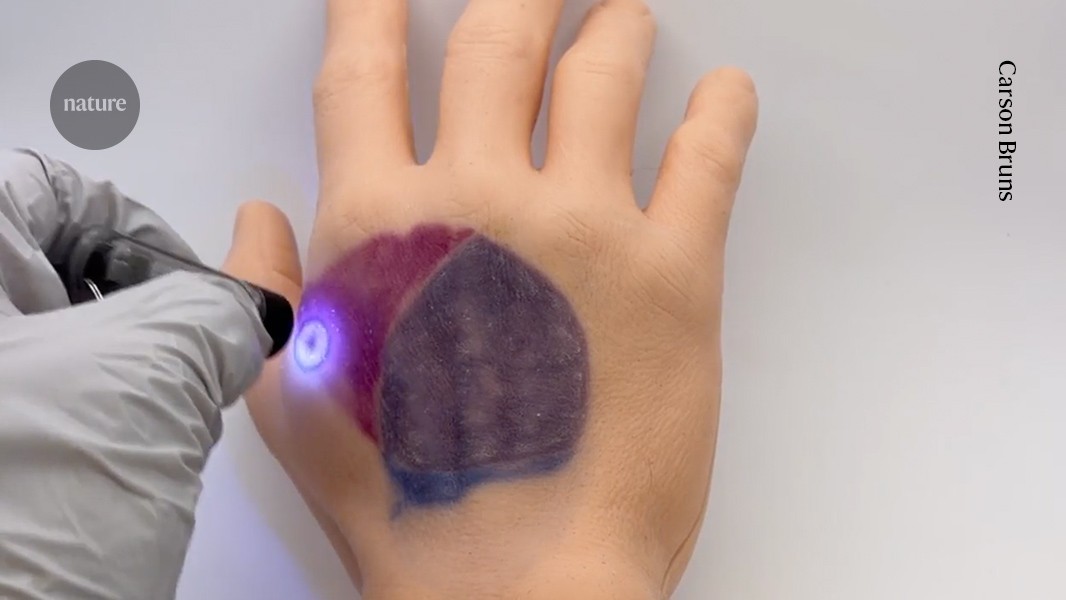
Invisible ink becomes visible under UV light on a silicon hand.Credit: Carson Bruns
Carson Bruns, a nanoscientist at the University of Colorado Boulder, has joined a long list of scientists who experiment on themselves. In Bruns’ case, he tattooed his leg with an invisible ink. The ink becomes visible only under ultraviolet light and can be erased using bright visible light, so could be used in medical tattooing, such as for the markers used to direct radiotherapy to specific areas of the body.
The inks are made of photochromic dyes — chemical compounds that undergo a reversible colour change on exposure to a specific wavelength of light. Photochromic dyes that change in response to UV are already used in textiles and transition lenses in glasses. Adapting photochromic materials to be permanently implanted in living skin is a new application, says Haihui Joy Jiang, a chemist and materials scientist at the University of Sydney, Australia.
Bruns and his team have developed three coloured ink dyes in magenta, yellow and blue, which they tested on pig and silicone skin. The results are published in the journal Matter & Light. Bruns previously developed a tattoo ink called Magic Ink that turns magenta when exposed to UV light, which he and others then commercialized in 2024 through their start-up company, HYPRSKN, based in Boulder, Colorado.
Colour-changing inks that can be made invisible are an exciting development and could have applications for cosmetic and medical tattooing, says Jake Violi, a chemist at UNSW Sydney.
Like conventional tattoo dyes, the invisible inks are injected into the dermis of the skin. They are made of tiny spheres of transparent acrylic glass that contain photochromes. Bruns explains that the photochrome in each sphere undergoes a reaction when it absorbs a photon of light at the wavelength that corresponds to its colour. The reaction forms a chemical bond that changes the photochrome’s shape so it becomes flatter, making it visible. The photochrome stays visible until it absorbs a photon of visible light, which breaks the bond and causes it to go back to its original shape.
Bruns, C. J., Stockton, M., Gardner, E. & Kwon, H. Matter Light 1, 100119 (2026).
Did a tardigrade get the world’s tiniest tattoo? April’s best science images