// SPACE.COM — SPAZIO & SCIENZA
UAE unveils lander for bold 7-asteroid mission set to launch in 2028 (photos)
"We don't know what we're going to find — that's exploration."
When you purchase through links on our site, we may earn an affiliate commission. Here’s how it works.
The United Arab Emirates (UAE) has moved a step closer to launching its second-ever interplanetary mission — an ambitious, eight-year exploration of seven asteroids between Mars and Jupiter that will culminate with a landing on the mysteriously red asteroid 269 Justitia.
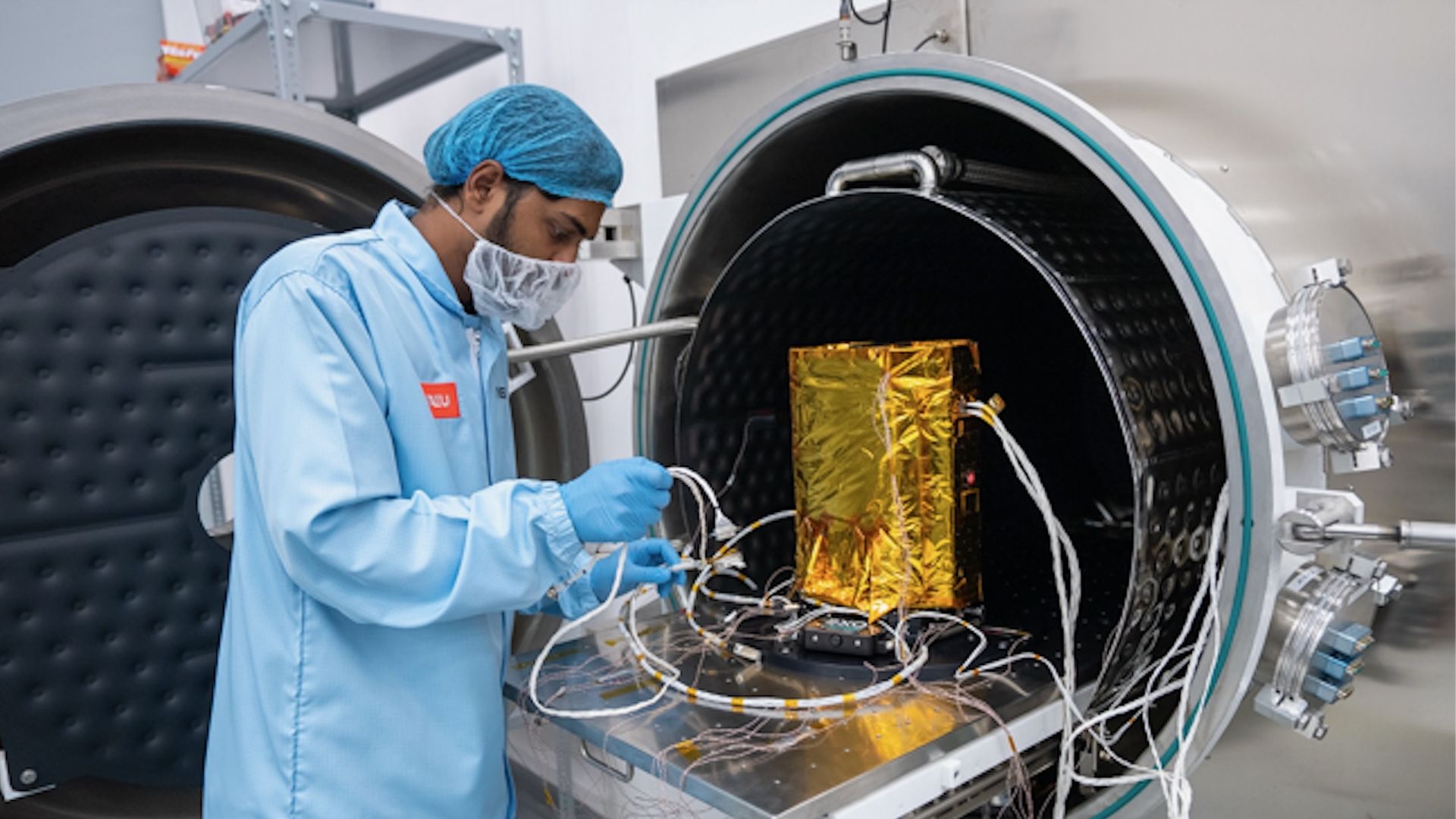
The mission team unveiled a half-scale model of the homegrown probe that will make that landing during an Oct. 1 press conference in Abu Dhabi, the capital of the UAE. The autonomous craft will ride attached to the main spacecraft MBR Explorer, named after Sheikh Mohammed bin Rashid al-Maktoum, the ruler of Dubai and the UAE's prime minister.
The flight-ready lander is being kept pristine in a vacuum chamber in the capital before being transported to Colorado by Etihad Airways, officials said, where it will be integrated with the main spacecraft, which was developed by the UAE Space Agency.
If all goes to plan, the mission will lift off from Japan in March 2028, kicking off the Emirates Mission to the Asteroid Belt (EMA). The project is an ambitious follow-up to the UAE Space Agency's Hope Mars orbiter, which has been studying the Red Planet since 2021.
"It's a proud moment for us here at the UAE," said Faisal al-Bannai, the secretary general of the Advanced Technology Research Council in Abu Dhabi.
EMA will conduct high-speed flybys of six asteroids before reaching and orbiting 269 Justitia. It will travel a total of about 3 billion miles (5 billion kilometers), which is equivalent to circling Earth roughly 125,000 times, said Najwa Aaraj, the CEO of the Technology Innovation Institute (TII) in Abu Dhabi, which designed, built and tested the mission's lander.
Along the way, the MBR Explorer will utilize gravity assists from Venus and then Earth to swing deeper into space, zipping past its first three asteroid targets: 10253 Westerwald, 623 Chimaera and 13294 Rockox. A subsequent gravity assist from Mars will fling the spacecraft even farther out, guiding it past three more space rocks: 88055 Ghaf, 23871 Ousha and 59980 Moza.
By 2036, the spacecraft is scheduled to rendezvous with its final and most intriguing target, 269 Justitia. A roughly 30-mile-wide (50 km) object in the middle of the asteroid belt, 269 Justitia is unusual for its remarkably crimson hue.