// ARS TECHNICA — INTELLIGENZA ARTIFICIALE
Ukraine's one-time test used fully autonomous drones to kill Russian soldiers
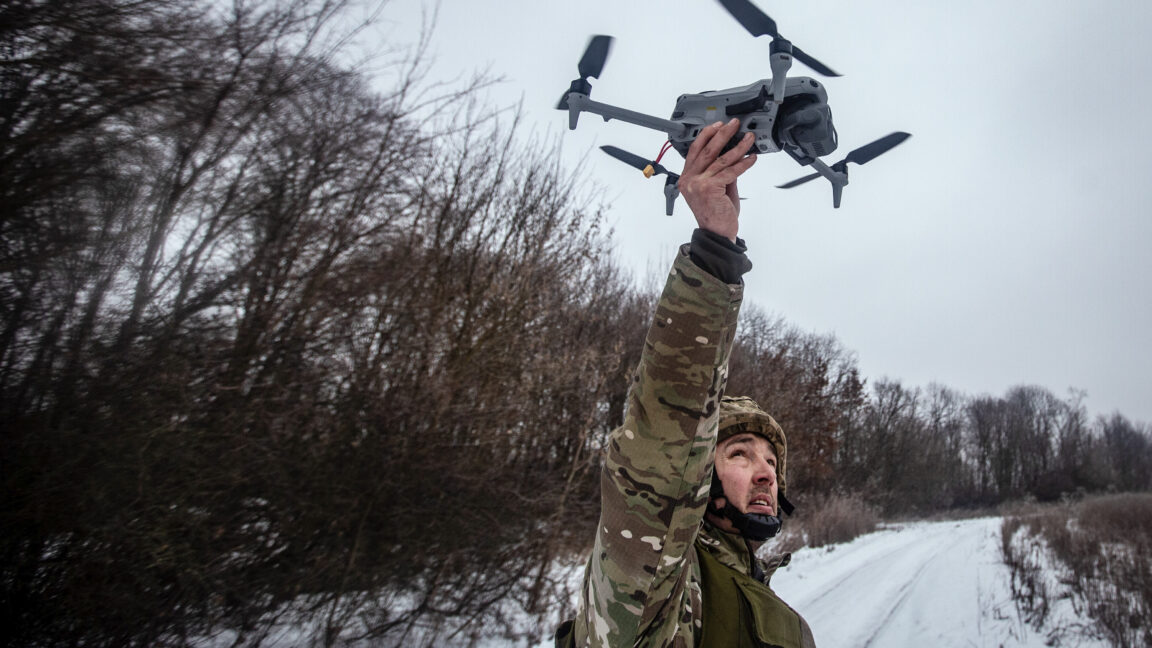
Full autonomy is rare, but Ukraine is installing AI modules on drones and robots.
Fully autonomous drones killed Russian soldiers during a battlefield test two years ago, according to a Ukrainian drone manufacturer. If true, the incident would represent another milestone in a war that has spurred unprecedented developments in military drones, robots, and AI-guided weaponry.
The one-time test was revealed by Alexander Kokhanovskyy, CEO of the Ukrainian drone maker Aero Center, during an interview with New Scientist at a press event hosted by the Ukrainian embassy in London. Kokhanovskyy described the test—which did not involve his current company Aero Center—using quadcopter drones that were preprogrammed to fly to a front-line area before activating an AI-powered “Terminator mode” that would seek out and attack any target in the given area.
There was apparently no video feed or anything else to show what the “Terminator” drones targeted and attacked. But Kokhanovskyy told New Scientist that human-piloted drones sent to check out the aftermath found “a couple” of dead Russian soldiers, which led to the conclusion that the fully autonomous drones had killed them.
Defence company representatives at the Ukrainian embassy event said that the Ukrainian government bans the use of AI in the final stage of target interception, according to New Scientist. A Ukrainian military commander also told New Scientist that his drone pilots only use semi-autonomous systems that always have humans making crucial control decisions. He described Ukraine’s commitment to “international humanitarian law” while emphasizing that the military always exercises “great care in decision-making in order to prevent civilian casualties.”
The one-time nature of this experiment makes sense when considering the practical limitations of this approach, along with considerations regarding international humanitarian law. Sending fully autonomous drones to attack anything and everything in a given area without any human operator intervention requires careful preplanning and carries the risk of so-called “friendly fire” incidents or attacks on civilian noncombatants. It is also unclear how effective these fully autonomous quadcopter drones were in selecting and attacking targets compared to human drone pilots.
There is currently no commonly agreed definition of what constitutes a lethal autonomous weapon system, according to the United Nations Office for Disarmament Affairs. But common characterizations describe weapon systems with the autonomy to “perform their functions in the absence of direction or input from a human actor.” US Department of Defense policy has defined lethal autonomous weapons as “weapon system[s] that, once activated, can select and engage targets without further intervention by a human operator.”
Fully autonomous weapons with the capability to “accomplish goals independently or with minimal supervision in complex and unpredictable environments” are not yet a battlefield reality in the war in Ukraine, according to Kateryna Bondar, a former advisor to the government of Ukraine, in her report for the Center for Strategic and International Studies (CSIS) think tank in Washington, DC. But she highlighted a growing number of drones integrating certain autonomous capabilities for navigation and sometimes targeting, even if human operators maintain overall control.
Ukraine and Russia are fielding many FPV drones for scouting and striking vehicles and even individual soldiers. These are typically controlled by trained drone pilots who wear virtual-reality goggles to see from the drone’s point of view while aiming for enemy targets. There are also larger quadcopter or multirotor “bomber” drones that can carry heavier payloads for either supply runs or for dropping explosives on enemy targets at the front lines.
Longer-range strike drones that resemble fixed-wing aircraft may incorporate more autonomous decision-making capabilities. In 2025, Russia l