// NATURE NEWS — SPAZIO & SCIENZA
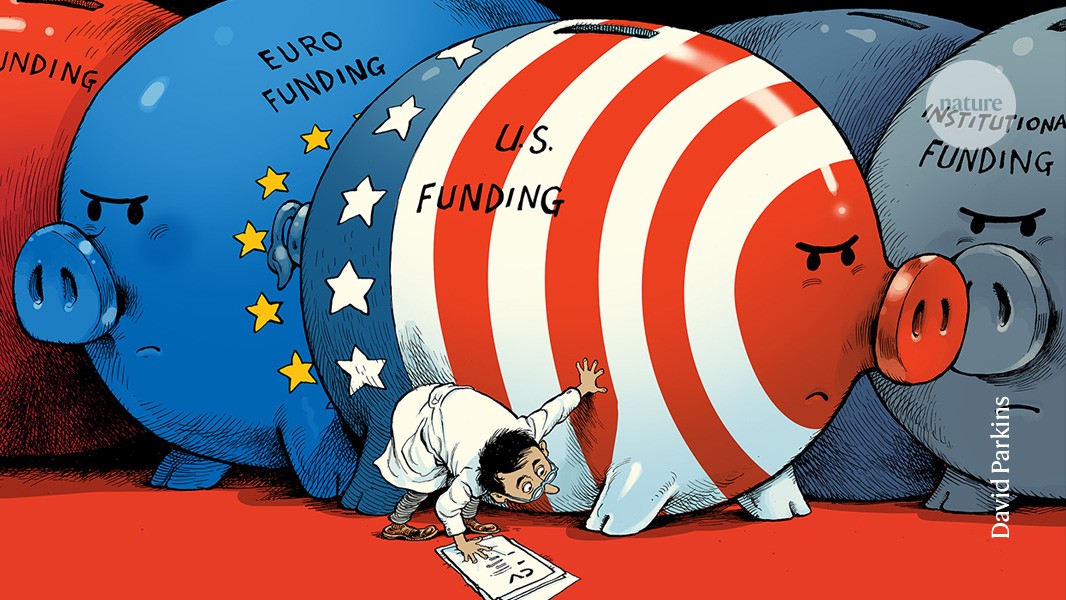
Will my lack of country-specific grants limit my chances of employment abroad?
Search author on:
PubMed
Google Scholar
After more than 20 years of academic research, supervision and contributions to engineering technology in Latin America, I’ve been pursuing faculty positions at universities in North America and Europe. The advertised positions match my expertise closely, but my applications have been consistently unsuccessful.
The reason only became clear through a candid exchange with a colleague who had served on a selection committee for one such position. My scientific qualifications, he noted, were competitive. The factor that stopped the committee choosing me was that I hadn’t obtained grant funding from the national research system of the country I wanted to move to.
This is a problem with how funding is structured in most research-intensive countries. Grant mechanisms are often national and tied to taxpayer-supported programmes that do not enable researchers based abroad to be awarded principal-investigator status. International collaboration is actively encouraged in research, but international leadership of funded projects is another matter entirely. The practical consequence is that no amount of scientific output or achievement by an individual can compensate for this gap.
Is there anything that an applicant can do to combat this bias? — An excluded international scholar
César Marín, an ecologist at Santo Tomás University in Santiago, Chile, agrees with you. “Demonstrating experience and success on getting national funds seem to be the main hiring criteria in many countries — regardless of strong publication and supervision record,” he affirms.
In general, experience of a local system “can be an implicit metric in academia”, notes Laura Ación, co-executive director of MetaDocencia, a capacity-building organization for researchers from Spanish-speaking communities. MetaDocencia’s research on the career paths of Latin American scientists1 suggests that, as Ación says, “a lack of competitiveness for European or US funding constitutes a structural disadvantage”.
This can take a toll on academic jobseekers. “I believe that, as a foreigner, I am behind the competition for many reasons,” explains Renan Lyra, a Brazilian psychology researcher who is currently searching for positions in the United Kingdom. He suspects that one of the reasons is that researchers doing UK degrees are trained to put together domestic grant applications, and are more likely to be involved in such applications with senior researchers. Experience in bringing in money is what hiring organizations really care about, Lyra thinks.
Even researchers moving between well-resourced systems notice the gap between them. Caroline Lynn Kamerlin started her independent career in Sweden before moving to the United States as a professor. She’s now a computational chemist at the Georgia Institute of Technology in Atlanta.
During the transition, she encountered what you describe: “When US hiring committees saw my CV, the biggest thing they saw was that I had no US funding, and the fact that I had clearly been able to get funding from several sources in Europe was not something they considered.”