// NATURE NEWS — SPAZIO & SCIENZA
Nature Index reveals the four countries to watch in biomedical engineering
Elliot Yates is an intern on the Nature Careers and Supplements team.
Search author on:
PubMed
Google Scholar
Biomedical-engineering research output has grown rapidly in the Nature Index. Between 2021 and 2025, the number of papers related to the field increased by 70%, a higher rate of increase than the growth of the database as a whole. This is also reflected by the subject’s proportion of all articles in the database, which rose from 2.4% to 2.7%. Within this expansion, however, the field’s research landscape has also shifted, with countries’ relative contributions reflecting changing patterns of international collaboration and research specialization.
The clearest trend is that between 2021 and 2025, biomedical-engineering research — in keeping with many other disciplines — moved decisively towards the leading nation, China. The country’s contribution to global output rose from 28.9% to 50.9%, while the field went from representing 2.8% of its total Nature Index output in 2021 to 3.5% in 2025.
The United States and Germany retained second and third place, respectively, throughout the period, but their focus on the field remained relatively static at around 2.3% to 2.5% of all output.
Here, we focus on four other countries among the leading ten in 2025 whose performance in biomedical engineering reveals more nuanced trends.
South Korea seems to have held a top-five position by developing and maintaining a strong specialization in the subject; Switzerland stands out for drawing on private-sector research and international collaboration to remain a leading European centre; Canada is one of the field’s fastest-rising countries; and the Netherlands has recorded more modest growth but retains a highly international network.
Leading university in biomedical engineering, 2021–25: Yonsei University
Most cited paper, 2021–25: ‘Superstrong, superstiff, and conductive alginate hydrogels’ (2022)1
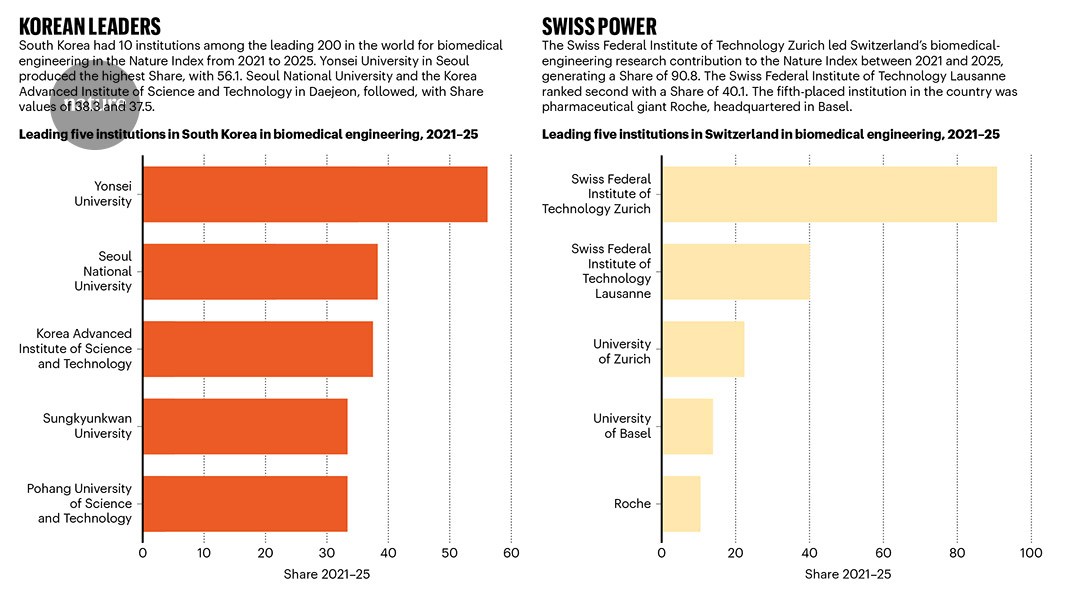
South Korea is an outlier among the leading nations in biomedical engineering in the Nature Index. Its research is unusually concentrated in the field, with 4.8% of its overall database output from 2021 to 2025 being in the subject, the highest percentage among the leading 25 countries. South Korea is also relatively less reliant on international collaboration compared with the three other countries featured in this article, with a little over half its papers in 2021–25 co-authored by researchers outside the country.