// NATURE NEWS — SPAZIO & SCIENZA
Capillary-selective vasodilation through myosin inhibition halts ischaemic cascades
Nature
(2026) Cite this article
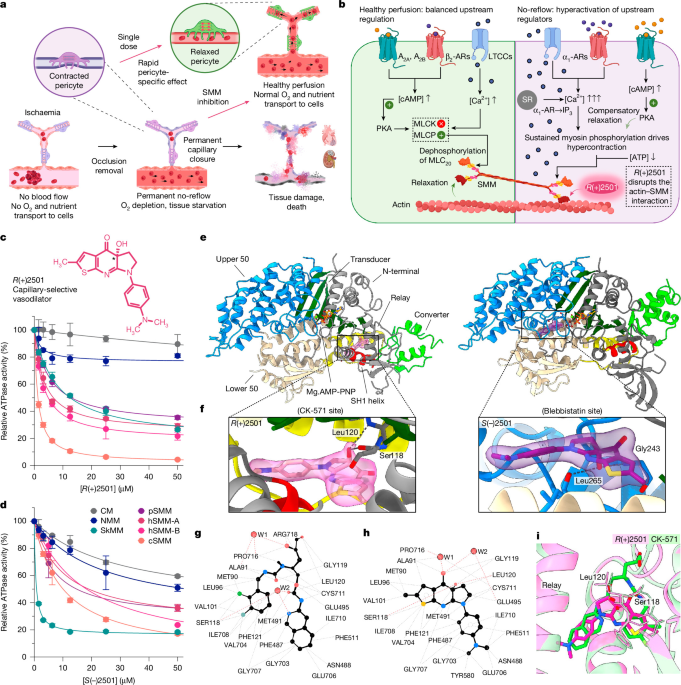
In acute myocardial infarction and acute kidney injury, capillary no-reflow denotes that capillary blood flow is still blocked despite successful arterial reperfusion. This is associated with substantially increased mortality and reinfarction risk; nevertheless, no targeted therapy exists so far1,2. Because capillary no-reflow is driven by smooth muscle myosin-mediated hypercontraction of capillary pericytes, we developed R(+)2501, a myosin-specific and capillary-selective vasodilator. In reperfused animal models of acute myocardial infarction and acute kidney injury, direct in vivo imaging showed that R(+)2501 rapidly restored capillary flow, an effect sustained even after rapid drug clearance. Ex vivo experiments confirmed reversal of pericyte constriction directly. Restoration of capillary blood flow, together with clearance of trapped neutrophils, linked resolution of capillary no-reflow to attenuation of an early driver of reperfusion injury. R(+)2501 enhanced capillary perfusion while preserving coronary autoregulation and systemic haemodynamics, and markedly improved survival during acute reperfusion. We further found that acute myocardial infarction induced renal capillary no-reflow, which was reversed by R(+)2501, suggesting that capillary no-reflow contributes to the pathophysiology of cardiorenal syndrome type I. These findings establish pericyte-targeted smooth muscle myosin inhibition as a therapeutic strategy to restore microvascular perfusion and halt the ischaemic cascade across organs, while defining a specific physiological role for capillaries and pericytes in circulatory regulation.
This is a preview of subscription content, access via your institution
Access Nature and 54 other Nature Portfolio journals
Get Nature+, our best-value online-access subscription
Prices may be subject to local taxes which are calculated during checkout
The data supporting the findings of this study have been deposited in the figshare repository at https://doi.org/10.6084/m9.figshare.32956559. The atomic coordinates and structure factors have been deposited in the Protein Data Bank (PDB) under accession codes 29ZY (SMM–R(+)2501) and 29ZZ (SMM–S(−)2501). Any extra data supporting the findings of this study are available from the corresponding authors upon reasonable request. Source data are provided with this paper.
Freitas, F. & Attwell, D. Pericyte-mediated constriction of renal capillaries evokes no-reflow and kidney injury following ischaemia. eLife 11, e74211 (2022).
Article
CAS
PubMed
PubMed Central
Google Scholar
O’Farrell, F. M. & Attwell, D. A role for pericytes in coronary no-reflow. Nat. Rev. Cardiol. 11, 427–432 (2014).