// ARS TECHNICA — MODA & SOCIETÀ
Stratospheric airship flew from US to Japan to test sky cell tower concept
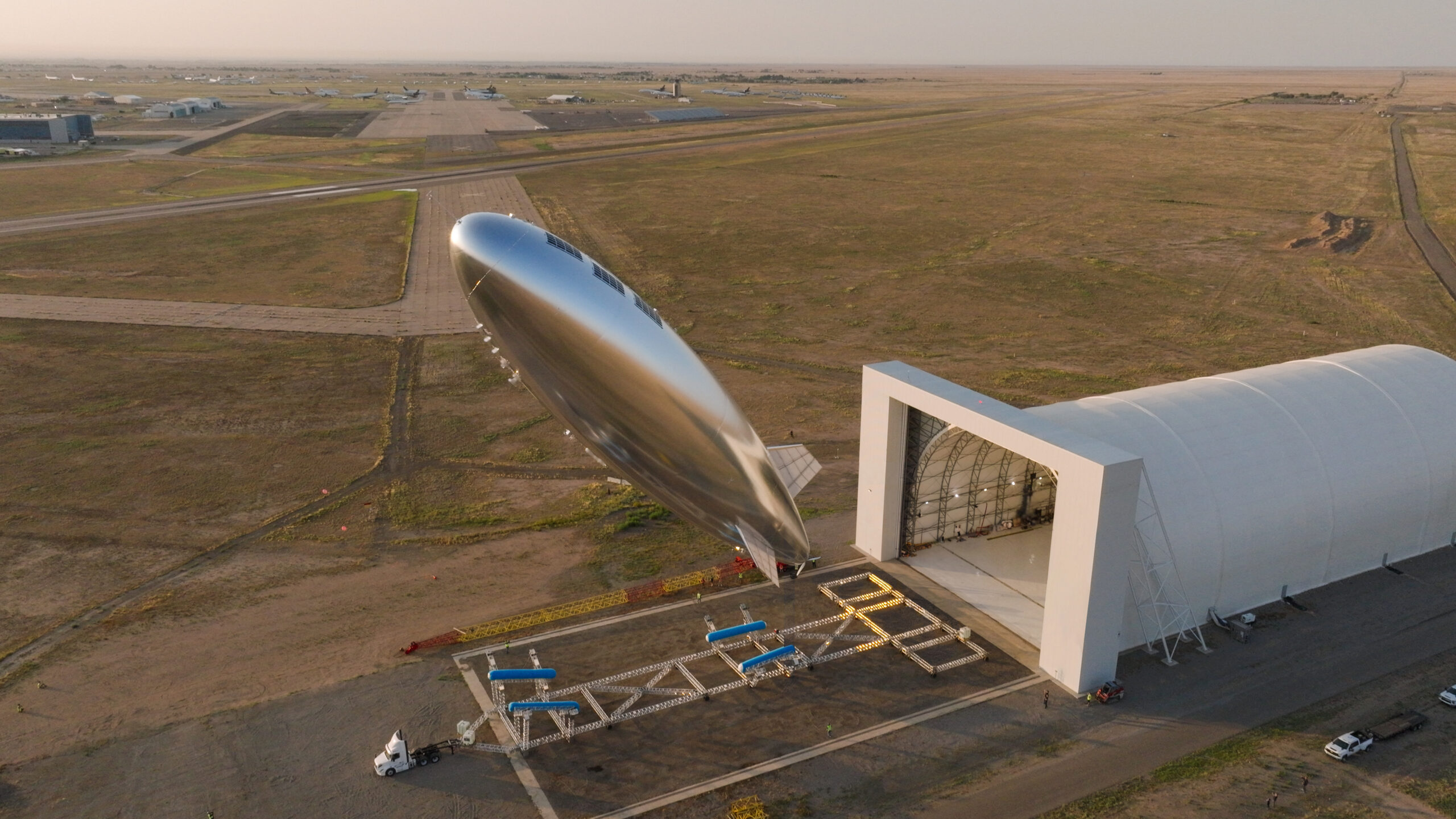
Tests showed Sceye’s high-flying platform can deliver connectivity in disasters.
Nearly 100 years after the dirigible Graf Zeppelin made the first nonstop airship journey across the Pacific Ocean, another airship has successfully completed a round-trip flight from New Mexico to Japan and back. But the significance of this modern feat was less about the journey’s length and more about its purpose: demonstrating how a lighter-than-air platform can act as a cell phone tower in the sky.
The trans-Pacific flight that took place over a month between August and September 2026 was the most notable milestone yet for Sceye, a US aerospace company based near Albuquerque, New Mexico. Sceye has developed an uncrewed platform filled with helium for buoyancy and equipped with an electric-powered propeller for active propulsion, allowing it to resist most strong winds and keep hovering over the same location for long periods. The platform also uses top-mounted solar panels and onboard batteries to stay powered for stratospheric operations around the clock.
“We can stay over an area of operation, and we do that in the stratosphere right around 60,000 feet, so we’re twice as high as air traffic and we’re above the jet stream, and yet 30 times closer than low-Earth orbit satellites,” Mikkel Frandsen, founder and CEO of Sceye, told Ars. “We can fly through day and night until the sun comes up the next morning and recharges the batteries, at which point we’re still at the same altitude and still over the same area of operation.”
There have been many past technology demonstrations and attempts to make stratospheric platforms commercially viable since the late 1990s, Frandsen said. In Sceye’s case, the company began testing a series of smaller prototypes in 2016 before eventually reaching the stratosphere with a 215-foot (65-meter) length version in 2021. The latest version extends to 270 feet (83 meters).
The lighter-than-air platform has also benefited from advances in material sciences that “were either not discovered or not understood back in the late 1990s,” Frandsen said. He highlighted the example of the discovery of graphene in 2004, which “greatly helped us optimize strength relative to weight on our hull, the energy density of our batteries, and performance relative to the area and weight of our solar panels.”
The design could eventually scale up to a high altitude platform system (HAPS) capable of lifting payloads as heavy as 551 pounds (250 kilograms). That would be between 25 and 50 times more payload capacity than competing stratospheric platforms such as high-flying drones, according to Helena, a US nonprofit organization with a for-profit investment arm that has invested in Sceye.
Sceye’s current platform has already done multiple flight demonstrations with payloads exceeding 220 pounds (100 kilograms) and can provide up to 1 kilowatt of onboard power capability for any devices that it may be carrying.
A heavier payload and higher power capacity opens the door to bigger mission possibilities, such as someday using a single Sceye platform hovering in the stratosphere to provide mobile broadband coverage equivalent to 500 ground-based cell towers. That may prove useful for both enhancing commercial telecommunications services and providing emergency coverage during disaster scenarios.
The concept was put to the test after Sceye’s platform launched from its New Mexico base on August 9, 2026, and traveled more than 9,320 miles (15,000 kilometers) across the Pacific to reach Japan. That 13-day journey required the airship to navigate through strong winds and avoid potential bad weather “during a window of typhoon season,” said Johnny Truong, chief technology officer of Sceye.