// NATURE NEWS — SPAZIO & SCIENZA
Experienced researchers ‘disrupt’ less than rookie scientists — but their ideas last
Search author on:
PubMed
Google Scholar
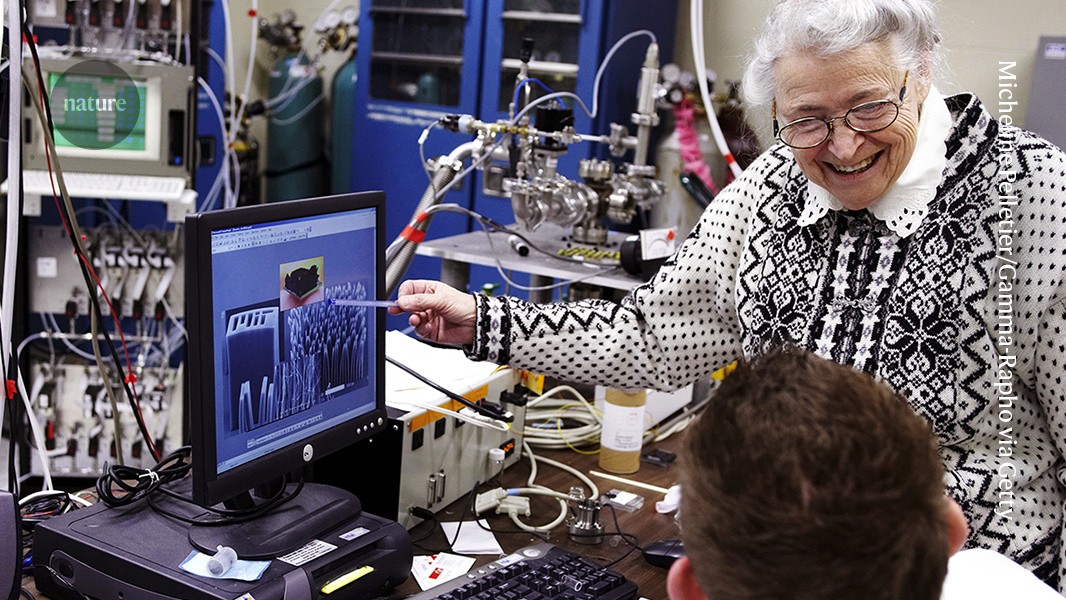
Physicist Mildred Dresselhaus with a student; a study has found that more experienced scientists produce more persistently disruptive science than their younger peers.Credit: Micheline Pelletier/Gamma-Rapho via Getty
Experienced scientists produce ‘disruptive’ work less often than early-career researchers, but when they do, their innovations are more likely to have a lasting effect, according to a study1 published in the Proceedings of the National Academy of Sciences (PNAS) on 19 October.
Previous research has suggested that experienced scientists are less likely to produce disruptive work2 — discoveries that overturn established foundations, rather than building on them incrementally — than are those starting their careers. The latest findings challenge the view that scientists become less innovative as they age, says Sam Arts, who studies scientific and technological innovation at KU Leuven in Antwerp, Belgium.
The latest study analysed more than 11 million papers published between 1800 and 2022 by around 206,000 scientists globally, all of whom had more than 40 years of research experience. The authors used those papers’ citation patterns as a proxy to measure the extent to which their innovations disrupted previous work, and how likely it was that their findings were displaced by subsequent research.
Citation patterns are often used to measure changes in innovation, but some scientists have questioned whether such metrics can accurately capture the disruptiveness of scientific findings3.
The latest study estimated how disruptive a scientific paper is using a measure called the CD index4. This metric is calculated by analysing subsequent citations: is the focal paper cited with its accompanying references, or without them? Or do subsequent studies cite just the focal paper’s references, and not the paper itself? If a paper is cited without its references also being cited, this is a good indication that those references “are no longer relevant”, says co-author An Zeng, who studies the science of science at Beijing Normal University in China.
But the conventional CD index measures only how strongly a paper overturns previous work, and does not consider whether that disruption endures, say the authors. To address this issue, they also used their own metric, called persistent disruption (PD), which identifies highly disruptive papers (using the CD index) and then looks at how much these papers are themselves disrupted by future papers5. A persistently disruptive paper, say the researchers, is one that disrupts previous work and that is not displaced by subsequent research.
Their method involved first identifying a focal paper, and then examining whether subsequent papers cite it directly and/or indirectly (by referencing one of those citing papers). If a later study cites both the original, focal paper and a study that cites it, it shows that the focal paper’s disruptiveness is still there, says co-author Nan Deng, who studies the science of science at the National Science Library of the Chinese Academy of Sciences in Beijing.
The study found that the probability of a researcher publishing a highly disruptive paper decreased as their career progressed, but the chance of them publishing a persistently disruptive paper increased over time, from about 1% at the start of their career to about 2.2% after 40 years.