// NATURE NEWS — SPAZIO & SCIENZA
WEE1 opposes APC/CCDH1 activity to promote S phase entry
Nature
(2026) Cite this article
WEE1 phosphorylates and inhibits the activity of cyclin-dependent kinases to prevent mitotic entry and establish a G2 DNA damage checkpoint1,2,3. Consequently, WEE1 inhibitors have been developed to be synthetically lethal in TP53-mutated tumours that become reliant on this WEE1-mediated checkpoint, and such inhibitors are undergoing clinical trials. However, WEE1 inhibitors also have efficacy in TP53-wild-type tumours, and many trials have been terminated owing to high levels of toxic side effects, suggesting that WEE1 has unknown functions. Here we show that WEE1 promotes cell cycle re-entry from quiescence (G0) by opposing the activity of the E3 ubiquitin ligase, anaphase-promoting complex–cyclosome bound to CDH1 (APC/CCDH1). WEE1 phosphorylates CDH1 (FZR1) at key residues that mediate the interaction between CDH1 and APC/C. Cells with loss of function of WEE1 during G0/G1 have delayed S phase entry, impaired G1/S transition, abnormal S phase accumulation of cyclin-dependent kinase inhibitor p21Cip1/Kip1 and a p21-dependent G2 arrest. Reduced expression of APC/CCDH1 or p21 renders cells more sensitive to acute WEE1 inhibition, and both pathways are downregulated in cells with acquired WEE1 inhibitor resistance. These results reveal a mechanism of cell cycle control that has implications for how WEE1 inhibitors should be used in the clinic.
Cyclin-dependent kinases (CDKs) control passage through the eukaryotic cell cycle. WEE1 (ref. 4) is a tyrosine kinase that inhibits CDK1 by phosphorylating Tyr15 (refs. 1,2,3). Late in G2, CDC25 phosphatases dephosphorylate Tyr15, promoting mitotic entry1,5,6,7,8. This mechanism forms a G2 DNA damage checkpoint, which becomes vital in TP53-mutated cancer cells9. Thus, WEE1 inhibitors (WEE1i) have been developed to be synthetically lethal in TP53-mutated cancers and are being trialled across several indications10,11. However, toxic side effects of unknown origin11 have led to trial suspensions. WEE1 also inhibits CDK2, a key driver of G1/S progression and proliferative commitment. Consistently, non-phosphorylatable CDK2T14A;Y15F knock-in mutant mice and human colorectal cancer cells enter S phase faster when returning to the cycle from quiescence12,13. However, no direct cellular evidence of the impact of WEE1 on CDK2 is available14, and exogenous WEE1 expression in IMR90 human fibroblasts has no effect on G1/S timing15. Therefore, we sought to clarify the function of WEE1 in early cell cycle control. We demonstrate a role for WEE1 in suppressing the anaphase-promoting complex–cyclosome bound to CDH1 (APC/CCDH1), a key antagonist of G1/S progression, to promote timely cell cycle re-entry following release from quiescence. We identify CDH1 (FZR1) as a WEE1 substrate relevant to cell cycle control. Our findings shed light on the pleiotropic impact of WEE1i in cells.
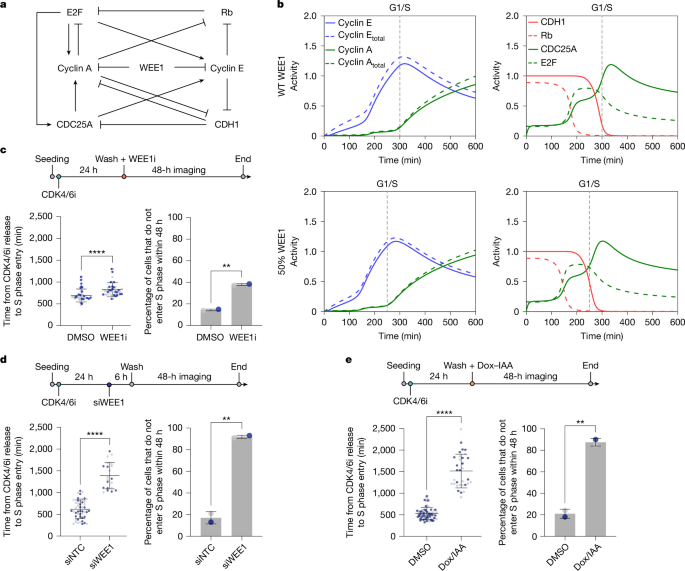
To understand the potential roles of WEE1 in regulation of CDK2 activity during G1 and S phase entry, we constructed an influence diagram describing the known interactions of WEE1 with the G1/S regulatory network (Fig. 1a). WEE1 inhibits cyclin E–CDK2 and cyclin A–CDK2 (ref. 16). We converted this influence diagram to a series of ordinary differential equations and parametrized the model to reproduce the known dynamics of the G1/S regulatory network (Fig. 1b). We simulated the depletion of WEE1 levels to 50% of baseline and observed that CDK2 was activated earlier and S phase entry was faster than in the presence of 100% WEE1 activity.
a, Influence diagram of the G1/S regulatory network. b, Time-course simulation of the ordinary differential equation model demonstrating how reduction of WEE1 activity to 50% of WT levels predicts a faster increase in CDK2 activity and a shorter G1 phase. Cyclin Etotal refers to Tyr15-phosphorylated (inactive) and Tyr15-unphosphorylated (active) CDK2 combined (blue dashed curve), whereas cyclin E is Tyr15-unphosphorylated CDK2 only (a