// PC GAMER — GAMING
Asus ROG Rapture GT-BN98 router review
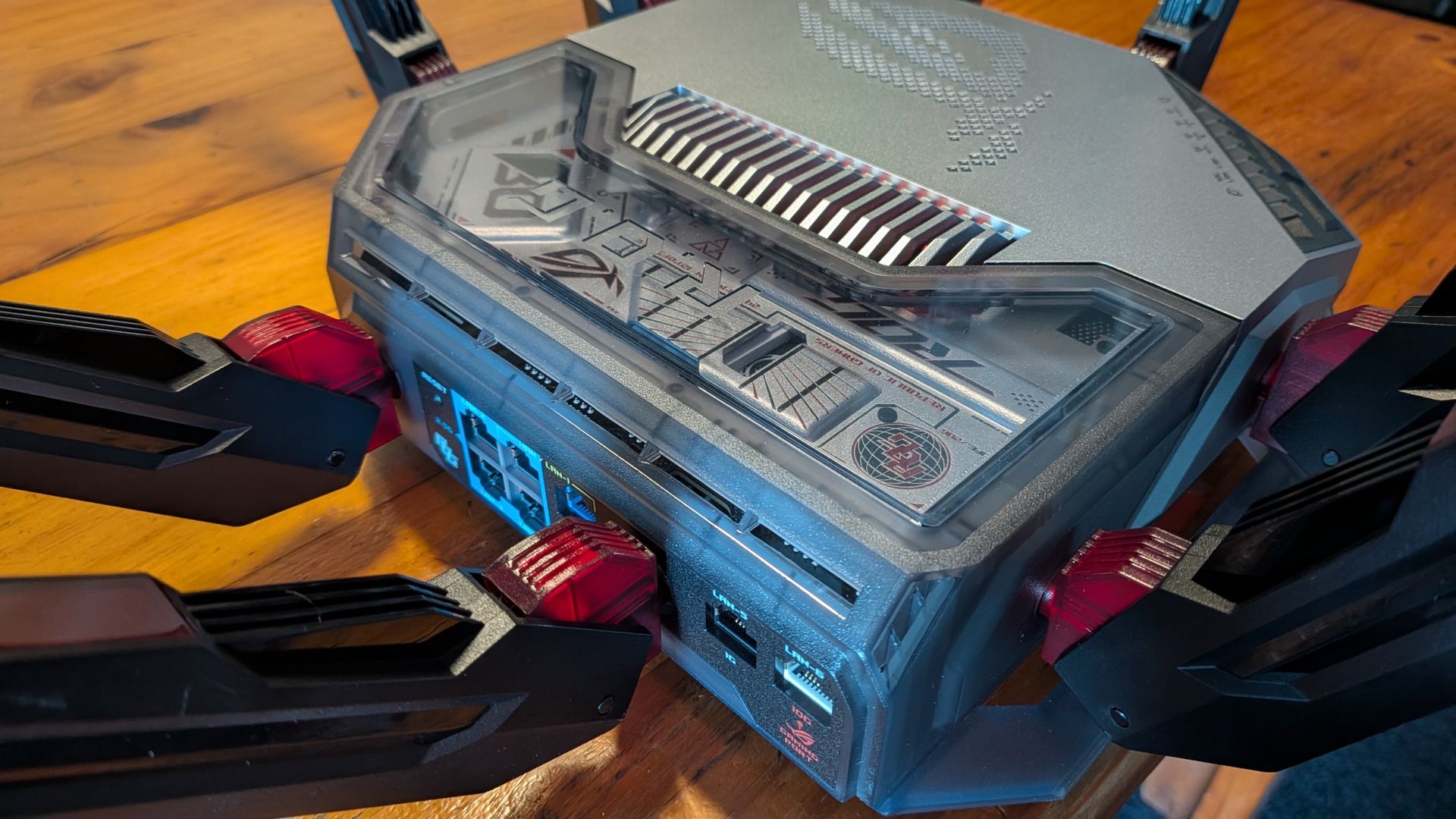
Ultimately, while its raw, close-range speed doesn’t yet match mature, Wi-Fi 7 rivals, this fully-featured gaming router is arguably more performant than any other standalone router we’ve tested. Our only caveat is that Wi-Fi 8 rivals from TP-Link and Asus itself are about to drop and we’ve not reviewed them yet.
PC Gamer's got your back
Our experienced team dedicates many hours to every review, to really get to the heart of what matters most to you. Find out more about how we evaluate games and hardware.
We’re not surprised that Asus has delivered the first Wi-Fi 8 router. The company has been ruling the router roost recently and notably broke the 3,000 Mbps transfer-rate barrier with its AI-enhanced, ROG Rapture GT-BE19000AI Wi-Fi 7 gaming router. That’s old hat now that its functionally-identical Wi-Fi 8 sibling, the Asus ROG Rapture GT-BN98 Pro, is here. Or is it?
Wi-Fi 8 (also known as 802.11bn) is expected to be officially ratified in late 2028. By the time you read this, at least four routers will have hit the market, but no laptops (or other devices) are in sight. But, that shouldn’t matter.
We've spent some time in the last year testing top-tier Wi-Fi 7 set-ups, and seeing they can be faster than some 10 Gbps wired connections, so why do we need another Wi-Fi generation? However, unlike previous generations, Wi-Fi 8 isn’t about delivering more speed, it’s about delivering a more-reliable signal (including more-robust uploading), to new and old devices alike, in crowded Wi-Fi environments, over greater distances, in real-world environments.
1× 10 Gbps WAN/LAN, 1× 2.5 Gbps WAN/LAN, 1× 10 Gbps LAN, 3× 2.5 Gbps LAN, USB 3.2 Gen 1, USB 2.0
Quad-Core CPU w/ NPU, parental controls, edge security controls, game acceleration, Docker, Portainer, AiQoS, multi-SSID, Alexa and Google voice assistants
This should particularly benefit networks with numerous IoT and smart-home devices; gamers who require reliable, very-low latencies; people in high-density apartment blocks; industrial facilities filled with metal and RF interference; and streamers uploading live footage.
Aficionados will know that the technologies used to manifest these advances are denoted by a smorgasbord of acronyms and Wi-Fi 8 doesn’t disappoint...
Primary benefits stem from Modulation and Coding Schemes (MCS) that support Unequal Modulation (UEQM). This means that, when you move further away from the signal, the smoother the performance drop-off curve will be. With previous generations, whenever the signal-to-noise (SNR) ratio increased at distance, performance plummeted down to a lower performance tier in a harsh, stepped fashion. This new technology provides better performance at mid-to-long range.