// SPACE.COM — SPAZIO & SCIENZA
Astronomers found a mysterious object beyond Neptune, and it could be a new dwarf planet
When you purchase through links on our site, we may earn an affiliate commission. Here’s how it works.
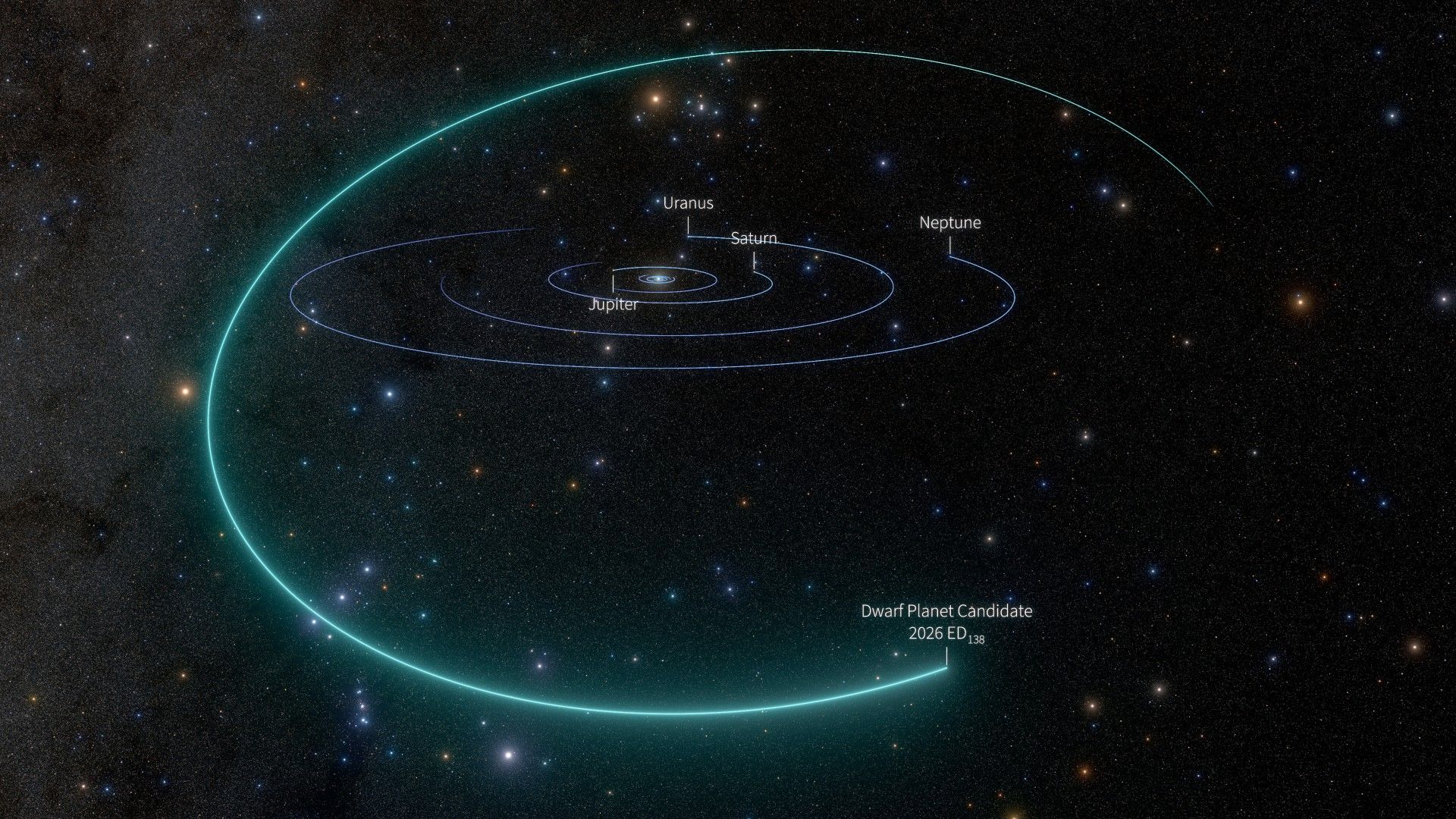
The powerful Vera Rubin Observatory has spotted what seems to be a dwarf planet circling the sun in the frigid depths beyond Neptune.
The icy object, known as 2026 ED138, is likely between 600 and 1500 kilometers (373 to 972 miles) wide, scientists say. It's therefore probably big enough to be sculpted into a sphere by its own gravity — a key characteristic that separates dwarf planets from asteroids and other small space rocks.
And if 2026 ED138 is indeed a dwarf planet, that's a pretty big deal, as astronomers have confirmed just five of them to date: Pluto, Ceres, Eris, Haumea and Makemake.
2026 ED138 was discovered by Matthew Holman, who works at the Center for Astrophysics | Harvard & Smithsonian (CfA). The big moment came on Oct. 13, when Holman was running previously collected Rubin data through a search code that he developed with his CfA colleague Kevin Napier.
That search revealed a mysterious object beyond Neptune's orbit. Despite its immense distance from the sun, this body was relatively bright, suggesting that it's larger than the average trans-Neptunian object.
"My first reaction was one of excited disbelief," Holman said in a statement on Tuesday (Oct. 27), the day the discovery of 2026 ED138 was announced. "Objects like this are very rare, so I immediately started checking whether I or the code had done something wrong."
Those checks involved a thorough search through Rubin's catalog. And that catalog is pretty heft, even though Rubin is a pretty new scope.
The Vera Rubin Observatory sits atop Cerro Pachón, an 8,799-foot-tall (2,682 meters) mountain in northern Chile, and features a primary mirror 28 feet (8.4 m) wide. The scope achieved first light in April 2025 and began its main project, the 10-year-long Legacy Survey of Space and Time (LSST), in June of this year.
During the LSST, Rubin images the entire southern sky every few days using a 3.2-gigapixel camera, the largest digital camera ever built for astronomy. This work creates a high-resolution time-lapse "movie" that can reveal a great deal about the cosmos.